
← Back to Class 9 Social Science Notes
From Ideas to Startups Class 9 Notes explain the meaning of entrepreneurship, the role of entrepreneurs, and the steps involved in starting a business. These notes cover business plans, functional areas of a business, management, operations, finance, accounting, human resources, marketing, and sales. Students will also learn about startups, unicorns, government initiatives such as Startup India, and the contribution of entrepreneurs to India’s economic growth. These notes are written in simple language to help Class 9 students understand the important concepts easily.

From Ideas to Startups Class 9 Notes
What is entrepreneurship?
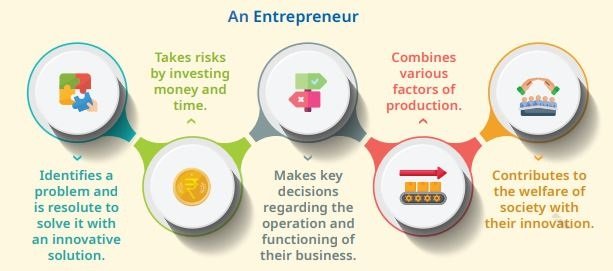
Entrepreneurship is the process of turning an idea into a business. An entrepreneur finds opportunities, solves problems, and creates value for society. For example, if you set up a lemonade (nimby pani) stall at a school festival, you need to—
- Buy lemons, sugar, and glasses.
- Decide the selling price.
- Keep a record of expenses and earnings.
- Check whether you made a profit or loss.
- Know if customers liked the product.
- This is similar to how the business works.

Story: From a Dead Mouse to Riches
A poor young man sold a dead mouse to a shopkeeper for two coins because his cat was hungry. With these two coins, the young man brought fruit and water. which he sold to a tired flower picker in exchange for flowers. He then sold the flowers in the city. Step by step he became very rich through intelligence, hard work, and smart decisions. He also helped people in his community.
Story: Rooftop to Revolution Lijjat Papad
In 1959, seven women in Mumbai started making papads. They had only 80 rs and borrowed equipment. They work together as a team and maintain the good quality of Papad. They have started a cooperative society called Shri Mahila Griha Udyog Lijjat Papad and expanded across India. In 2023, it had over 45000 women members, and the annual turnover is Rs. 1600 crore.
Story: Mohan Singh Oberoi, The Hotel Entrepreneur
Mohan Singh was born in Punjab in 1898. They faced many difficulties after his father’s death. He worked as a hotel clerk for Rs. 50 per month. That time he learned every part of hotel management and brought a small hotel by investing his savings. He improved hotel services and facilities and built one of India’s largest hotel chains.
Functions of an Entrepreneur
An entrepreneur and their team perform many important tasks.
- Human Resources – Hiring and training employees.
- Operations – Managing daily work efficiently.
- Finance – Managing money and expenses.
- Marketing—promoting products and building a brand.
- Customer Service – Keeping customers happy.
These different tasks are called functional areas of a business.
Business Plan—A Road Map for the Business
What is a business plan?
A business plan is a written document that explains “What the business wants to achieve,” “How it will achieve its goals,” and “The steps needed to start and run the business successfully.” It is like a road map that helps the entrepreneurs to make good decisions.
To make a business plan, the below could be especially helpful while creating a business plan.
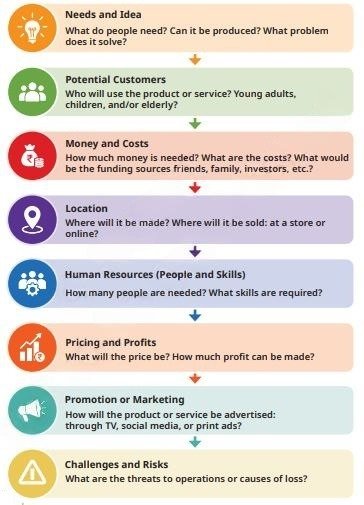
1. Needs and Idea: First, find out what customers need.
Questions to Think About:
- What products do people want?
- Do they like cakes, pastries, bread, or healthy snacks?
- What problem will the bakery solve?
2. Potential Customers: Know who will buy your products.
Questions to Think About:
- Who are your customers?
- Children, young adults, or families?
3. Money and Costs: Plan how much money is needed.
Expenses May Include:
- Oven and equipment
- Rent
- Ingredients
- Packaging
- Salaries
4. Location: Choose the right place for the bakery.
Good Locations:
- Near schools
- Near colleges
- Near markets
- Busy areas
5. Human Resources: Decide who will work in the bakery.
Staff Needed:
- Bakers
- Helpers
- Billing staff
- Delivery staff
6. Pricing and Profits: Set prices carefully.
Remember:
- Cover all costs.
- Earn profit.
- Keep prices affordable.
7. Promotion or Marketing: Tell people about your bakery.
Ways to Advertise:
- Social media
- Posters
- Special discounts
- Attractive packaging
8. Challenges and Risks: Every business faces problems.
Common Challenges:
- Strong competition
- Rising ingredient costs
- Changing customer tastes
- Low sales
Functional Areas of a Business
A business has different departments called functional areas. Each area performs a specific job and helps the business run smoothly. These areas:
- Help in better decision-making.
- Use resources properly.
- Improve coordination among employees.
- Support business growth and success.
Every successful business runs on four key pillars. Together, they turn goals into growth.
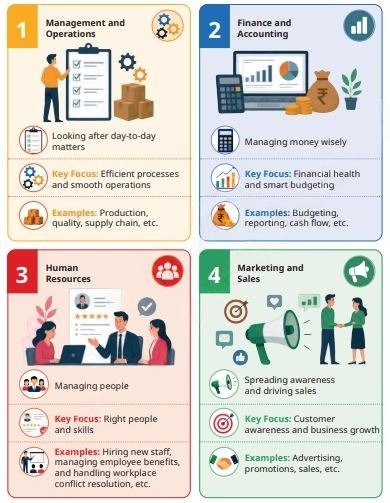
Management and Operations
Management means planning, organizing, and guiding resources to achieve business goals. The functions of the management are
- Planning business activities
- Organizing resources
- Making decisions
- Guiding employees
- Achieving business goals
Operations means producing and delivering goods or services efficiently and on time. The functions of operations are
- Producing products
- Maintaining quality
- Reducing wastage
- Delivering products on time
Finance and Accounting
1. Finance
Finance is the management of money in a business. It involves planning, obtaining, and using funds to help the business operate and grow. Finance Includes:
- Planning money needs
- Arranging funds
- Using money wisely
- Managing profits and cash flow
2. Accounting
Accounting is the process of recording, organizing, and reporting financial transactions. Functions of Accounting:
- Recording income and expenses
- Maintaining financial records
- Calculating profit or loss
- Following tax rules
Profit and Loss Account
A profit and loss account shows whether a business has made a profit or a loss during a specific period. The formula for finding profit or loss is—
Profit = Total Revenue − Total Expenses
- Revenue: The revenue is the total money earned from selling goods or services.
- Expenses: Expenses are the costs of running the business. For example, Salaries, Electricity bills, Raw materials, Interest on loans, taxes etc.
Human Resources
The people who work in the business are called human resources. They are the most important part of any business because they help to grow and succeed. Function of the Human Resources—
- Hiring employees
- Training workers
- Paying salaries
- Creating a safe and comfortable workplace
- Motivating employees
Marketing and Sales
Marketing and sales help attract customers and increase the sale of products and services. Functions of Marketing and Sales
- Advertising products
- Promoting the business
- Attracting customers
- Increasing sales
- Building a good brand image
Startups and Their Contribution to the Nation
What is a startup?
A startup is a new business started with an innovative idea to solve problems and meet people’s needs. Not every startup becomes successful. Some of the startups grow quickly, some face difficulty, and some may even close down.
Failure is not bad if people learn from it and try again. Every failure teaches valuable lessons for future success. Swami Vivekananda says that “success comes through hard work, dedication, and perseverance.”
India is the third-largest startup ecosystem in the world. It is supported by the young and talented population. In 2025, India has around 120 unicorns.
What is Unicorn?
A unicorn is a startup valued at more than 1 billion US dollars.
Major startup sectors in India are—
- E-commerce: Online shopping businesses.
- Fin-tech: Digital payment and financial services.
- Health-tech: Online healthcare services.
- Agri-tech: Technology used in farming and agriculture.
The government of India launched the Startup India scheme to encourage entrepreneurship and innovation. The name of the startup is “Atamanirbhar Bharat.” The aims to make India self-reliant through local solutions and innovation.
As India moves towards the vision of Viksit Bharat 2047, entrepreneurship will continue to play a vital role in creating employment, driving innovation, empowering communities, and building a more prosperous, self-reliant, and sustainable nation. The next generation of entrepreneurs may well be sitting in your classroom today, ready to transform ideas into solutions that make a meaningful difference to society.
Contribution of Entrepreneurs to the Nation
- Improving Quality of Life
- Creating Jobs and Income
- Paying Taxes to the Government
- Producing Goods and Services
- Making Innovations
- Corporate Social Responsibility (CSR)
Disclaimer: The content that is present on our website is based on the NCERT Class 9 Social Science textbook and is provided for educational purposes only. All the content and images have been taken from Social Science Class 9 NCERT Textbook and CBSE Support material. Images and content shown above are the property of individual organizations and are used here for reference purposes only. To make it easy to understand, some of the content and images are generated by AI and cross-checked by the teachers.