
← Back to Class 9 Social Science Notes
In this chapter, Manage Your Personal Finances Class 9 Notes, students will learn the basics of managing money in their daily lives. The chapter explains important concepts such as income, expenses, budgeting, saving, banking, and financial planning. These notes are prepared in simple language to help students understand how to use money wisely, develop good saving habits, and make responsible financial decisions.

Manage Your Personal Finances Class 9 Notes
In childhood we get pocket money from relatives during festivals and special occasions. Some people spend it, and some save it in a piggyback or any other safe place. This money we can use for our needs and wants.
Personal finance means planning and managing our money wisely. It includes—
- Spending money carefully
- Saving money regularly
- Investing money for the future
- Planning for future needs and goals
Money is an important resource, so it should be used wisely. Good financial planning helps us achieve our future goals.
Pillars of Personal Finance
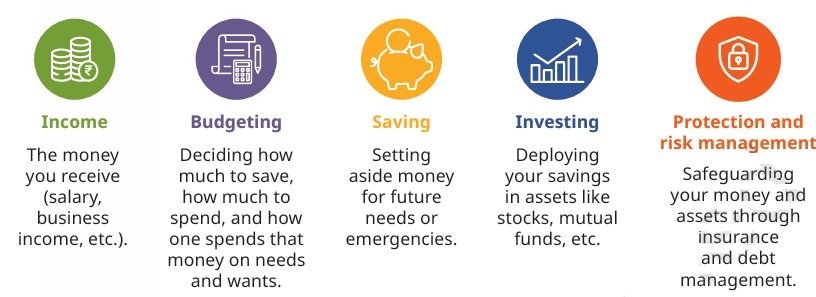
1. Income (Earnings)
Income is money earned by a person regularly or sometimes by doing work, business, or from investments. It is a starting stage where the finance. Without income, a person cannot spend, save, or invest money. Examples of Income:
- A teacher earns a salary.
- A shopkeeper earns profit from a business.
- A person earns rent from property.
- An investor earns interest from bank deposits.
- A shareholder receives dividends and interest from securities.
2. Budgeting (Planning Expenses)
Budgeting means planning in advance how we will spend our income. A budget is a written plan that helps to balance the income and expenses. People make budgets to achieve future goals, such as:
- Saving for a school trip
- Buying sports equipment
- Paying for higher education
- Keeping money for emergencies
If a person can set the financial goals, then it helps us to spend, save, and invest wisely. The questions to set a goal are—
What do I want to achieve?
- How much money do I need?
- By when do I want to achieve it?
- What steps will help me reach it?
Benefits of budgeting—
- Controls unnecessary spending
- Helps save money
- Prioritises important expenses
- Helps live within income
Steps in Budgeting

- ✔Identify Expenses: Make a list of all monthly expenses to know where money is spent.
- ✔Set a Savings Goal: Decide how much to save, for what purpose, and by when. For example, to buy a bicycle costing ₹3,000 in 6 months, save ₹500 each month.
- ✔Track Spending: Compare actual spending with the budget regularly to avoid overspending.
- ✔Review and Adjust: Update the budget when income, expenses, or goals change.
Saving
Saving means keeping aside a part of our income for future use. The money saved over time is called savings.
Why is saving important?
Saving helps in emergencies and unexpected situations –
- Provides financial security
- Helps achieve future goals
- Provides comfortable living
People also save money to invest in assets such as –
- Fixed Deposits (FDs)
- Stocks
- Mutual Funds
- Real Estate
Investing (Growing Wealth)
Investing means putting your savings into assets so that your money can grow over time and earn returns. For example, Sameer invests ₹500 in a savings scheme earning 8% interest. After 1 year, he has ₹540. This example shows that investing helps the money to grow.
Why is investing important?
- Increases wealth over time
- Protects the value of money
- Helps beat inflation (rising prices)
- Helps achieve future financial goals
What is inflation?
If a school bag costs ₹1,000 today and prices rise by 6%, it may cost ₹1,060 next year. If your money does not grow, you can buy less in the future. This is known as inflation.
What is Compounding?
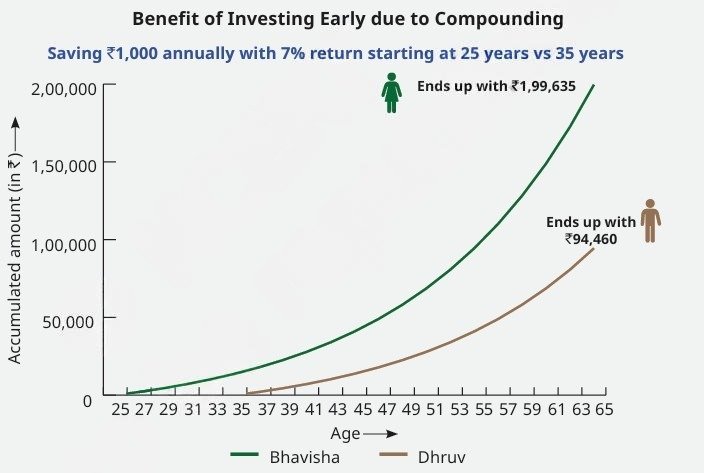
Compounding means earning returns not only on the original money but also on the returns already earned. This helps money grow faster over time.
Important Terms
- Liquidity: Refers to how quickly and easily an asset can be converted into cash or cash equivalents without affecting its value.
- Inflation: The increase in the prices of goods and services over time, which reduces the purchasing power of money. As prices rise, the same amount of money can buy fewer goods and services than before.
- Purchasing power: The real-world value of money, measured by the quantity of goods and services a single unit of currency can buy. It determines your standard of living, as higher purchasing power means you get more goods and services with the same amount of money, while a decrease means you can afford less with the same amount of cash.
Power of Early Investments
Starting to invest early helps money grow more because of compounding. For example, Bhavisha starts saving ₹1,000 every year at age 25, and Dhruv starts saving the same amount at age 35. By age 65, Bhavisha has much more money because her investments have had more time to grow.
Some of the common Investment Options are –
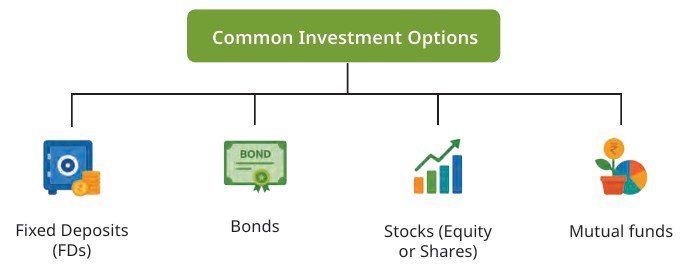
✔ Fixed Deposits (FDs): In a fixed deposit, a person deposits a lump sum amount for a fixed period, such as one, three, or five years. During this period, the bank or post office pays a fixed rate of interest on this amount, which remains unchanged throughout the investment period. For example, PPF, NSC, Sukanya Samriddhi Yojana, etc.
✔ Bonds: Bonds are investments through which people lend money to the government or companies (issuers of bonds) for a fixed period. Bondholders earn regular interest. For example, if you buy a bond worth ₹10,000 that pays 5% interest per year, you will receive ₹500 as interest after one year. If the bond matures after one year, you will receive ₹10,500 in total.
✔ Stocks (Shares): Shares represent ownership in a company. When a person buys shares, they become a part-owner of that company and may earn returns through dividends as well as an increase in the share price. Investing in shares involves higher risk because share prices fluctuate due to market conditions, company performance, and broader economic changes.
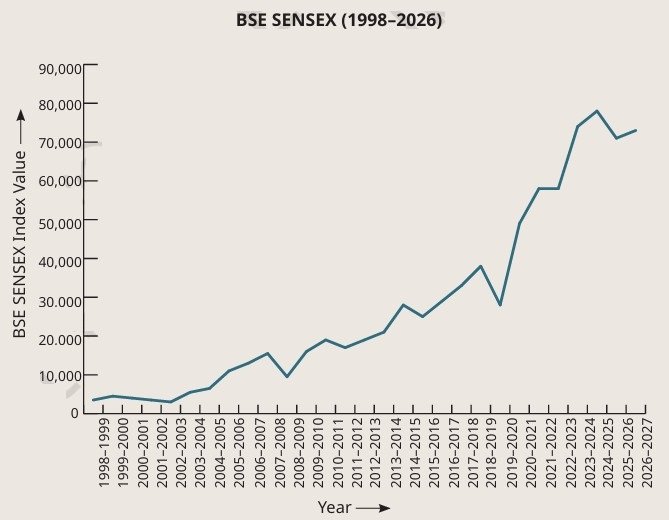
✔ Mutual Funds: Mutual funds pool money from many investors and invest it in a basket of shares, bonds, or other financial assets. These investments are managed by professional fund managers who decide where to invest the money. Mutual funds are popular because they reduce risk by spreading investments across different types of assets, a strategy known as portfolio diversification.
Protection and Risk Management
Life is uncertain. Illness, accidents, loss of income, or damage to property can cause financial problems. Therefore, people need protection to keep their income, savings, and assets safe.
Insurance: Insurance is a legal contract in which a person pays a fixed amount called a premium to an insurance company. In return, the company provides financial help during specific losses or emergencies. For example, a family pays ₹500 every month for health insurance. If someone falls sick, the insurance company pays a large part of the medical expenses. Benefits of Insurance
- Provides financial security during emergencies
- Reduces the burden of unexpected expenses
- Protects savings and assets
- Helps families recover from financial losses
- Encourages financial planning
How does the insurance work?
Insurance works on the principle of risk sharing. Many people pay premiums into a common pool. In case of any unexpected loss, those insured receive financial support from the insurance company.
Type of Insurance
There are multiple types of insurance.
✔ Health Insurance: The health insurance covers hospital, medicine, and treatment expenses. It reduces the financial burden of illness and accidents. For example, the Ayushman Bharat scheme.
✔ Life Insurance: It provides financial support to the family if the policyholder dies; then the insurance company pays the amount to the family members. It helps to meet daily expenses, education costs, and loan repayments.
✔ General Insurance: The general insurance protects against losses related to property and vehicles. For example,
- Motor Insurance: Covers vehicle damages and accidents.
- Property Insurance: Protects homes and businesses from fire, theft, floods, etc.
- Crop Insurance: Protects farmers from losses due to natural disasters and pests.
- Cattle Insurance: Covers loss due to death or disability of animals.
Borrowing and Credit
Borrowing means taking money as a loan from banks, relatives, or other sources and repaying it later. Credit is the ability to borrow money and pay it back in the future. Borrowing helps when an important need is there. For example, an education loan helps the students to continue higher studies.
Risks of Borrowing
There are some risks also associated with borrowing. For example, if you borrow some amount from the bank for unnecessary things, then it creates a burden, and it may lead to financial problems if the loan is not repaid on time.
The people have to borrow only when necessary, and they have to repay the amount on time.
Risk and Return
When deciding where to invest money, it is important to consider four factors—risk, return, time horizon, and liquidity.
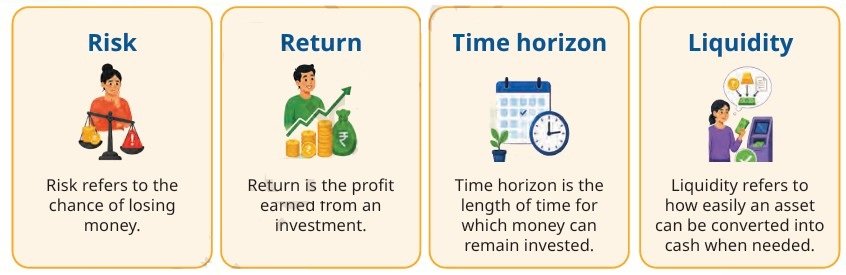
- ✔ Risk: Risk refers to the chance of losing money.
- ✔ Return: Return is the profit earned from an investment.
- ✔ Time horizon: The time horizon is the length of time for which money can remain invested.
- ✔ Liquidity: Liquidity refers to how easily an asset can be converted into cash when needed.
Different investment options have different levels of these factors. For example,
- ✔ Fixed Deposits (FDs): Low risk, lower but steady returns.
- ✔ Mutual Funds: Moderate risk, higher return potential.
- ✔ Shares (Stocks): Highest risk, but can give the highest returns over the long term.
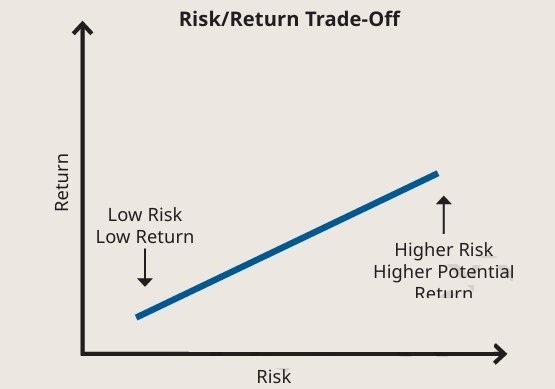
- Low Risk → Low Return
- High Risk → High Return
Taxes
What are taxes?
Taxes are compulsory payments made by people and businesses to the government. The government uses this money to provide public services like
- Schools
- Hospitals
- Roads and transport
- Defense and security
Types of Taxes
- Direct taxes, which are paid directly on a person’s or organization’s income or profits, such as the income tax.
- Indirect taxes, which are added to the price of goods and services, such as the Goods and Services Tax (GST).
Personal Income Tax
Income tax is paid on the income earned during a financial year. If the people are having earnings below a certain limit, then the income tax gives a rebate to them. If the person has a higher income, it can lead to higher tax payment.
This helps to reduce income inequality, and the government uses this money in public welfare and development of the country.
Tax Slab System (FY 2025-26)
| Annual Income | Tax Rate |
|---|---|
| Up to ₹4 lakh | Nil |
| ₹4 lakh – ₹8 lakh | 5% |
| ₹8 lakh – ₹12 lakh | 10% |
| ₹12 lakh – ₹16 lakh | 15% |
| ₹16 lakh – ₹20 lakh | 20% |
| ₹20 lakh – ₹24 lakh | 25% |
| Above ₹24 lakh | 30% |
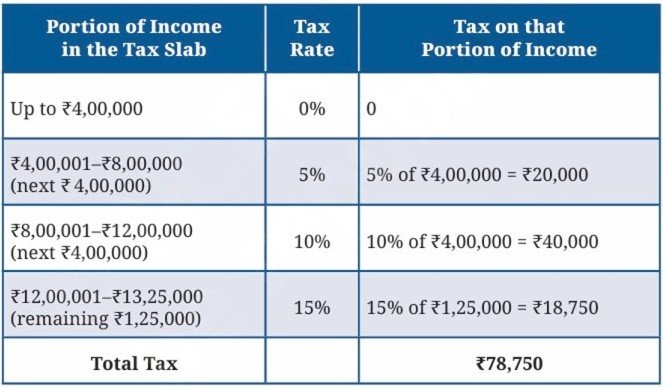
If the person has an earning of Rs. 14 lakh per year, then the annual salary is 1,400,000.
| Standard Deduction = ₹75,000 |
| Taxable Income = ₹13,25,000 |
| Total Income Tax = ₹78,750 |
Paying taxes honestly and on time is the duty of every citizen. Taxes help the government provide essential services and support the country’s development.
How to apply the tax rate as per the tax slabs?
Disclaimer: The content that is present on our website is based on the NCERT Class 9 Social Science textbook and is provided for educational purposes only. All the content and images have been taken from Social Science Class 9 NCERT Textbook and CBSE Support material. Images and content shown above are the property of individual organizations and are used here for reference purposes only. To make it easy to understand, some of the content and images are generated by AI and cross-checked by the teachers.