
In Class 10 Civics, the chapter Power Sharing Class 10 MCQ explains how power is distributed among different organs of government and social groups to avoid conflicts. These MCQs are designed to help students understand important concepts like horizontal and vertical distribution of power, community government, and the role of democracy in maintaining harmony.
Power Sharing Class 10 MCQ
1. Which of the following statement(s) are true with respect to the ethnic composition of Belgium?
- I. 59 percent of the total population of Belgium lives in the Wallonia region and speaks French.
- II. 40 percent live in the Flemish region and speak Dutch.
- III. One percent of the Belgians speak German.
- IV. In the capital city Brussels, 80 percent people speak French while 20 per cent are Dutch speaking.
A. I and II
B. III and IV
C. I, II and III
D. I and IV
2. The cartoon below depicts Germany’s government that was formed after the 2005 elections. It included the two major parties of the country, namely the Christian Democratic Union and the Social Democratic Party. The two parties are historically competing with each other. Which of the following options best explains the cartoon?
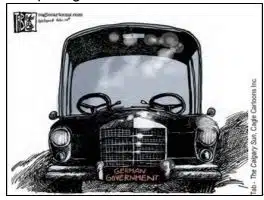
a. Coalition Government.
b. Two Party System.
c. Democratic government.
d. Bi-party system.
3. Consider the following statements on Power Sharing and choose the correct statement(s) –
- I. Imposing the will of the majority community over others.
- II. It helps in reducing the possibility of conflict between the social groups.
- III. Power Sharing is a good way to ensure the stability of political order.
- IV. It brings socio- political opposition among parties.
Choose the correct option:
A. I and II
B. I and III
C. II and IV
D. II and III
4. Consider the following statements regarding power sharing arrangements in Belgium and identify the incorrect one from the following:
A. Equal number of members from Dutch and French community in the central government
B. Separate government for Brussels with equal representation of communities
C. The state government to be subordinate to the central government
D. Community government elected by people belonging to one language community
5. Which one of the following religions was protected and fostered by Sri Lankans in their constitution?
A. Christianity
B. Hinduism
C. Buddhism
D. Islam
6. Which of the following statements accurately distinguishes between Majoritarianism and Power sharing?
a. Majoritarianism emphasizes the dominance of the majority community, while Power sharing emphasizes the sharing of power among different groups.
b. Majoritarianism emphasizes the need for consensus building, while Power sharing emphasizes the exclusion of minority groups.
c. Majoritarianism emphasizes the importance of accommodating minority interests, while Power sharing emphasizes the need for majority rule.
d. Majoritarianism emphasizes the need for peaceful resolution of conflicts, while Power sharing emphasizes the use of force to impose the majority’s will.
7. Which one of the following countries adopted majoritarianism in their Constitution?
A. Nepal
B. India
C. Sri Lanka
D. Bangladesh
8. Identify the significant reason of power sharing from the following options.
A. Reduces socio-economic conflicts
B. Provides ethnic -cultural development
C. Allows people to enjoy specific rights
D. Restricts supremacy of one party
9. Apart from the Central and the State Government, Belgium has a third kind of government as well. Identify this third kind of government from the following options:
A. Democratic Government
B. Socialist Government
C. Community Government
D. Liberal Government
10. Consider the following statements on power sharing and select the answer using the codes given below:
- I. It is good for democracy.
- II. It creates harmony in different groups
- III. It brings transparency in the governance.
- IV. It brings socio-political competition among parties.
A. I, II & III
B. II, III & IV
C. I, III & IV
D. I, II & IV
11. Two statements are given in the question below as Assertion (A) and Reasoning (R). Read the statements and choose the appropriate option.
Assertion (A): Sri Lanka adopted Sinhala as the only official language of the state.
Reason (R): The government of Sri Lanka wanted to foster their culture, language and religion.
Options:
A. Both A and R are true, and R is the correct explanation of A.
B. Both A and R are true, but R is not the correct explanation of A.
C. A is true but R is false.
D. A is false but R is true
12. Belgium solved its problem of majoritarianism by strengthening which of the following types of government?
(A) Unitary
(B) Presidential
(C) Federal
(D) Parliamentary
13. Two statements are given below. They are Assertion (A) and Reason (R). Read both the statements carefully and choose the correct option:
Assertion (A): Belgium’s ‘community government’ has the power regarding cultural, educational and language-related issues.
Reason (R): The State Governments are subordinate to the Central Government in Belgium.
Options:
(A) Both (A) and (R) are true and (R) is the correct explanation of (A).
(B) Both (A) and (R) are true, but (R) is not the correct explanation of (A).
(C) (A) is true, but (R) is false.
(D) (A) is false, but (R) is true.
14. Which of the following was the primary objective of Belgium to form the separate government in Brussels?
(a) Promoting cultural events.
(b) Managing international relations.
(c) Enforcing local laws.
(d) Ensuring linguistic accommodation.
15. Two statements are given below. They are Assertion (A) and Reason (R). Read both the statements and choose the correct option.
Assertion (A): Power sharing is the spirit of democracy.
Reason (R): A legitimate government is one where all the groups connect with the government through their participation.
Options:
(A) Both (A) and (R) are true and (R) is the correct explanation of (A).
(B) Both (A) and (R) are true, but (R) is not the correct explanation of (A).
(C) (A) is true, but (R) is false.
(D) (A) is false, but (R) is true.
16. Which one of the following is the majority community in Sri Lanka?
(A) Sinhalas
(B) Indian Tamils
(C) Sri Lankan Tamils
(D) Christians
17. Which one of the following is the minority group in Sri Lanka?
(a) Tamils
(b) Christians
(c) Sinhalese
(d) Muslims
18. With which of the following countries does Belgium share its border?
(a) Italy
(b) Switzerland
(c) Luxembourg
(d) Spain
19. Consider the following statements on Power Sharing and choose the correct option:
I. It deepens democracy.
II. It helps to reduce conflicts among social groups.
III. It is a way to ensure political stability.
IV. It brings socio-economic struggles.
Options:
(A) I, II and III
(B) II, III and IV
(C) I, III and IV
(D) I, II and IV
20. There are two statements given as Assertion (A) and Reason (R). Read both the statements and choose the correct option.
Assertion (A): Belgium amended their constitution four times.
Reason (R): Amendments were to enable everyone to live together in the same country.
(a) Both Assertion (A) and Reason (R) are true and Reason (R) is the correct explanation of the Assertion (A).
(b) Both Assertion (A) and Reason (R) are true, but Reason (R) is not the correct explanation of the Assertion (A).
(c) Assertion (A) is true, but Reason (R) is false.
(d) Assertion (A) is false, but Reason (R) is true.
21. How many people in Belgium speak Dutch?
A. 40%
B. 59%
C. 74%
D. 20%
Explanation: Belgium is a small country but has a divided Dutch-speaking majority (59%), French-speaking minority (40%), and German-speaking minority (1%).
22. Which of the following communities was rich and powerful in Belgium and leading to tensions in the 1950s–60s?
A. Dutch-speaking community
B. German-speaking community
C. French-speaking community
D. Brussels residents
Explanation: The French-speaking community in Belgium was a rich and powerful group, especially during 1950 to 1960.
23. What is the percentage of people who speak Sinhala in Sri Lanka?
A. 59%
B. 40%
C. 74%
D. 18%
Explanation: The Sinhala-speaking people in Sri Lanka are 74%, and Tamil-speaking people are around 18%.
24. The 1956 Act in Sri Lanka: which of the following languages was recognised as an official language?
A. Tamil
B. Sinhala
C. English
D. Pali
25. Which of the following was NOT demanded from Sri Lankan Tamils?
A. Recognition of Tamil as an official language
B. Regional autonomy
C. Euality of opportunity in jobs and education
D. Protection of Buddhism by the state
Explanation: The Sri Lankan Tamils demanded the recognition of Tamil as an official language, euality of opportunity in jobs and education, etc.
26. What was the outcome of the civil war in Sri Lanka?
A. Strengthened unity among communities
B. Thousands killed and many displaced
C. Tamils gained autonomy.
D. Sinhala dominance ended.
Explanation: The war was fought between the Sri Lankan government and the LTTE, which demanded an independent Tamil state in the north and east.
27. Which of the following is a uniue feature of the Belgian model of power-sharing?
A. Sinhala recognised as the only official language
B. Community government elected by linguistic groups
C. Majority rule by the Dutch-speaking community
D. Tamils given regional autonomy
Explanation: The belgium is special because people vote based on their language communities.
28. Why was Brussels chosen as the headuarters of the European Union?
A. It had a majority of Dutch speakers.
B. It represented successful power-sharing arrangements.
C. It was geographically central in Europe.
D. It had no ethnic tensions.
Explanation: Brussels was chosen as the EU headuaters because Belgium showed how different language communites could share power peacefully.
29. Which of the following is a prudential reason for power sharing?
A. It ensures eual participation of citizens.
B. It reduces chances of social conflict and instability.
C. It is the very spirit of democracy.
D. It gives moral legitimacy to government.
30. Which of the following is a moral reason for power sharing?
A. It helps avoid civil war.
B. It ensures better economic outcomes.
C. It respects citizens’ right to be consulted in governance.
D. It prevents majority dominance in the short run.
31. The term ‘prudential’governance. refers to _.
A. Moral values
B. Religious beliefs
C. Careful calculation of gains and losses
D. Majority opinion
Explanation: The word prudential means being practical and cautious.
32. Which of the following coalition governments formed in Germany in 2005 and consisted of which of the following members?
A. Christian Democratic Union and Green Party
B. Social Democratic Party and Communist Party
C. Christian Democratic Union and Social Democratic Party
D. Liberal Party and Social Democratic Party
33. Which of the following arrangements is an example of horizontal distribution of power?
A. Power shared between Union and State governments
B. Power shared among legislature, executive, and judiciary
C. Power shared among different political parties
D. Power shared among social groups
34. The system of checks and balances in democracy ensures that:
A. One organ of government dominates the others.
B. Each organ can exercise unlimited power.
C. No organ can exercise unlimited power.
D. Judiciary is subordinate to the executive.
35. In Belgium, the community government is elected by:
A. Only Dutch-speaking citizens
B. Only French-speaking citizens
C. People belonging to one language community, irrespective of where they live
D. Citizens of Brussels only
36. Which of the following is an example of vertical division of power?
A. Separation of powers among the legislature, executive, and judiciary
B. Division of powers between Union and State governments
C. Representation of weaker sections through reserved constituencies
D. Coalition government formed by multiple parties
Disclaimer: We have provide you with the accurate handout of “Power Sharing Class 10 MCQ“. If you feel that there is any error or mistake, please contact me at anuraganand2017@gmail.com. The above CBSE study material present on our websites is for education purpose, not our copyrights.
All the above content and Screenshot are taken from Social Science Code 087 Class 10 NCERT Textbook, CBSE Sample Paper, CBSE Old Sample Paper, CBSE Board Paper and CBSE Support Material which is present in CBSEACADEMIC website, NCERT website This Textbook and Support Material are legally copyright by Central Board of Secondary Education or NCERT. We are only providing a medium and helping the students to improve the performances in the examination.
Images and content shown above are the property of individual organisations and are used here for reference purposes only. To make it easy to understand, some of the content and images are generated by AI and cross-checked by the teachers. For more information, refer to the official CBSE textbooks available at cbseacademic.nic.in.