
Sound Waves Characteristics and Applications Class 9 MCQ questions based on the latest NCERT syllabus. This collection includes competency-based, case study, assertion-reason, and multiple-choice questions that help students understand sound waves, their characteristics, propagation, reflection, and real-life applications. These MCQs are ideal for CBSE Class 9 exam preparation and improving conceptual understanding.
Sound Waves Characteristics and Applications Class 9 MCQ
Conceptual Recall MCQs
Q1. Sound is produced when an object
a) Stops moving
b) Vibrates
c) Rotates
d) Expands
Answer: b) Vibrates
Q2. In humans, sound is produced by the vibration of:
a) Tongue
b) Vocal cords
c) Teeth
d) Nose
Answer: b) Vocal cords
Q3. Sound needs a __ to propagate.
a) Vacuum
b) Medium
c) Force
d) Light
Answer: b) Medium
Q4. Which of the following is not a medium for sound propagation?
a) Solid
b) Liquid
c) Gas
d) Vacuum
Answer: d) Vacuum
Q5. The regions of higher density in a sound wave are called:
a) Rarefactions
b) Compressions
c) Vibrations
d) Pulses
Answer: b) Compressions
Q6. Sound waves are classified as:
a) Transverse waves
b) Longitudinal waves
c) Electromagnetic waves
d) Stationary waves
Answer: b) Longitudinal waves
Q7. Sound is a form of _________.
a) Matter
b) Energy
c) Force
d) Light
Answer: b) Energy
Q8. In sound wave propagation, what is transferred?
a) Particles of medium
b) Energy of vibration
c) Heat only
d) Light waves
Answer: b) Energy of vibration
Q9. The highest point in the graph of a sound wave is called:
a) Rarefaction
b) Crest
c) Trough
d) Compression
Answer: b) Crest
Q10. The distance between two consecutive crests is called:
a) Frequency
b) Wavelength
c) Time period
d) Amplitude
Answer: b) Wavelength
Q11. The maximum change in density of air in a compression compared to average density is called:
a) Frequency
b) Amplitude
c) Intensity
d) Wavelength
Answer: b) Amplitude
Q12. The amount of sound energy passing through a unit area per unit time is called:
a) Amplitude
b) Intensity
c) Frequency
d) Time period
Answer: b) Intensity
Q13. The human perception of frequency is called:
a) Loudness
b) Pitch
c) Timbre
d) Intensity
Answer: b) Pitch
Q14. The audible range of human hearing is:
a) 2 Hz – 200 Hz
b) 20 Hz – 20,000 Hz
c) 200 Hz – 2000 Hz
d) 2000 Hz – 20,000 Hz
Answer: b) 20 Hz – 20,000 Hz
Q15. The bouncing back of sound waves from a surface is called:
a) Refraction
b) Reflection
c) Reverberation
d) Diffraction
Answer: b) Reflection
Q16. Echoes are stronger when sound reflects from the following:
a) Soft surfaces
b) Rough surfaces
c) Hard and smooth surfaces
d) Transparent surfaces
Answer: c) Hard and smooth surfaces
Q17. Sound waves with frequency less than 20 Hz are called
a) Audible waves
b) Ultrasonic waves
c) Infrasonic waves
d) Noise
Answer: c) Infrasonic waves
Q18. The human audible range is _________.
a) 2 Hz – 200 Hz
b) 20 Hz – 20 kHz
c) 200 Hz – 2000 Hz
d) 2000 Hz – 20,000 Hz
Answer: b) 20 Hz – 20 kHz
Application-Based MCQs
Q19. A student plucks a rubber band stretched across a cardboard box. The sound becomes louder compared to when it is stretched between two fingers. Why?
a) The box acts as a sound source.
b) The box absorbs sound.
c) The box amplifies vibrations.
d) The box reduces tension.
Answer: c) The box amplifies vibrations.
Q20. If astronauts strike metal tools during a spacewalk, they cannot hear the clanking sound because
a) Space is too cold.
b) Space has no air medium.
c) Tools do not vibrate in space.
d) Sound travels faster in a vacuum.
Answer: b) Space has no air medium.
Q21. A student hears a louder knock when his ear is placed on the desk compared to when it is in the air. Why?
a) Desk absorbs sound
b) Sound travels faster in solids.
c) Sound is weaker in solids.
d) Desk blocks vibrations
Answer: b) Sound travels faster in solids.
Q22. Astronauts cannot hear each other directly in space because _________.
a) Space is too cold.
b) Space has no medium for sound.
c) Their suits block sound.
d) Sound travels too fast in a vacuum
Answer: b) Space has no medium for sound.
Q23. A piston oscillates back and forth in a tube filled with air. What does this motion produce?
a) Only rarefactions
b) Only compressions
c) Alternating compressions and rarefactions
d) No disturbance
Answer: c) Alternating compressions and rarefactions
Q24. A supersonic aircraft produces a loud sound called a sonic boom. This happens because:
a) The aircraft vibrates continuously.
b) Aircraft flies faster than the speed of sound.
c) Aircraft produce transverse waves.
d) Aircraft creates a vacuum in air
Answer: b) Aircraft flies faster than the speed of sound.
Q25. In Activity 10.6, grains sprinkled on a stretched sheet move when a loud sound is produced nearby. Why?
a) Sound pushes grains directly
b) Sound energy makes the sheet vibrate.
c) Grains absorb sound waves.
d) Sound creates a vacuum under grains
Answer: b) Sound energy makes the sheet vibrate.
Q26. A microphone converts:
a) Electrical energy into sound energy
b) Sound energy into electrical energy
c) Heat energy into sound energy
d) Sound energy into light energy
Answer: b) Sound energy into electrical energy
Q27. If a sound wave has 10 oscillations in 2 seconds, its frequency is _________.
a) 2 Hz
b) 5 Hz
c) 10 Hz
d) 20 Hz
Answer: b) 5 Hz
Q28. A sound wave has a frequency of 5 Hz. What is its time period?
a) 0.1 s
b) 0.2 s
c) 2 s
d) 5 s
Answer: b) 0.2 s
Q29. A plate is struck harder in Activity 10.6. The grains on the sheet jump higher. Why?
a) Larger amplitude → more energy transferred
b) Smaller amplitude → less energy transferred
c) Sound waves stop grains from moving.
d) Sound waves reduce density variations.
Answer: a) Larger amplitude → more energy transferred
Q30. During a thunderstorm, lightning is seen before thunder is heard because
a) Sound travels faster than light.
b) Light travels much faster than sound.
c) Sound does not travel in air.
d) Thunder is produced later than lightning.
Answer: b) Light travels much faster than sound.
Q31. A whistle produces a shrill sound. This means it has:
a) Low pitch, low frequency
b) High pitch, high frequency
c) Low pitch, high frequency
d) High pitch, low frequency
Answer: b) High pitch, high frequency
Q32. A person moves farther away from a loudspeaker. The sound heard becomes softer because _________.
a) Frequency decreases
b) Amplitude decreases with distance.
c) Pitch decreases
d) Wavelength increases
Answer: b) Amplitude decreases with distance.
Q33. A student claps in a corridor and hears an echo after 0.5 s. If the speed of sound is 340 m/s, the distance to the wall is:
a) 34 m
b) 85 m
c) 170 m
d) 340 m
Answer: b) 85 m
Q34. Why can’t echoes be heard in a small room?
a) Sound is absorbed by walls.
b) Reflections arrive too quickly (<0.1 s).
c) Sound travels slower indoors.
d) Sound waves stop vibrating.
Answer: b) Reflections arrive too quickly (<0.1 s).
Q35. Ultrasonography is used in medicine because _________.
a) Ultrasound can pass through bones.
b) Ultrasound can image internal organs without surgery.
c) Ultrasound is audible to humans.
d) Ultrasound travels slower in liquids.
Answer: b) Ultrasound can image internal organs without surgery.
Q36. Infrasonic waves are useful for:
a) Breaking kidney stones
b) Detecting earthquakes and volcanic eruptions
c) Cleaning delicate machine parts
d) Welding metals
Answer: b) Detecting earthquakes and volcanic eruptions
Assertion–Reason MCQs
Q37. Assertion (A): Sound is produced by vibrating objects.
Reason (R): Vibrations stop → sound stops.
a) Both A and R are true, and R explains A.
b) Both A and R are true, but R does not explain A.
c) A is true, R is false.
d) A is false, R is true.
Answer: a) Both A and R are true, and R explains A.
Q38. Assertion (A): Bats use sound to locate prey at night.
Reason (R): They produce ultrasonic waves, which reflect back from objects.
a) Both A and R are true, and R explains A.
b) Both A and R are true, but R does not explain A.
c) A is true, R is false.
d) A is false, R is true.
Answer: a) Both A and R are true, and R explains A.
Q39. Assertion (A): Sound cannot travel in vacuum.
Reason (R): Sound requires a medium like air, water, or solid to propagate.
a) Both A and R are true, and R explains A.
b) Both A and R are true, but R does not explain A.
c) A is true, R is false.
d) A is false, R is true.
Answer: a) Both A and R are true, and R explains A.
Q40. Assertion (A): Sound becomes faint when air is removed from a bell jar.
Reason (R): Without air, vibrations cannot reach our ears.
a) Both A and R are true, and R explains A.
b) Both A and R are true, but R does not explain A.
c) A is true, R is false.
d) A is false, R is true.
Answer: a) Both A and R are true, and R explains A.
Q41. Assertion (A): Sound waves are mechanical waves.
Reason (R): They require a material medium for propagation.
a) Both A and R are true, and R explains A.
b) Both A and R are true, but R does not explain A.
c) A is true, R is false.
d) A is false, R is true.
Answer: a) Both A and R are true, and R explains A.
Q42. Assertion (A): In sound waves, particles of the medium travel along with the wave.
Reason (R): Particles vibrate about their mean positions parallel to the wave direction.
a) Both A and R are true, and R explains A.
b) Both A and R are true, but R does not explain A.
c) A is false, and R is true
d) A is true, R is false.
Answer: c) A is false, R is true.
Q43. Assertion (A): Sound waves make particles of the medium vibrate.
Reason (R): These vibrations transfer energy without actual movement of particles.
a) Both A and R are true, and R explains A.
b) Both A and R are true, but R does not explain A.
c) A is true, R is false.
d) A is false, R is true.
Answer: a) Both A and R are true, and R explains A.
Q44. Assertion (A): A speaker produces sound when an electrical signal is given.
Reason (R): The diaphragm inside the speaker vibrates due to the signal.
a) Both A and R are true, and R explains A.
b) Both A and R are true, but R does not explain A.
c) A is true, R is false.
d) A is false, R is true.
Answer: a) Both A and R are true, and R explains A.
Q45. Assertion (A): Frequency and time period are inversely related.
Reason (R): Higher frequency means shorter time period.
a) Both A and R are true, and R explains A.
b) Both A and R are true, but R does not explain A.
c) A is true, R is false.
d) A is false, R is true.
Answer: a) Both A and R are true, and R explains A.
Q46. Assertion (A): Everyday sounds usually contain a mixture of frequencies.
Reason (R): A tuning fork produces nearly single-frequency sound.
a) Both A and R are true, and R explains A.
b) Both A and R are true, but R does not explain A.
c) A is true, R is false.
d) A is false, R is true.
Answer: a) Both A and R are true, and R explains A.
Q47. Assertion (A): Sound travels fastest in solids.
Reason (R): Particles in solids are closely packed, so vibrations transfer quickly.
a) Both A and R are true, and R explains A.
b) Both A and R are true, but R does not explain A.
c) A is true, R is false.
d) A is false, R is true.
Answer: a) Both A and R are true, and R explains A.
Q48. Assertion (A): Speed of sound in air increases with temperature.
Reason (R): Higher temperature increases particle vibration and energy transfer.
a) Both A and R are true, and R explains A.
b) Both A and R are true, but R does not explain A.
c) A is true, R is false.
d) A is false, R is true.
Answer: a) Both A and R are true, and R explains A.
Q49. Assertion (A): Loudness depends on the amplitude of sound waves.
Reason (R): Larger amplitude waves carry more energy and sound louder.
a) Both A and R are true, and R explains A.
b) Both A and R are true, but R does not explain A.
c) A is true, R is false.
d) A is false, R is true.
Answer: a) Both A and R are true, and R explains A.
Q50. Assertion (A): Dogs and bats can hear ultrasonic sounds.
Reason (R): Their hearing range extends beyond 20 kHz.
a) Both A and R are true, and R explains A.
b) Both A and R are true, but R does not explain A.
c) A is true, R is false.
d) A is false, R is true.
Answer: a) Both A and R are true, and R explains A.
Q51. Assertion (A): Echoes are heard only if the reflecting surface is at least 17 m away.
Reason (R): The minimum time gap of 0.1 s is required for the brain to distinguish two sounds.
a) Both A and R are true, and R explains A.
b) Both A and R are true, but R does not explain A.
c) A is true, R is false.
d) A is false, R is true.
Answer: a) Both A and R are true, and R explains A.
Q52. Assertion (A): Reverberation occurs due to multiple reflections of sound.
Reason (R): These reflections arrive with a time difference less than 0.05 s.
a) Both A and R are true, and R explains A.
b) Both A and R are true, but R does not explain A.
c) A is true, R is false.
d) A is false, R is true.
Answer: a) Both A and R are true, and R explains A.
Q53. Assertion (A): Bats use ultrasonic waves to locate prey at night.
Reason (R): They sense echoes of ultrasonic waves reflected from objects.
a) Both A and R are true, and R explains A.
b) Both A and R are true, but R does not explain A.
c) A is true, R is false.
d) A is false, R is true.
Answer: a) Both A and R are true, and R explains A.
Q54. Assertion (A): Sonar works on the principle of echolocation.
Reason (R): Ultrasonic waves are sent into water, and their reflections are analyzed.
a) Both A and R are true, and R explains A.
b) Both A and R are true, but R does not explain A.
c) A is true, R is false.
d) A is false, R is true.
Answer: a) Both A and R are true, and R explains A.
Case-Based MCQ
Q55. A student performs Activity with a tuning fork. He strikes the prong on a rubber pad and touches it to water. Waves are seen on the water surface.
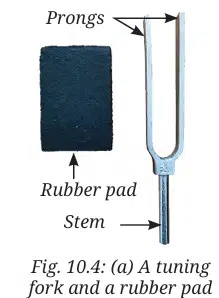
What does this experiment prove?
a) Sound travels faster in water.
b) Tuning fork prongs vibrate to produce sound.
c) Water absorbs vibrations completely.
d) Sound is produced without vibrations.
Answer: b) Tuning fork prongs vibrate to produce sound.
Q56. In the vacuum bell jar experiment, an electric bell rings inside the jar. As air is pumped out, the sound becomes faint and finally inaudible, though the bell is still visibly vibrating.
What conclusion can be drawn?
a) Sound travels faster in a vacuum.
b) Sound cannot propagate without a medium.
c) Bell stops vibrating in a vacuum
d) Sound is absorbed by glass walls.
Answer: b) Sound cannot propagate without a medium.
Q57. In Activity 10.5, a Slinky is stretched, and one end is pushed and pulled quickly. Disturbances travel along the slinky, but the marked turn only oscillates back and forth.

What does this demonstrate?
a) Sound waves carry particles forward.
b) Disturbance propagates, particles oscillate about mean positions.
c) Slinky turns move along with the disturbance.
d) Sound waves are transverse in nature.
Answer: b) Disturbance propagates, particles oscillate about mean positions.
Q58. A student uses the Phyphox app to record frequencies of musical notes ‘Sa, Re, Ga, Ma, Pa, Dha, Ni, Sa.’ He observes that ‘Sa’ has the lowest frequency and the values increase for other notes.
What does this experiment show?
a) All notes have the same frequency.
b) Musical notes differ because of distinct frequencies.
c) Frequency does not affect sound.
d) Frequency and time period are unrelated.
Answer: b) Musical notes differ because of distinct frequencies.
Q59. A student measures a 5 s delay between lightning and thunder. Using the speed of sound in air as 340 m/s, the distance of the lightning strike is _________.
a) 340 m
b) 1700 m
c) 3000 m
d) 5000 m
Answer: b) 1700 m
Q60. An experiment requires echoes to arrive at least 0.2 s after sound emission. If the speed of sound is 343 m/s, what minimum distance should the reflecting surface be placed at?
a) 17.15 m
b) 34.3 m
c) 68.6 m
d) 85 m
Answer: c) 68.6 m
Q61. A naval sonar signal returns after 0.90 s. The speed of sound in seawater is 1530 m/s. What is the distance of the object?
a) 340 m
b) 688.5 m
c) 1530 m
d) 3060 m
Answer: b) 688.5 m
Q62. A student uses a mobile app to generate sounds from 20 Hz to 1000 Hz. He notices that at 20 Hz the sound is barely audible, while at 1000 Hz it is clear and shrill.
What does this experiment show?
a) Loudness depends on frequency.
b) Pitch depends on frequency.
c) Amplitude decreases with frequency.
d) Frequency and pitch are unrelated.
Answer: b) Pitch depends on frequency.
Q63. A student sprinkles rice grains on a stretched balloon sheet fixed over a container. When a loud sound is produced nearby, the grains jump.
What conclusion can be drawn?
a) Sound waves move grains directly.
b) Sound transfers energy to the sheet, causing vibration.
c) Sound waves are transverse in nature.
d) Sound waves stop grains from vibrating.
Answer: b) Sound transfers energy to the sheet, causing vibration.
Diagram-Based MCQs
Q64. In the diagram of vocal cords, when they are closed, what happens?
a) No vibration occurs
b) Air passes freely without sound.
c) Vocal cords vibrate to produce sound.
d) Sound stops completely.
Answer: c) Vocal cords vibrate to produce sound.
Q65. In Fig. 10.2, the rubber band produces sound only when

a) It is stretched and vibrating.
b) It is loose and still
c) It is pressed against the box.
d) It is removed from the box.
Answer: a) It is stretched and vibrating.
Q66. In Fig. 10.6, when spoons are tapped underwater, sound is heard. This proves that:
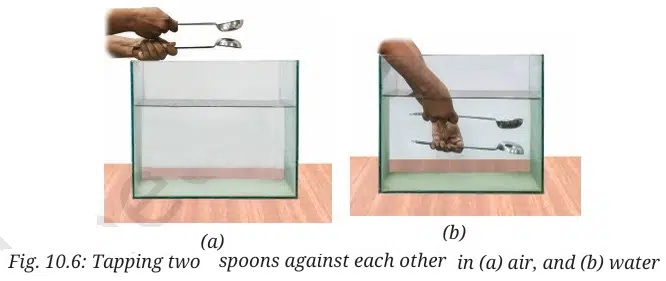
a) Sound travels only in air.
b) Sound travels through liquids.
c) Sound cannot travel in solids.
d) Sound is absorbed by water.
Answer: b) Sound travels through liquids.
Q67. In Fig. 10.7 (bell jar experiment), when air is let back into the jar, the sound becomes louder again. This shows:
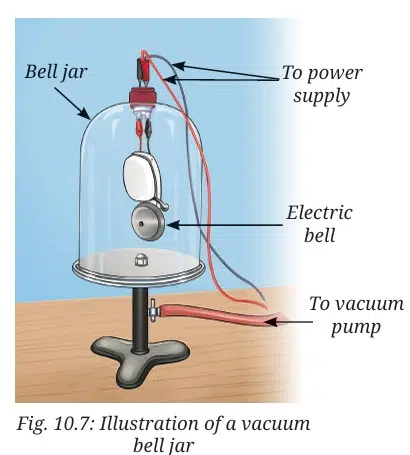
a) Air blocks sound
b) Air acts as a medium for sound.
c) Sound travels faster in a vacuum.
d) A bell vibrates only in air
Answer: b) Air acts as a medium for sound.
Q68. In Fig. 10.9, when the piston moves forward, the nearby air particles _________.
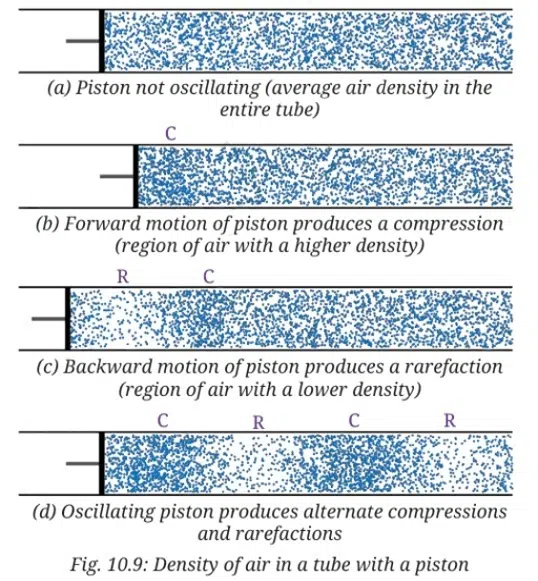
a) Spread out, creating rarefaction
b) Compress, creating a higher density region
c) Stop vibrating completely
d) Move randomly without a pattern
Answer: b) Compress, creating a higher density region
Q69. In Figure, the displacement of particles is shown parallel to the wave propagation. This indicates:
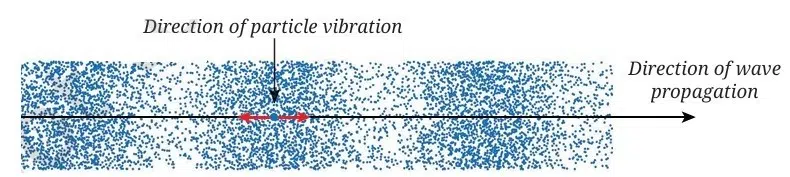
a) Transverse wave
b) Longitudinal wave
c) Electromagnetic wave
d) Stationary wave
Answer: b) Longitudinal wave
Q70. In Fig. 10.14, grains move when sound is produced. This shows:
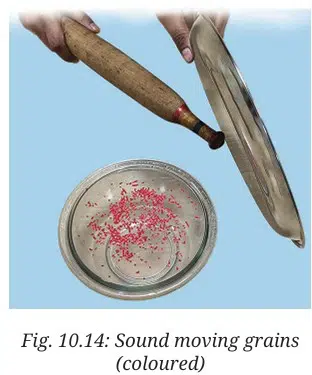
a) Sound is matter.
b) Sound is energy.
c) Sound is light.
d) Sound is a vacuum
Answer: b) Sound is energy.
Q71. In Fig. 10.15, the microphone works by:
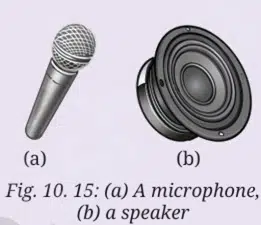
a) Vibrating diaphragm → electrical signal
b) Vibrating diaphragm → light signal
c) Vibrating cone → heat signal
d) Vibrating cone → magnetic signal
Answer: a) Vibrating diaphragm → electrical signal
Q72. In Fig. 10.16, the region above average density represents _________.
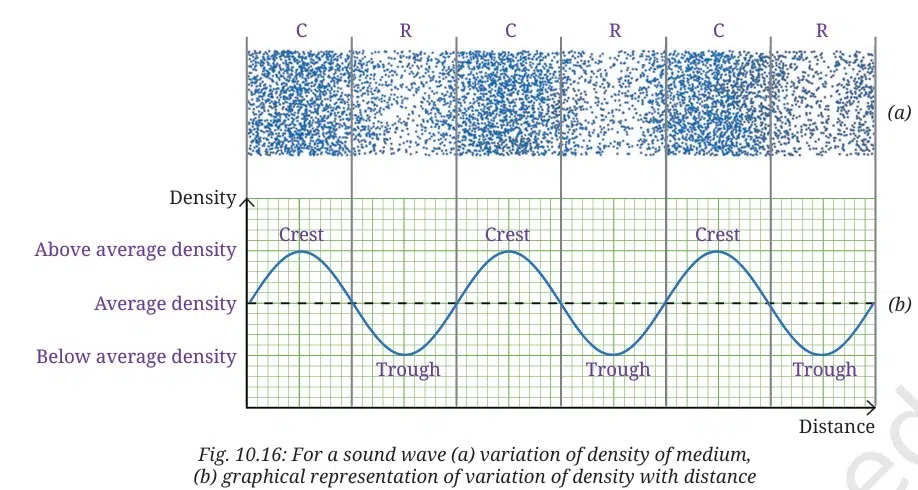
a) Rarefaction
b) Compression
c) Trough
d) Silence
Answer: b) Compression
Q73. In Fig. 10.18, the wave with a short wavelength compared to a long wavelength will have:
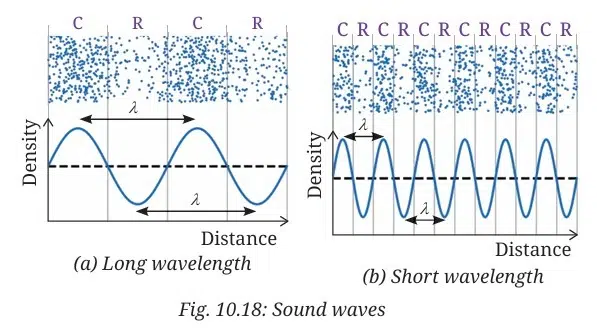
a) Lower frequency
b) Higher frequency
c) Same frequency
d) No frequency
Answer: b) Higher frequency
Q74. In Fig. 10.20, the wave with higher amplitude carries _________.
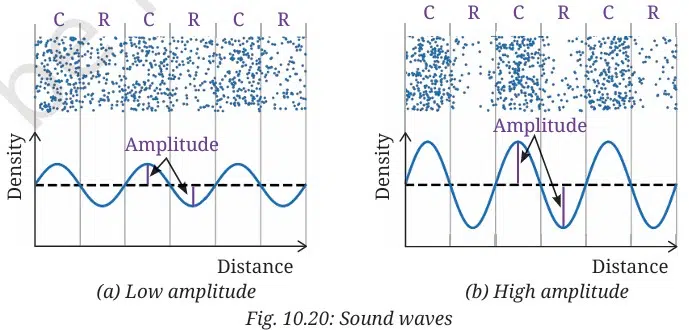
a) Less energy
b) More energy
c) No energy
d) Same energy as low amplitude
Answer: b) More energy
Q75. In Fig. 10.21, sound intensity decreases with distance because _________.
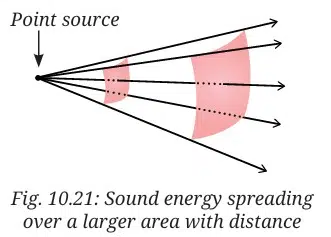
a) Energy is lost in air.
b) Energy spreads over a larger area
c) Sound stops vibrating.
d) Sound changes frequency.
Answer: b) Energy spreads over a larger area
Q76. In Fig. 10.24, the eardrum vibrates when sound enters the ear. These vibrations are:
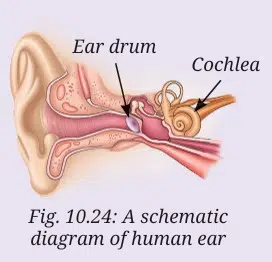
a) Directly converted into sound by bones
b) Amplified by tiny bones and converted into electrical signals by the cochlea
c) Absorbed by nasal cavity
d) Transmitted only to one ear
Answer: b) Amplified by tiny bones and converted into electrical signals by the cochlea
Q77. In Fig. 10.25, a tuning fork produces a single-frequency sound called:
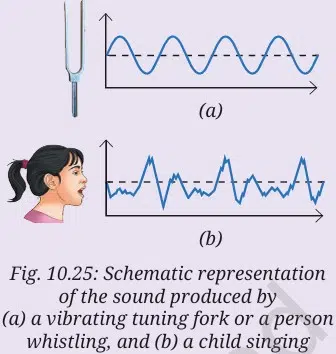
a) Musical note
b) Tone
c) Timbre
d) Octave
Answer: b) Tone
Q78. In Fig. 10.21 (sound spreading), why does intensity decrease with distance?
a) Energy is lost in air.
b) Energy spreads over a larger area
c) Sound frequency decreases
d) Sound stops vibrating.
Answer: b) Energy spreads over a larger area
Q79. In an auditorium, sound-absorbing panels and curtains are used mainly to:
a) Increase echoes
b) Reduce reverberation
c) Increase pitch
d) Increase loudness
Answer: b) Reduce reverberation
Q80. In Figure, bats locate prey using
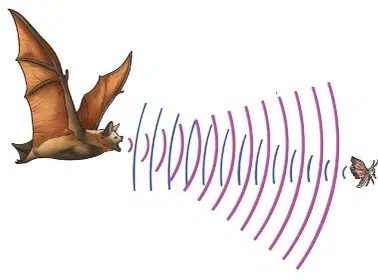
a) Reflection of light
b) Reflection of ultrasonic waves
c) Infrared radiation
d) Magnetic signals
Answer: b) Reflection of ultrasonic waves
Q81. In Fig. 10.28, sonar is used to detect submarines by _________.
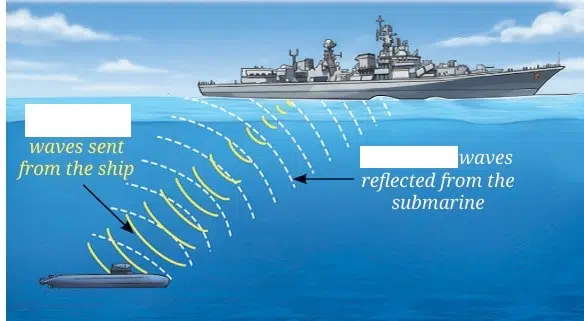
a) Sending ultrasonic waves and analyzing their reflections
b) Sending infrasonic waves and measuring absorption
c) Using light waves underwater
d) Measuring changes in water pressure
Answer: a) Sending ultrasonic waves and analyzing their reflections
Disclaimer: The content that is present on our website is based on the NCERT Class 9 Science textbook and is provided for educational purposes only. All the content and images have been taken from Science Class 9 NCERT Textbook and CBSE Support material. Images and content shown above are the property of individual organizations and are used here for reference purposes only. To make it easy to understand, some of the content and images are generated by AI and cross-checked by the teachers.