
Reproduction: How Life Continues Class 9 MCQ questions based on the latest NCERT syllabus. This collection features competency-based, case study, assertion-reason, and multiple-choice questions designed to help students understand the basics of reproduction, asexual and sexual reproduction, reproductive structures in plants and animals, and the importance of reproduction in the continuity of life. These MCQs are perfect for CBSE Class 9 exams and concept-based learning.
Reproduction How Life Continues Class 9 MCQ
Conceptual Recall MCQs
Q1. Asexual reproduction involves:
a) Two parents
b) One parent
c) Fusion of gametes
d) Variation in offspring
Answer: b) One parent
Q2. Bryophyllum reproduces asexually by:
a) Seeds
b) Stem cuttings
c) Leaf plantlets
d) Roots
Answer: c) Leaf plantlets
Q3. Sexual reproduction involves:
a) One parent
b) Two parents
c) Spores only
d) Budding
Answer: b) Two parents
Q4. In humans, the number of chromosomes in gametes is:
a) 23
b) 46
c) 22
d) 44
Answer: a) 23
Q5. The transfer of pollen grains from anther to stigma is called:
a) Fertilization
b) Pollination
c) Germination
d) Seed dispersal
Answer: b) Pollination
Q6. Pollination in maize and wheat occurs mainly through:
a) Water
b) Wind
c) Insects
d) Birds
Answer: b) Wind
Q7. Fertilization in frogs and most fish occurs:
a) Inside the female body
b) Outside the female body
c) By budding
d) By spore formation
Answer: b) Outside the female body
Q8. Fertilization inside the female body is called:
a) External fertilization
b) Internal fertilization
c) Budding
d) Spore formation
Answer: b) Internal fertilization
Q9. The male gametes are produced in:
a) Scrotum
b) Tests
c) Vas deferens
d) Seminal vesicles
Answer: b) Testes
Q10. The female reproductive organ where the fetus develops is:
a) Ovary
b) Fallopian tube
c) Uterus
d) Cervix
Answer: c) Uterus
Q11. Fusion of sperm and egg forms:
a) Embryo
b) Foetus
c) Zygote
d) Ovule
Answer: c) Zygote
Q12. The process of shedding the uterine lining when fertilization does not occur is called:
a) Ovulation
b) Menstruation
c) Implantation
d) Fertilization
Answer: b) Menstruation
Q13. A balanced diet during pregnancy should be rich in:
a) Carbohydrates only
b) Proteins, vitamins, and minerals
c) Fats only
d) Sugars only
Answer: b) Proteins, vitamins, and minerals
Q14. Which protective device helps prevent both pregnancy and STIs?
a) Oral pills
b) Copper-T
c) Condoms
d) Surgical methods
Answer: c) Condoms
Application-Based MCQs
Q15. Farmers prefer vegetative propagation methods like grafting and tissue culture because _________.
a) They produce genetically different plants.
b) They produce identical plants with desirable traits.
c) They reduce crop yield.
d) They slow down reproduction.
Answer: b) They produce identical plants with desirable traits.
Q16. Why do we refrigerate food items?
a) To increase moisture
b) To slow or stop reproduction of fungi and bacteria
c) To increase spore formation
d) To remove nutrients from food
Answer: b) To slow or stop reproduction of fungi and bacteria
Q17. Why does meiosis reduce the chromosome number to half?
a) To prevent doubling of chromosomes in each generation
b) To increase variation
c) To stop cell division
d) To produce identical offspring
Answer: a) To prevent doubling of chromosomes in each generation
Q18. A pea flower with stamens removed and covered with a muslin cloth does not form fruit. What does this show?
a) Fruits form without pollination
b) Pollination is necessary for fruit formation.
c) The ovary alone can form fruit.
d) Sepals protect fruit formation.
Answer: b) Pollination is necessary for fruit formation.
Q19. Why are pollen grains of insect-pollinated flowers sticky and spiny?
a) To float in air
b) To attach to insect bodies
c) To dissolve in water
d) To repel birds
Answer: b) To attach to insect bodies
Q20. In Vallisneria, pollination occurs through:
a) Wind currents
b) Water currents
c) Insects
d) Birds
Answer: b) Water currents
Q21. Why are testes located in the scrotum outside the body?
a) To protect them from injury
b) To keep them cooler than body temperature for sperm formation
c) To store sperm
d) To produce hormones only
Answer: b) To keep them cooler than body temperature for sperm formation
Q22. IVF (in vitro fertilization) is called the “test tube baby” technique because:
a) Fertilization occurs inside the uterus
b) Fertilization occurs outside the female body in a lab dish.
c) Fertilization occurs in a test tube directly
d) Fertilization occurs without gametes
Answer: b) Fertilization occurs outside the female body in a lab dish.
Q23. Why does the uterus lining become thick and rich in blood vessels after ovulation?
a) To prepare for menstruation
b) To nourish the developing zygote if fertilization occurs
c) To store sperm cells
d) To prevent ovulation
Answer: b) To nourish the developing zygote if fertilization occurs
Q24. Why is breastfeeding important for newborns?
a) It provides complete nutrition and protects against diseases.
b) It helps the baby breathe.
c) It increases the baby’s height immediately.
d) It replaces vaccination.
Answer: a) It provides complete nutrition and protects against diseases.
Q25. Why do animals with internal fertilization generally produce fewer eggs compared to external fertilization?
a) Because internal fertilization is less efficient
b) Because embryos are better protected inside the female body
c) Because sperm are fewer in number
d) Because eggs are destroyed by water currents
Answer: b) Because embryos are better protected inside the female body.
Q26. Why is postpartum depression important to recognize and treat?
a) It affects only physical health.
b) It can harm both the mother’s emotional well-being and the baby’s care.
c) It is always permanent.
d) It prevents fertilization.
Answer: b) It can harm both the mother’s emotional well-being and the baby’s care.
Assertion–Reason MCQs
Q27. Assertion (A): Offspring produced by asexual reproduction are called clones.
Reason (R): They are genetically identical to the parent.
a) Both A and R are true, and R explains A.
b) Both A and R are true, but R does not explain A.
c) A is true, R is false.
d) A is false, R is true.
Answer: a) Both A and R are true, and R explains A.
Q28. Assertion (A): Yeast reproduces by budding.
Reason (R): Small outgrowths emerge from the parent cell and separate to form new individuals.
a) Both A and R are true, and R explains A.
b) Both A and R are true, but R does not explain A.
c) A is true, R is false.
d) A is false, R is true.
Answer: a) Both A and R are true, and R explains A.
Q29. Assertion (A): Meiosis creates variation in offspring.
Reason (R): Chromosomes segregate randomly, producing different combinations in gametes.
a) Both A and R are true, and R explains A.
b) Both A and R are true, but R does not explain A.
c) A is true, R is false.
d) A is false, R is true.
Answer: a) Both A and R are true, and R explains A.
Q30. Assertion (A): Petals are often brightly colored and fragrant.
Reason (R): They attract pollinators to help in reproduction.
a) Both A and R are true, and R explains A.
b) Both A and R are true, but R does not explain A.
c) A is true, R is false.
d) A is false, R is true.
Answer: a) Both A and R are true, and R explains A.
Q31. Assertion (A): Pollination is necessary for fruit and seed formation.
Reason (R): Pollen grains germinate on stigma and deliver male gametes to ovules.
a) Both A and R are true, and R explains A.
b) Both A and R are true, but R does not explain A.
c) A is true, R is false.
d) A is false, R is true.
Answer: a) Both A and R are true, and R explains A.
Q32. Assertion (A): Wind-pollinated plants produce a very large number of pollen grains.
Reason (R): This increases the chance of pollen reaching the stigma despite wastage.
a) Both A and R are true, and R explains A.
b) Both A and R are true, but R does not explain A.
c) A is true, R is false.
d) A is false, R is true.
Answer: a) Both A and R are true, and R explains A.
Q33. Assertion (A): Internal fertilization provides more protection to gametes.
Reason (R): A fertilized egg or embryo develops inside the female body.
a) Both A and R are true, and R explains A.
b) Both A and R are true, but R does not explain A.
c) A is true, R is false.
d) A is false, R is true.
Answer: a) Both A and R are true, and R explains A.
Q34. Assertion (A): Fish and frogs produce thousands of eggs at a time.
Reason (R): Many eggs are destroyed by water currents or eaten by other animals.
a) Both A and R are true, and R explains A.
b) Both A and R are true, but R does not explain A.
c) A is true, R is false.
d) A is false, R is true.
Answer: a) Both A and R are true, and R explains A.
Q35. Assertion (A): Gametes have half the number of chromosomes compared to body cells.
Reason (R): Meiosis reduces chromosome number to half in gametes.
a) Both A and R are true, and R explains A.
b) Both A and R are true, but R does not explain A.
c) A is true, R is false.
d) A is false, R is true.
Answer: a) Both A and R are true, and R explains A.
Q36. Assertion (A): Sperm are motile while eggs are non-motile.
Reason (R): Sperm have a tail for movement, while eggs are large and contain stored nutrients.
a) Both A and R are true, and R explains A.
b) Both A and R are true, but R does not explain A.
c) A is true, R is false.
d) A is false, R is true.
Answer: a) Both A and R are true, and R explains A.
Q37. Assertion (A): Menstruation occurs if fertilization does not happen.
Reason (R): The thickened uterine lining is no longer needed and is shed.
a) Both A and R are true, and R explains A.
b) Both A and R are true, but R does not explain A.
c) A is true, R is false.
d) A is false, R is true.
Answer: a) Both A and R are true, and R explains A.
Q38. Assertion (A): The father determines the biological sex of the baby.
Reason (R): The mother always contributes an X chromosome, while the father contributes either X or Y.
a) Both A and R are true, and R explains A.
b) Both A and R are true, but R does not explain A.
c) A is true, R is false.
d) A is false, R is true.
Answer: a) Both A and R are true, and R explains A.
Q39. Assertion (A): Oral contraceptive pills prevent pregnancy.
Reason (R): They alter hormone release and stop ovulation.
a) Both A and R are true, and R explains A.
b) Both A and R are true, but R does not explain A.
c) A is true, R is false.
d) A is false, R is true.
Answer: a) Both A and R are true, and R explains A.
Q40. Assertion (A): Prenatal sex determination is prohibited by law in India.
Reason (R): It prevents gender-selective abortion and maintains a healthy sex ratio.
a) Both A and R are true, and R explains A.
b) Both A and R are true, but R does not explain A.
c) A is true, R is false.
d) A is false, R is true.
Answer: a) Both A and R are true, and R explains A.
Case-Based MCQ
Q41. A student moistens a slice of bread and keeps it in a warm chamber. After three days, mold grows on it.
What does this experiment show?
a) Mold grows from seeds in bread
b) Spores present in air germinate on moist bread.
c) Bread itself produces fungi.
d) Moisture prevents fungal growth.
Answer: b) Spores present in air germinate on moist bread.
Q42. In Activity, pea flowers were treated differently. Fruits formed in all except the flower bud with stamens removed.
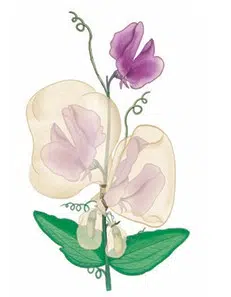
What conclusion can be drawn?
a) Sepals are essential for fruit formation.
b) Pollination is necessary for fruit formation.
c) Fruits form without gametes.
d) The ovary alone forms fruits without pollination.
Answer: b) Pollination is necessary for fruit formation.
Q43. Table shows that wind-pollinated grasses release 500,000–1,000,000 pollen grains per flower but form only 50–200 seeds, while insect-pollinated plants release 20,000–40,000 pollen grains and form 800–1,000 seeds.
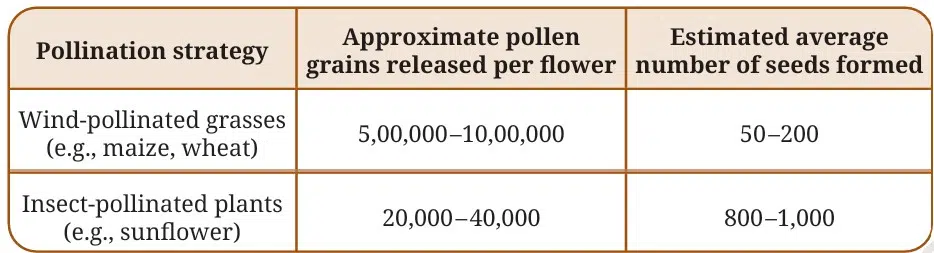
What does this comparison show?
a) Wind pollination is more efficient than insect pollination.
b) Insect pollination is more efficient than wind pollination.
c) Both strategies produce equal efficiency.
d) Wind pollination produces no seeds.
Answer: b) Insect pollination is more efficient than wind pollination.
Q44. Table shows that frogs produce 5,000–50,000 eggs at a time, but survival of young ones is low, while birds produce 1–15 eggs at a time with moderate to high survival.
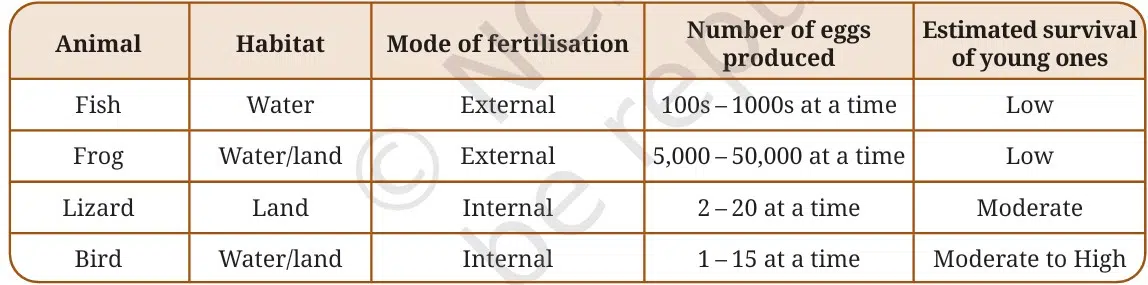
What does this comparison show?
a) External fertilization is more efficient.
b) Internal fertilization increases survival chances.
c) Birds produce fewer eggs due to lack of yolk.
d) Fish and frogs have higher survival rates.
Answer: b) Internal fertilization increases survival chances.
Q45. A scientist observes gametogenesis in humans. He finds millions of tiny motile gametes produced in males, while only a few large non-motile gametes are produced in females.
What conclusion can be drawn?
a) Male gametes are eggs; female gametes are sperm.
b) Male gametes are numerous and motile; female gametes are few and nutrient-rich.
c) Both gametes are identical in size and number.
d) Gametes are produced by mitosis only.
Answer: b) Male gametes are numerous and motile; female gametes are few and nutrient-rich.
Q46. A girl’s menstrual cycle is typically 28 days. Ovulation occurs around Day 14. If fertilization does not occur, menstruation begins around Day 28.
What does this show?
a) Ovulation and menstruation are unrelated.
b) The menstrual cycle prepares the uterus for possible pregnancy.
c) Fertilization always occurs on Day 14.
d) Menstruation occurs only in boys.
Answer: b) The menstrual cycle prepares the uterus for possible pregnancy.
Diagram-Based MCQs
Q47. A couple uses oral contraceptive pills but not condoms. Which risk remains?
a) Pregnancy only
b) STIs like HIV, gonorrhea, and syphilis
c) No risk at all
d) Lack of ovulation
Answer: b) STIs like HIV, gonorrhea, and syphilis
Q48. In Fig. 11.6 (yeast), the small round outgrowths are called:
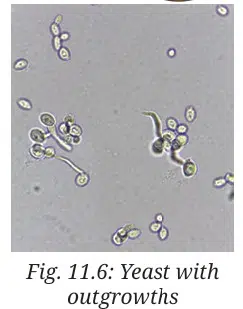
a) Spores
b) Buds
c) Hyphae
d) Nodes
Answer: b) Buds
Q49. In Figure (fungi), the round sac at the tip of hyphae contains _________.
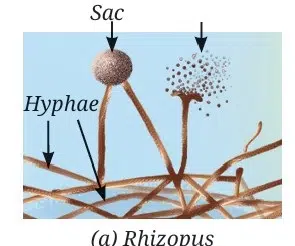
a) Seeds
b) Spores
c) Buds
d) Roots
Answer: b) Spores
Q50. In Figure, the male reproductive part of a flower is __________.
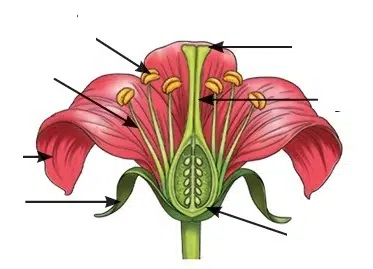
a) Pistil
b) Stamen
c) Sepal
d) Petal
Answer: b) Stamen
Q51. In Fig. 11.11, the ovary contains:
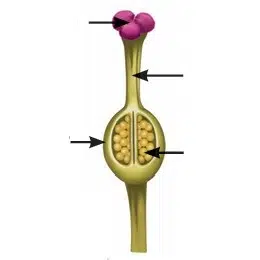
a) Pollen grains
b) Ovules with egg cells
c) Filaments
d) Sepals
Answer: b) Ovules with egg cells
Q52. In Figure, the transfer of pollen from the anther to the stigma of the same flower is:
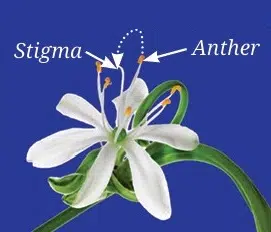
a) Cross-pollination
b) Self-pollination
c) Fertilization
d) Seed dispersal
Answer: b) Self-pollination
Q53. In Figure, the pollen tube grows through the style to reach the:
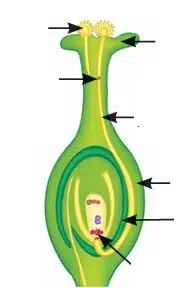
a) Sepals
b) Ovary and ovule
c) Petals
d) Filament
Answer: b) Ovary and ovule
Q54. In Figure (butterfly life cycle), the feeding stage is _________.
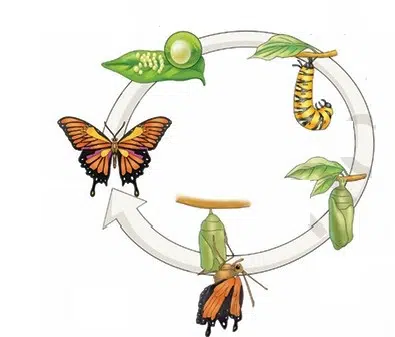
a) Egg
b) Larva
c) Pupa
d) Adult
Answer: b) Larva
Q55. In reptiles and birds, each egg contains:
a) No yolk
b) Enough yolk to nourish the embryo until hatching
c) Larva that feeds on wastes
d) Embryo that develops outside the egg
Answer: b) Enough yolk to nourish the embryo until hatching
Q56. In Figure (male reproductive system), the tube carrying sperm from testes to urethra is the vas deferens.
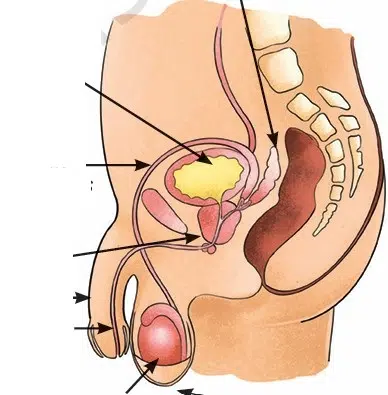
a) Vas deferens
b) Scrotum
c) Seminal vesicle
d) Prostate gland
Answer: a) Vas deferens
Q57. In Fig. 11.19 (female reproductive system), the passage connecting the uterus to the outside is:
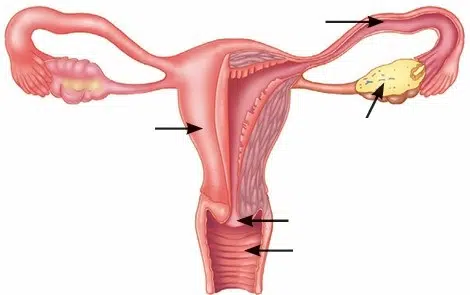
a) Ovary
b) Fallopian tube
c) Cervix and vagina
d) Urethra
Answer: c) Cervix and vagina
Q58. In Figure, fusion of sperm and egg results in _________.
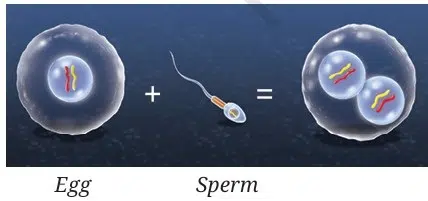
a) Ovulation
b) Zygote formation
c) Menstruation
d) Implantation
Answer: b) Zygote formation
Q59. In Figure, ovulation occurs around:

a) Day 1–8
b) Day 6–10
c) Day 14
d) Day 10
Answer: c) Day 14
Q61. Which part of the female reproductive system is blocked in surgical contraception methods?
a) Ovary
b) Fallopian tubes
c) Cervix
d) Uterus
Answer: b) Fallopian tubes
Disclaimer: The content that is present on our website is based on the NCERT Class 9 Science textbook and is provided for educational purposes only. All the content and images have been taken from Science Class 9 NCERT Textbook and CBSE Support material. Images and content shown above are the property of individual organizations and are used here for reference purposes only. To make it easy to understand, some of the content and images are generated by AI and cross-checked by the teachers.