
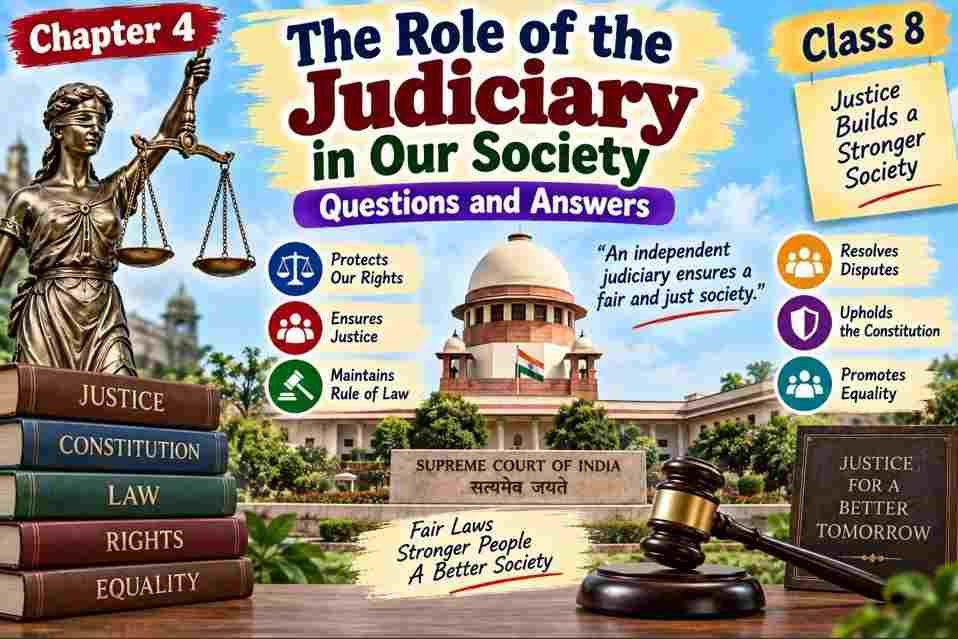
The Role of the Judiciary in Our Society Class 8 MCQ with Answers provides important multiple-choice questions based on the chapter. These questions help students understand the role of the judiciary, courts, justice, fundamental rights, and the importance of an independent judiciary. Students can use these MCQs for revision and exam preparation.
The Role of the Judiciary in Our Society Class 8 MCQ
Conceptual Recall
Q. The Madras High Court (1892) is an example of:
A. Pure Mughal architecture
B. Indo-Saracenic architecture blending Islamic, Hindu, and Gothic styles
C. Gothic European style only
D. Stepwell architecture
Answer: B. Indo-Saracenic architecture blending Islamic, Hindu, and Gothic styles
Q. The Supreme Court of India came into existence on:
A. 15 August 1947
B. 26 January 1950
C. 2 October 1949
D. 1 January 1951
Answer: B. 26 January 1950
Q. The retirement age of a Supreme Court judge in India is:
A. 60 years
B. 62 years
C. 65 years
D. 70 years
Answer: C. 65 years
Q. Under Article 131, the Supreme Court has exclusive original jurisdiction to decide disputes between:
A. Centre and States, or between States
B. Citizens and Parliament
C. President and Governors
D. Lok Sabha and Rajya Sabha
Answer: A. Centre and States, or between States
Q. The retirement age of a High Court judge in India is:
A. 60 years
B. 70 years
C. 65 years
D. 62 years
Answer: D. 62 years
Q. Under Article 226, High Courts exercise:
A. Writ jurisdiction to enforce Fundamental Rights
B. Power to appoint Governors
C. Control over Parliament
D. Power to frame new laws
Answer: A. Writ jurisdiction to enforce Fundamental Rights
Q. District Judges are appointed by:
A. The President directly without consultation
B. The Prime Minister of India
C. The Chief Justice of India alone
D. The Governor of the State in consultation with the High Court
Answer: D. The Governor of the State in consultation with the High Court
Q. Arbitration in India is governed by:
A. Legal Services Authorities Act, 1987
B. Mediation Act, 2023
C. Arbitration and Conciliation Act, 1996
D. Gram Nyayalayas Act, 2008
Answer: C. Arbitration and Conciliation Act, 1996
Q. Which ADR method involves a neutral mediator who helps parties reach a mutual settlement but cannot impose a decision?
A. Arbitration
B. Mediation
C. Lok Adalat
D. Gram Nyayalaya
Answer: B. Mediation
Application-Based
Q. Why is Indo-Saracenic architecture considered distinctive?
A. It combined Islamic domes, Hindu carvings, and Gothic arches into one style
B. It avoided Indian craftsmanship completely
C. It was built only with wood
D. It was used only for temples
Answer: A. It combined Islamic domes, Hindu carvings, and Gothic arches into one style
Q. Why did colonial rulers build monuments like the Victoria Memorial?
A. To replace temples
B. To serve only as forts
C. To store weapons
D. To showcase imperial power and blend Indian and European traditions
Answer: D. To showcase imperial power and blend Indian and European traditions
Q. Why is the Supreme Court called the final interpreter of the Constitution?
A. Because it appoints the President
B. Because it frames new laws
C. Because it gives the last word on constitutional disputes
D. Because it controls the legislature
Answer: C. Because it gives the last word on constitutional disputes
Q. Why was the first PIL filed by Kapila Hingorani important?
A. It demanded reservation for women
B. It secured the release of thousands of under-trial prisoners who had been jailed longer than their possible sentence
C. It opposed the Emergency
D. It sought to abolish zamindari
Answer: B. It secured the release of thousands of under-trial prisoners who had been jailed longer than their possible sentence
Q. Why is the Appellate Jurisdiction of the Supreme Court important?
A. It allows appeals from High Courts and tribunals on constitutional and legal questions
B. It frames new laws directly
C. It appoints Governors of States
D. It controls the Election Commission
Answer: A. It allows appeals from High Courts and tribunals on constitutional and legal questions
Q. Why was the Special Leave Petition (Article 136) introduced?
A. To give the Supreme Court discretionary power to hear appeals from any court or tribunal for substantive justice
B. To allow the President to appoint judges
C. To abolish High Courts
D. To replace writ petitions
Answer: A. To give the Supreme Court discretionary power to hear appeals from any court or tribunal for substantive justice
Q. Why is the supervisory jurisdiction of High Courts (Article 227) important?
A. It abolishes tribunals
B. It allows High Courts to frame new laws
C. It gives High Courts power to appoint Governors
D. It ensures subordinate courts act within their authority and jurisdiction
Answer: D. It ensures subordinate courts act within their authority and jurisdiction
Q. Why was the family’s case against the builder taken to the National Consumer Commission?
A. Because it was a dispute about electricity
B. Because it was a criminal case
C. Because it was a consumer dispute involving breach of agreement
D. Because it was a military matter
Answer: A. Because it was a consumer dispute involving breach of agreement
Q. Why are Lok Adalats called “People’s Courts”?
A. They settle disputes quickly and amicably without formal procedures
B. They are run only by villagers
C. They are used only for criminal cases
D. They are controlled by the Parliament
Answer: A. They settle disputes quickly and amicably without formal procedures
Q. Why were Gram Nyayalayas established under the 2008 Act?
A. To decentralise justice and provide simple, mobile courts at village level
B. To replace High Courts
C. To hear only corporate disputes
D. To abolish Lok Adalats
Answer: A. To decentralise justice and provide simple, mobile courts at village level
Assertion–Reason
Q. Assertion (A): Indo-Saracenic architecture flourished in India during the mid-19th to early 20th century.
Reason (R): It was a colonial style blending Mughal, Rajput, and Gothic elements.
A. Both A and R are true, and R is the correct explanation of A
B. Both A and R are true, but R is not the correct explanation of A
C. A is true, R is false
D. A is false, R is true
Answer: A. Both A and R are true, and R is the correct explanation of A
Q. Assertion (A): The Madras High Court’s facade includes Islamic arches and Hindu-style pillars.
Reason (R): Local artisans contributed to its construction, blending traditions.
A. Both A and R are true, and R is the correct explanation of A
B. Both A and R are true, but R is not the correct explanation of A
C. A is true, R is false
D. A is false, R is true
Answer: A. Both A and R are true, and R is the correct explanation of A
Q. Assertion (A): Judges of the Supreme Court are appointed by the President of India.
Reason (R): Article 124 of the Constitution provides for the establishment and appointment process.
A. Both A and R are true, and R is the correct explanation of A
B. Both A and R are true, but R is not the correct explanation of A
C. A is true, R is false
D. A is false, R is true
Answer: A. Both A and R are true, and R is the correct explanation of A
Q. Assertion (A): Writ jurisdiction allows citizens to enforce Fundamental Rights.
Reason (R): Article 32 gives this right at the national level, while Article 226 gives it at the state level.
A. Both A and R are true, and R is the correct explanation of A
B. Both A and R are true, but R is not the correct explanation of A
C. A is true, R is false
D. A is false, R is true
Answer: A. Both A and R are true, and R is the correct explanation of A
Q. Assertion (A): The President of India can seek the opinion of the Supreme Court on questions of law or public importance.
Reason (R): This is called the Advisory Jurisdiction under Article 143.
A. Both A and R are true, and R is the correct explanation of A
B. Both A and R are true, but R is not the correct explanation of A
C. A is true, R is false
D. A is false, R is true
Answer: A. Both A and R are true, and R is the correct explanation of A
Q. Assertion (A): The law declared by the Supreme Court is binding on all courts in India.
Reason (R): Article 141 ensures uniformity and consistency in judicial decisions.
A. Both A and R are true, and R is the correct explanation of A
B. Both A and R are true, but R is not the correct explanation of A
C. A is true, R is false
D. A is false, R is true
Answer: A. Both A and R are true, and R is the correct explanation of A
Q. Assertion (A): Subordinate Courts are important because they bring the judiciary in close contact with the people.
Reason (R): They include District Courts, Sessions Courts, Revenue Courts, and Small Causes Courts.
A. Both A and R are true, and R is the correct explanation of A
B. Both A and R are true, but R is not the correct explanation of A
C. A is true, R is false
D. A is false, R is true
Answer: A. Both A and R are true, and R is the correct explanation of A
Q. Assertion (A): Digital technology has made the judicial system more transparent.
Reason (R): Litigants can now directly check case details and access judgments online.
A. Both A and R are true, and R is the correct explanation of A
B. Both A and R are true, but R is not the correct explanation of A
C. A is true, R is false
D. A is false, R is true
Answer: A. Both A and R are true, and R is the correct explanation of A
Q. Assertion (A): Arbitration decisions are legally binding and enforceable by courts.
Reason (R): Arbitrators act fairly and impartially, allowing both parties to present their case.
A. Both A and R are true, and R is the correct explanation of A
B. Both A and R are true, but R is not the correct explanation of A
C. A is true, R is false
D. A is false, R is true
Answer: A. Both A and R are true, and R is the correct explanation of A
Q. Assertion (A): Mediation is the most common form of ADR in India.
Reason (R): It is governed by the Mediation Act, 2023.
A. Both A and R are true, and R is the correct explanation of A
B. Both A and R are true, but R is not the correct explanation of A
C. A is true, R is false
D. A is false, R is true
Answer: A. Both A and R are true, and R is the correct explanation of A
Case Study
Q. The Victoria Memorial Hall in Kolkata features domes, arches, balconies, and chhatrīs. It is now a museum showcasing colonial history.
What does this reveal about colonial architecture?
A. It was built only for military use
B. It combined Indian motifs with European design to project authority and aesthetics
C. It avoided decorative elements
D. It was used only for religious purposes
Answer: B. It combined Indian motifs with European design to project authority and aesthetics
Q. In 1997, the Supreme Court in Vishaka v. State of Rajasthan laid down guidelines against sexual harassment at the workplace. Later, in 2013, the government enacted a law based on these guidelines.
What does this case show about the role of the judiciary?
A. It only punishes criminals
B. It can lay down guidelines that influence future legislation
C. It avoids involvement in social issues
D. It works only during emergencies
Answer: B. It can lay down guidelines that influence future legislation
Q. The Gauhati High Court covers Assam, Nagaland, Mizoram, and Arunachal Pradesh. This shows that one High Court can serve multiple states or Union Territories.
What does this arrangement highlight?
A. Flexibility in judicial structure to serve multiple regions efficiently
B. Each state must have its own High Court
C. High Courts are only for Union Territories
D. Judges are appointed by Governors only
Answer: A. Flexibility in judicial structure to serve multiple regions efficiently
Q7. Courts have introduced e-filing, hybrid hearings, live streaming, and translation of judgments. In 2024–25, the Supreme Court installed a “Virtual Justice Clock” at its entrance to display real-time judicial data.
What does this initiative show?
A. Courts are committed to transparency and accountability using digital technology
B. Courts are avoiding public access to data
C. Courts are limiting hearings to physical presence only
D. Courts are abolishing subordinate courts
Answer: A. Courts are committed to transparency and accountability using digital technology
Q7. A dispute between two neighbours over land boundaries was referred to a Lok Adalat. Both parties agreed to a compromise, saving time and avoiding lengthy court procedures.
What does this example show about Lok Adalats?
A. They promote amicable settlement and reduce judicial backlog
B. They impose strict punishments
C. They are used only for corporate disputes
D. They replace the Supreme Court
Answer: A. They promote amicable settlement and reduce judicial backlog
Diagram/Visual-Based
Q. A writ petition can be filed under:
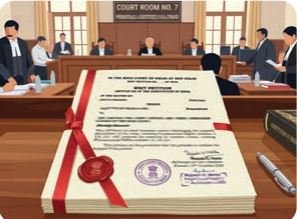
A. Article 32 and Article 226
B. Article 370 and Article 371
C. Article 356 and Article 360
D. Article 14 and Article 15
Answer: A. Article 32 and Article 226
Q. The logo of the Supreme Court of India carries the Sanskrit motto:
A. “Satyameva Jayate”
B. “Yato Dharmastato Jayah” (Where there is dharma, there is victory)
C. “Sarve Bhavantu Sukhinah”
D. “Vasudhaiva Kutumbakam”
Answer: B. “Yato Dharmastato Jayah” (Where there is dharma, there is victory)
Q. The current strength of the Supreme Court is:
A. 25 judges including the Chief Justice
B. 34 judges including the Chief Justice
C. 40 judges including the Chief Justice
D. 20 judges including the Chief Justice
Answer: B. 34 judges including the Chief Justice
Q. The Supreme Court’s power under Article 142 allows it to:
A. Pass any order necessary for complete justice
B. Frame new laws directly
C. Appoint Governors
D. Control elections
Answer: A. Pass any order necessary for complete justice
Q. According to Article 214, every State must have:
A. A Tribunal
B. A District Court
C. A Lok Adalat
D. A High Court
Answer: D. A High Court
Q. Judges of the High Court are appointed by the President in consultation with:
A. Election Commission
B. Prime Minister only
C. Lok Sabha Speaker
D. Chief Justice of India, Governor of the State, and Chief Justice of the concerned High Court
Answer: D. Chief Justice of India, Governor of the State, and Chief Justice of the concerned High Court
Q. The National Green Tribunal (NGT) deals with:
A. Environmental issues
B. Consumer disputes
C. Electricity disputes
D. Armed Forces disputes
Answer: A. Environmental issues
Q. The National Judicial Data Grid provides:
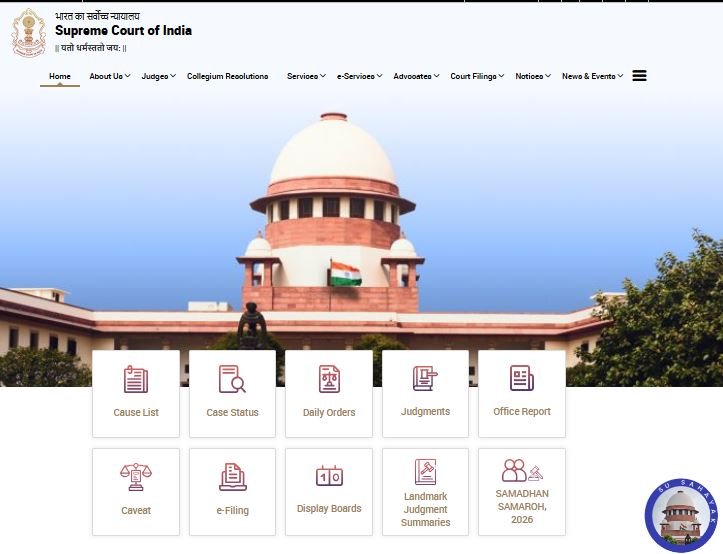
A. Online access to case details and judgments
B. Appointment of judges
C. Election results
D. Police records
Answer: A. Online access to case details and judgments
Q. Which new law replaced the Indian Penal Code, 1860?
A. Bharatiya Sakshya Adhiniyam, 2023
B. Bharatiya Nagarik Suraksha Sanhita, 2023
C. Bharatiya Nyaya Sanhita, 2023
D. Criminal Procedure Code, 1973
Answer: C. Bharatiya Nyaya Sanhita, 2023
Q. The Legal Services Authorities Act, 1987 gives statutory recognition to:
A. Gram Nyayalayas
B. Lok Adalats
C. Arbitration panels
D. Consumer Commissions
Answer: B. Lok Adalats
Q. The Gram Nyayalayas Act, 2008 established:
A. Mobile village-level courts with simplified procedures
B. Corporate tribunals
C. High Courts in every district
D. Arbitration centres only in cities
Answer: A. Mobile village-level courts with simplified procedures
Q. Which ADR method is most suitable when parties want a final binding decision enforceable by law?
A. Gram Nyayalaya
B. Mediation
C. Lok Adalat
D. Arbitration
Answer: D. Arbitration
Disclaimer: The content that is present on our website is based on the NCERT Class 8 Social Science textbook and is provided for educational purposes only. All the content and images have been taken from Socail Science Class 8 NCERT Textbook. Images and content shown above are the property of individual organizations and are used here for reference purposes only. To make it easy to understand, some of the content and images are generated by AI and cross-checked by the teachers.