
Political parties are one of the most important institutions in a democracy. A political party is a group of people who come together to contest elections, hold power in the government, and work to implement policies based on their ideologies.
Political Parties Class 10 MCQ
1. Which of the following is the main factor that led to the rise of multiple political parties at the same level in India?
a. A federal political system
b. Varied economic conditions.
c. Linguistic and regional diversity
d. Low levels of literacy and political awareness
2. Choose the right option to fill in the blank.
The emergence of is directly connected to the rise of political parties.
a. Monitory democracies
b. Direct democracies
c. Representative democracies
d. Constitutional democracies
3. Which of the following statements Is correct keeping the requirement of formation of government in view.
- Statement i: It is possible for independent candidates to form a government.
- Statement ii: Government formation is exclusively reserved for political parties.
- Statement iii: The formation of government is limited to only elected political parties.
- Statement iv: Government can only be formed by political parties that are elected and hold a majority.
a. Statement i and ii are right.
b. Statement i, ii and iii are right.
c. Statement iii is right.
d. Only statement iv is right.
4. There are two statements marked as Assertion (A) and Reason (R). Mark your answer as per the codes provided below:
Assertion (A): India is a country with a multi-party system set up.
Reason (R): The multi-party system often appears very messy and leads to political instability.
a. Both (A) and (R) are true and (R) is the correct explanation of (A)
b. Both (A) and (R) are true but (R) is not the correct explanation of (A)
c. (A) is correct but (R) is wrong
d. (A) is wrong but (R) is correct
5. Which of the following are the main components of a political party? Choose the correct option:
- I. Leaders
- II. Active members
- III. Followers
- IV. Pressure groups
(A) Only I, II and III are correct.
(B) Only II, III and IV are correct.
(C) Only I, III and IV are correct.
(D) Only I, II and IV are correct.
6. Which one of the following pairs is correctly matched?
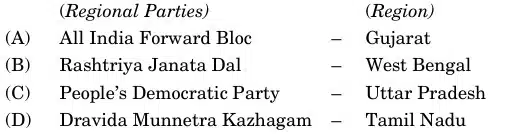
7. Which one of the following countries has two-party system?
(a) China
(b) United Kingdom
(c) India
(d) Pakistan
8. Which one of the following orders has been passed by the Supreme Court to reform political parties in India?
(A) It is mandatory for all parties to hold organizational elections.
(B) It is mandatory for all parties to file income tax returns.
(C) It is mandatory for all the candidates to give details of criminal cases on affidavit.
(D) Issuing orders to regulate the internal working of parties.
9. In which one of the following options are political parties a necessary condition?
(a) Democracy
(b) Authoritarian
(c) Dictatorship
(d) Despotism
10. Which of the following States is ruled by a regional party?
(a) Haryana
(b) Madhya Pradesh
(c) Odisha
(d) Rajasthan
11. Which one of the following countries adopted multi-party system?
(a) USA
(b) India
(c) China
(d) United Kingdom
12. Which of the following best describes a political party?
a. A group of people who come together to contest elections and hold power in government
b. The people who only criticize the government
c. A people who make laws without elections
d. None of the above
Explanation: A political party is an organized group that holds power and promotes collective good through policies and programs.
13. Which of the following is not considered a function of political parties?
a. Contesting elections
b. Forming and running governments
c. Shaping public opinion
d. Conducting the Census
Explanation: The census is not a part of political parties; the political parties mainly contest elections, form governments, and shape opinions.
14. Which of the following is considered a component of a political party?
a. Leaders, active members, and followers
b. Only leaders and voters
c. Only ministers and bureaucrats
d. None of the above
Explanation: Political parties are made up of leaders, active members, and followers.
15. Which country has a one-party system?
a. India
b. United States
c. China
d. None of the above
Explanation: China allows only the Communist Party to rule, making it a one-party system.
16. Which of the following is an example of a two-party system?
a. India
b. Sri Lanka
c. Nepal
d. United States
Explanation: The United States and the United Kingdom have a two-party system, where power alternates between these two main parties.
17. India has which type of party system?
a. One-party system
b. Two-party system
c. Multi-party system
d. None of the above
Explanation: India has a multi-party system due to its social and geographical diversity, where coalition governments are common.
18. What is the role of opposition parties?
a. Contest elections and form governments
b. Voice different views and criticize government policies.
c. Select candidates for the ruling party
d. None of the above
Explanation: Opposition parties play a crucial role in democracy by criticizing government policies and mobilizing opposition.
19. Why are political parties necessary for democracy?
a. Political parties divide society.
b. The party only represents one community.
c. They perform essential functions like contesting elections, forming governments, and shaping opinion.
d. None of the above
Explanation: Political parties are essential to democracy because they perform functions that sustain representative democracy.
20. What is the minimum criterion for a party to be recognized as a state party?
a. 6% of total votes in Lok Sabha elections and 4 seats
b. 6% of total votes in Assembly elections and at least 2 seats
c. 10% of total votes in Assembly elections and 5 seats
d. None of the above
Explanation: A party is considered a state party if it wins at least 6% of the votes and 2 seats in the assembly elections.
21. Who is guiding the philosophy of the Bharatiya Janata Party (BJP)?
a. Bahujan Samaj
b. Revolutionary democracy
c. Integral humanism
d. None of the above
Explanation: The BJP draws inspiration from Deendayal Upadhyay’s integral humanism and cultural nationalism.
22. Who is the founder of Bahujan Samaj Party (BSP)?
a. Kanshi Ram
b. Sahu Maharaj
c. b. R. Ambedkar
d. Jotiba Phule
Explanation: BSP was founded by Kanshi Ram in 1984, which represents Dalits, tribals, backward classes, and minorities.
23. Which national party was formed in 1964 and believes in Marxism-Leninism?
a. Indian National Congress
b. Communist Party of India – Marxist (CPI-M)
c. Bharatiya Janata Party
d. None of the above
Explanation: CPI-M, founded in 1964, stands for socialism and secularism and opposes imperialism and communalism.
24. Which of the following is considered the oldest political party in India?
a. Bharatiya Janata Party
b. Bahujan Samaj Party
c. Indian National Congress
d. National People’s Party
Explanation: The Indian National Congress was founded in 1885 and played a dominant role in Indian politics after independence.
25. Which is the first party from Northeast India to become a national party?
a. National People’s Party (NPP)
b. CPI-M
c. Aam Aadmi Party
d. None of the above
Explanation: NPP was established in 2013 by P.a. Sangma, and it became the first national party from the Northeast.
26. Which reform was implemented to prevent defection among elected representatives?
a. Equal Remuneration Act
b. Right to Information Act
c. Anti-Defection Law
d. None of the above
Explanation: In the Constitution a provision was made to stop defection due to the membership getting terminated on changing parties.
27. What is the main challenge facing political parties in India?
a. Lack of internal democracy
b. Too much ideological difference
c. Excessive women’s representation
d. None of the above
Explanation: Power in parties is often concentrated in the hands of a few leaders; there is a lack of transparency, and regular internal elections are not held.
Disclaimer: We have provide you with the accurate handout of “Political Parties Class 10 MCQ“. If you feel that there is any error or mistake, please contact me at anuraganand2017@gmail.com. The above CBSE study material present on our websites is for education purpose, not our copyrights.
All the above content and Screenshot are taken from Social Science Code 087 Class 10 NCERT Textbook, CBSE Sample Paper, CBSE Old Sample Paper, CBSE Board Paper and CBSE Support Material which is present in CBSEACADEMIC website, NCERT website This Textbook and Support Material are legally copyright by Central Board of Secondary Education or NCERT. We are only providing a medium and helping the students to improve the performances in the examination.
Images and content shown above are the property of individual organisations and are used here for reference purposes only. To make it easy to understand, some of the content and images are generated by AI and cross-checked by the teachers. For more information, refer to the official CBSE textbooks available at cbseacademic.nic.in.