
← Back to Class 9 Science Notes
Understanding How Forces Affect Motion Class 9 Notes is essential for learning the basic principles of physics. Force is a push or pull that can change the speed, direction, or state of motion of an object. This chapter explains the relationship between force and motion through concepts such as balanced and unbalanced forces, friction, inertia, and Newton’s Laws of Motion.
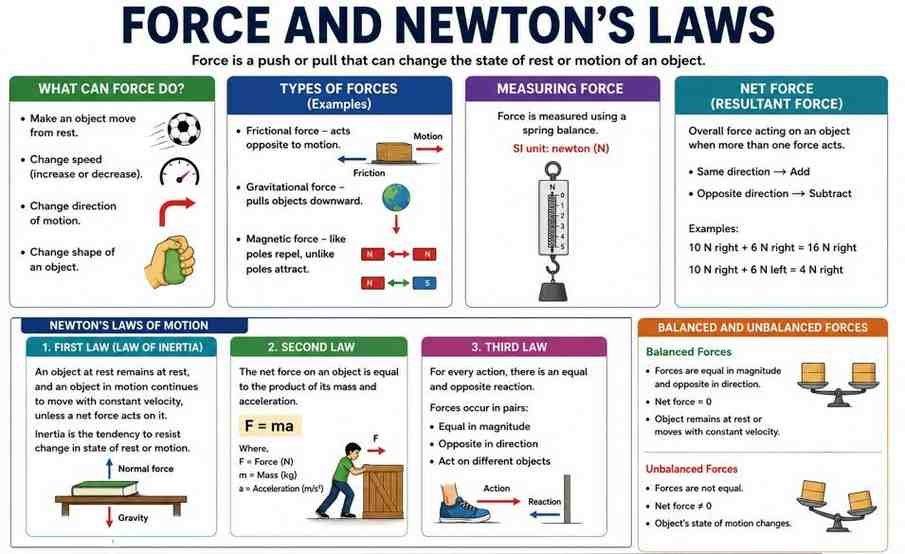
How Forces Affect Motion Class 9 Notes
The Concept of Force
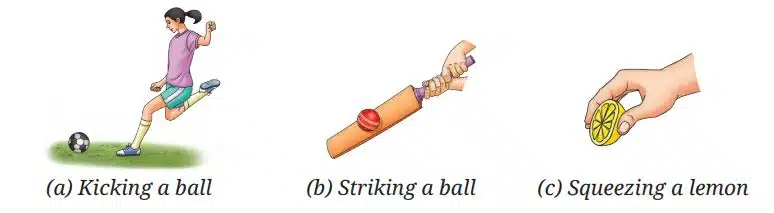
Force is a push or pull that can change the state of rest or motion of an object. It can make an object move, stop, change direction, or even change its shape. For example, a ball moves when you kick it, a cricket bat changes the direction of the ball and a lemon changes shape when you squeeze it.
What Can Force Do?
- Make an object move from rest.
- Change speed (increase or decrease)
- Change the direction of motion.
- Change the shape of an object.
Force Has Direction.
Force is not just about strength; it also has a direction. That’s why force is called a vector quantity. Example of direction:
- Friction acts opposite to motion.
- Magnetic force: like poles repel, and unlike poles attract.
- Gravitational force by Earth pulls objects downward.
- Buoyant force acts upward in liquids.
The SI unit of force is newton (named after Sir Isaac Newton) and its symbol is N. The magnitude of the force expresses its strength.
Measuring the magnitude of a force
The magnitude of a force tells us how strong a force is. To measure force, we use a device called a spring balance. A spring balance is an instrument used to measure the force or weight of an object.
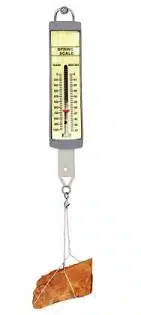
- It has a spring inside.
- When a force is applied, the spring stretches.
- The amount of stretch shows the magnitude of force.
Net Force (Resultant Force)
When more than one force acts on an object, the overall force acting on the object is called the net force or resultant force.
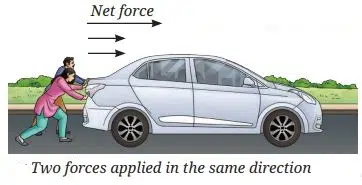
- If forces act in the same direction, they are added.
- If forces act in opposite directions, they are subtracted.
Example:
- 10 N right and 6 N right = 16 N right
- 10 N right and 6 N left = 4 N right
Balanced and Unbalanced Forces
In real life, usually, there is more than one force acting on an object. The effect of these forces depends on whether they are balanced or unbalanced.
1. Balanced Forces
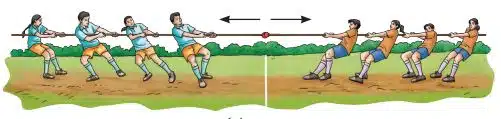
Balanced forces are forces that are equal in magnitude but opposite in direction. As a result, they cancel each other; the object does not move or remains in the same state. For example, In a tug of war, if both teams pull with equal force, the rope remains stationary because the forces are balanced. A book lying on a table: the gravity is downward, and the normal force is upward.
2. Unbalanced Force
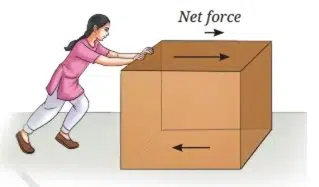
Unbalanced forces occur when forces are not equal. As a result, the net force acts on the object, and the object’s state changes: moving, stopping, or changing direction. For example, in a tug of war, if one team pulls harder, the rope moves towards that team. Pushing a box and it starts moving.
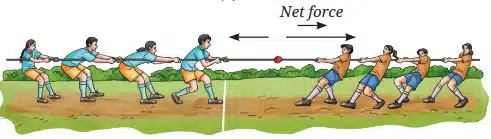
Example: Two forces of 10 N and 6 N are acting on a block lying on the table as shown in Fig. What is the magnitude and the direction of the net force acting on the block in each case?

Answer:
- (a) Net force = 10 N + 6 N = 16 N, acting towards the right side.
- (b) Net force = 10 N – 6 N = 4 N, acting towards the right side.
- (c) Net force = 10 N – 6 N = 4 N, acting towards the left side.
The Force of Friction: Often Overlooked but Always Present
Friction is a force that opposes the motion of an object when it comes in contact with another surface. It acts in the opposite direction to the movement of an object. When you push the object, then it may not move easily because of the friction; the object starts moving only when the applied force is greater than the frictional force.
- When an object is at rest, the forces are balanced.
- A car moving at constant speed has balanced forces.
- After motion starts, the friction slows it down.
The force of friction depends on the nature of surfaces.
| Surface Type | Friction |
|---|---|
| Rough (wood, cement) | High friction |
| Smooth (glass, marble) | Low friction |
1. Newton’s First Law of Motion
Inertia is the tendency of an object to stay at rest or keep moving in the same way unless an external force changes it.
Examples:
- Passengers move backward when a bus suddenly starts.
- Passengers move forward when a bus suddenly stops.
- Dust comes out when a carpet is beaten.
Newton’s First Law is also called the Law of Inertia.
Newton’s first law of motion, an object at rest remains at rest, and an object in motion continues to move with a constant velocity, unless a net force acts upon the object.
Newton’s first law of motion describes the motion of objects in the absence of a net force. It is natural to ask what happens to the motion of an object when there is a net force acting upon it. Newton’s second law of motion addresses this issue.
For example, if you are pushing one object on the floor, you push the object forward with a 10 N force, and the friction acts backward with a 10 N force. As a result, the net force = 10 N – 10 N = 0, meaning the object will be balanced and the net force will be 0, meaning the object will remain at rest.
2. Newton’s Second Law of Motion
Newton’s Second Law of Motion explains how force affects the motion of an object. Newton’s second law of motion is considered to be a fundamental law of nature. Many events around us can be explained on the basis of Newton’s second law of motion.
According to Newton’s Second Law:
F=ma
Where:
- F = Force (N)
- m = Mass (kg)
- a = Acceleration (m/s²)
For example, if you push an empty cart, then it moves easily, but when the cart is full of items, then it is harder to push. Reason: more mass, then less acceleration for the same force.
Example: A weightlifter is holding a barbell with a mass of 10 kg fixed on each side of the bar (Fig. 6.8). The mass of the bar itself is 10 kg. How much force is she applying to keep the barbell steady?
Answer: The total mass of the barbell is 30 kg. The gravitational force, due to the Earth, acting on the barbell in the downward direction is:
F = mg = 30 kg × 9.8 m/s² = 294 N
To keep the barbell steady, the weightlifter has to apply an equal force in the opposite direction. So, she is applying 294 N in the upward direction.
Mass vs Weight
| Mass | Weight |
|---|---|
| Amount of matter in an object | Force of gravity acting on an object |
| Measured in kg | Measured in N |
| Constant everywhere | Changes with gravity |
3. Newton’s Third Law of Motion
Whenever one object applies a force on another object, the second object simultaneously applies an equal and opposite force on the first object. This means that whenever you push or pull something, it pushes or pulls you back with an equal force in the opposite direction.
- Forces always occur in pairs.
- The two forces are equal in magnitude.
- They act in opposite directions.
- They act on different objects (so they do NOT cancel each other).
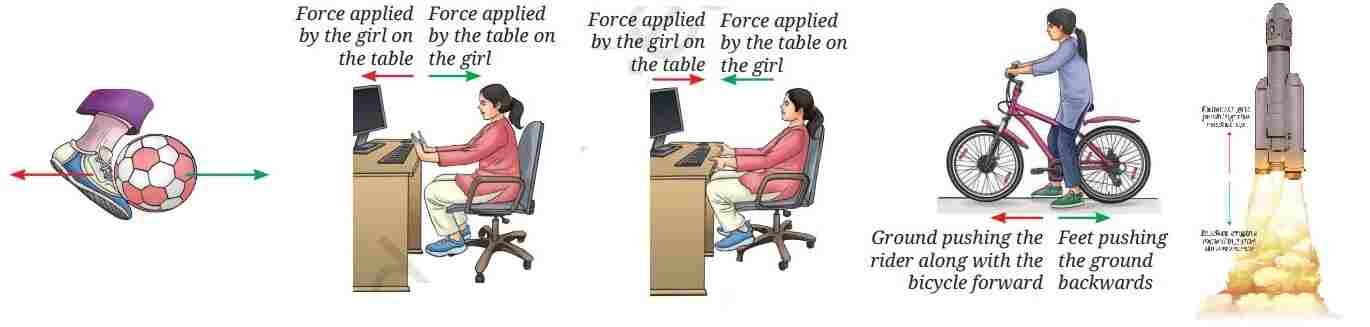
Example of Newton’s Third Law of Motion
- Pushing a wall: you push the wall, and the wall pushes you back.
- Walking: your foot pushes the ground backward, and the ground pushes you forward.
- Swimming: hands push water backward; water pushes the swimmer forward.
- Canoe movement: a paddle pushes water back, and water pushes the canoe forward.
- Ball kick: the foot pushes the ball, and the ball pushes the foot back.
Forces Acting on a System of Objects
Until now, you studied Newton’s Laws for a single object. But in real life, many objects are connected and move together. So how do we deal with them? Example,
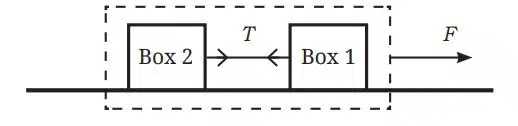
Two boxes on a smooth floor (no friction).
- Box 1 has mass 𝑚1
- Box 2 has mass 𝑚2
- A string connects them.
- A force 𝐹 pulls Box 1 to the right.
Example with number
Suppose:
- m1 = 2 kg
- m2 = 3 kg
- F = 25 N
- Total mass = 2 + 3 = 5 kg
- Acceleration = 25/5 = 5 m/s2
- Tension = m2 x a = 3×5 = 15 N
So:
- Both boxes accelerate at 5 m/s2
- The string pulls with a tension of 15 N.
Disclaimer: The content that is present on our website is based on the NCERT Class 9 Science textbook and is provided for educational purposes only. All the content and images have been taken from Science Class 9 NCERT Textbook and CBSE Support material. Images and content shown above are the property of individual organizations and are used here for reference purposes only. To make it easy to understand, some of the content and images are generated by AI and cross-checked by the teachers.
Very clearly explained
great explanation, very useful and advantageous for 9th graders
Very much welcome effort