
Prepare Natural Resources and Their Use Class 8 Notes with easy explanations, short summaries, key definitions, important points, and exam-oriented questions. These notes cover nature, resources, renewable and non-renewable resources, distribution of natural resources, stewardship, sustainable use, groundwater conservation, organic farming, and the natural resource curse in simple language.
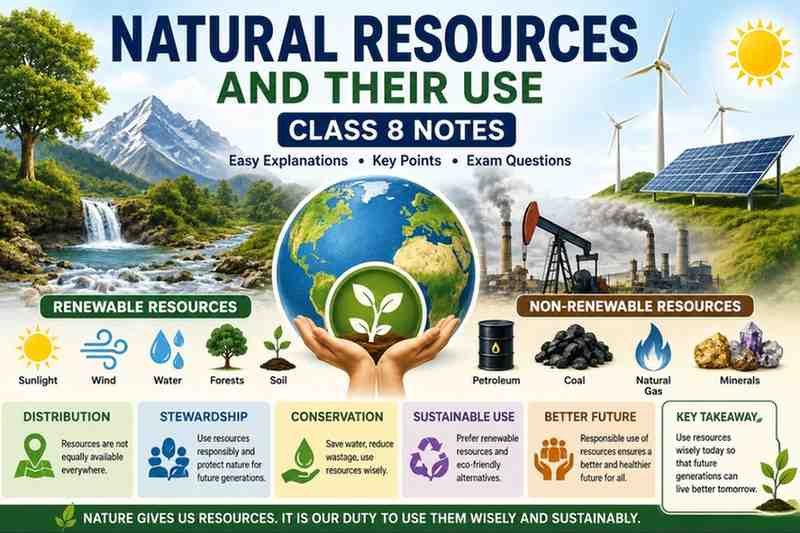
Natural Resources and Their Use Class 8 Notes
When does nature become a resource?
Nature is everything around us that is not made by humans. It includes all living and non-living things found on Earth like trees, rivers, air, soil, mountains, and animals. Nature exists on its own, but when humans use it for living or making new things, it becomes a resource. For example, a tree standing in the forest is nature, but cutting the tree and making furniture become a resource.
Definition:
- Nature: Nature is everything around us that is not made by humans, such as plants, animals, air, water, mountains, and rivers.
- Resource: A resource is anything that is useful to us and helps us meet our needs.
When does nature become a resource?
Nature becomes a resource only when people have the technology, money, and permission from society to use it. There are three basic conditions where nature becomes the resource.
- Technology access: We need the right tools and machines to use natural things. For example, petroleum is found in the deep sea and can only be taken out using drilling machines.
- Money (Cost): It should not be too expensive to get or use the resource. For example, if the gold cost is more than its value, then it may not be used.
- Culture (Society’s Beliefs and Rules): People’s beliefs, traditions, and laws decide whether a natural thing can be used or not. For example, a sacred tree in a village may not be cut because people respect it.
Categories of Natural Resources
We divide natural resources into groups so we can easily understand them; this method is called categorization. There are three main categories.
- Resources essential for life
- Resources for materials
- Resources for energy
1. Resources essential for life
Life on Earth is possible because of air, water, and food. We cannot make this because it is a gift of nature.
- We breathe air from the atmosphere.
- We drink water from rivers and ponds.
- We grow food in soil or get it from other living things.
2. Resources for Materials
Humans use natural things to make useful or beautiful things, like how a piece of wood can become a chair or a statue. India has many resources like marble, coal, gold, and more.
3. Resources for Energy
Energy is important for modern life; many of the factories, transport, electricity, or day-to-day life things depend on energy like coal, petroleum, natural gas, solar, wind, water, etc.
Renewable and non-renewable resources
A second way of categorizing natural resources could be based on whether they are renewable or not.
1. Renewable Resources
Renewable resources are natural resources that can be restored or regenerated by nature after they are used. Nature has the ability to replace these resources over time if they are used. For example,
- A forest grows back after trees are cut or after a fire.
- Sunlight is available every day.
- Wind keeps blowing naturally.
- Water is renewed through the water cycle.
- Crops can be grown again every season.
Key Points on Renewable Resources
- Nature can replace renewable resources.
- We must use them wisely and sustainably.
- Human activities like cutting forests, burning fossil fuels, and polluting rivers disturb nature’s balance.
- Protecting nature helps renewable resources last for future generations.
2. Non-Renewable Resources
Non-renewable resources are natural resources that are available in limited amounts and cannot be replaced quickly after they are used. For example,
- Petroleum (crude oil)
- Coal
- Natural gas
- Minerals (iron, copper, gold)
Key Points
- They are available in limited amounts.
- Once used, they cannot be replaced in a short time.
- India has large coal reserves, but they may last for only about 50 years if used continuously.
- As the population grows, the demand for electricity also increases.
Therefore, we should use non-renewable resources carefully and find better renewable alternatives.
Distribution of Natural Resources and Its Implications
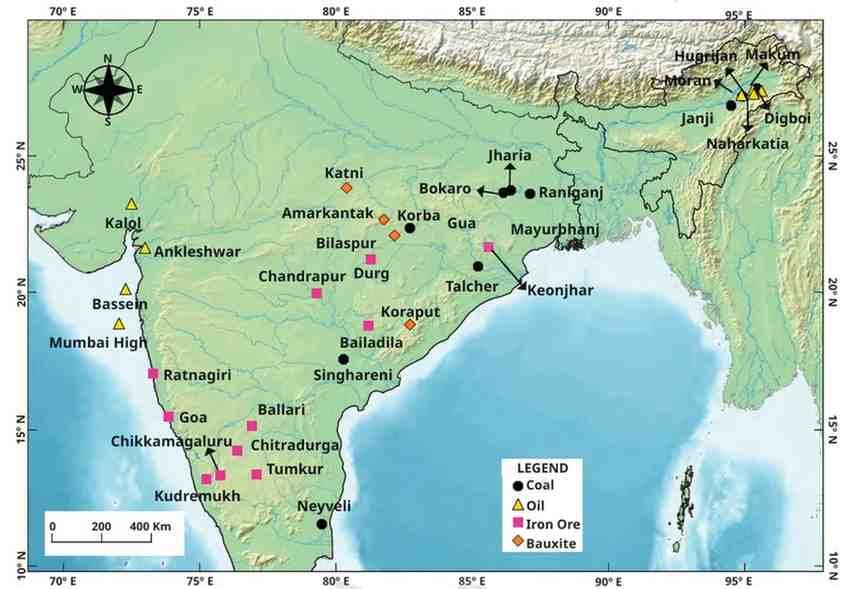
Natural resources are not equally available everywhere. Some places have more water, forest, minerals, or oil than others. Industries near natural resources can create jobs and help to grow the township and improve people’s lives.
Trade between the states and countries depends on where the natural resources are found. Nature does not follow the border of states or countries. Rivers and forests are shared by different states or countries. For example, the Kaveri River is shared by Karnataka, Tamil Nadu, Kerala, and Puducherry. These states must work together and share the water fairly to avoid conflicts.
The ‘Natural Resource Curse’
If a country has many natural resources, it does not mean that the country will be rich. This is called the Natural Resource Curse or Paradox of Plenty.
Some countries cannot use their resources to make valuable products, so these countries do not develop economically. India has mostly avoided this problem by developing industries that use natural resources.
To get long-term benefits, resources must be used wisely, managed properly, and protected for the future.
Responsible and Wise Use of Natural Resources: Stewardship
We should use natural resources carefully to protect nature and save them for future generations. Renewable resources should be allowed to regenerate, and non-renewable resources should be used wisely.
Irresponsible use of natural resources causes pollution, loss of biodiversity, and climate change.
Restoration and regeneration of renewable resources
Overuse of groundwater in farming leads to water shortages. We have to save water by rainwater harvesting, reusing water, and avoiding wastage.
The excessive use of chemical fertilizers and pesticides can damage the soil fertility. Instead of chemical fertilizers, farmers have to use traditional farming methods like natural fertilizers and cow dung, which helps to keep the soil healthy.
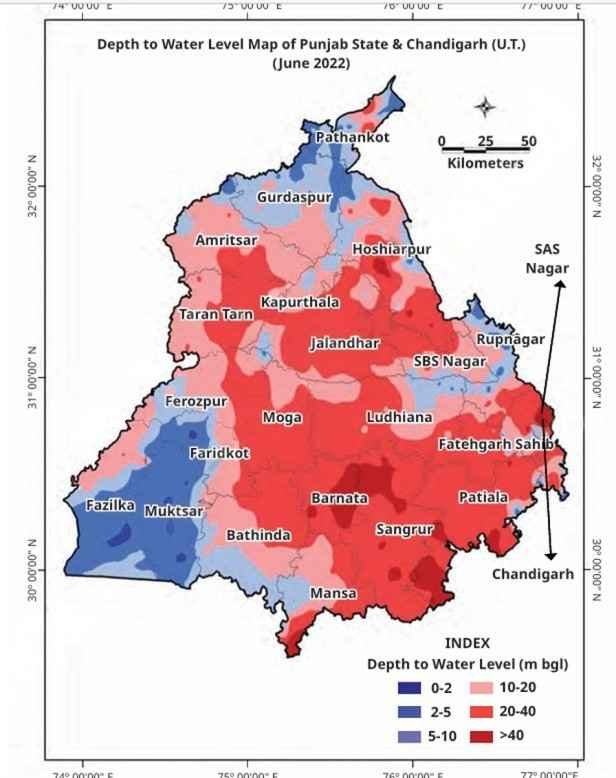
Overexploitation of groundwater: a caselet from Punjab.
Punjab has an important role in the Green Revolution. The farmers used too much groundwater, chemical fertilizers, and pesticides. As a result:
- Groundwater levels fell very low.
- Chemicals polluted the groundwater and caused health problems.
- About 80% of Punjab is now overexploited, meaning more groundwater is used than nature can replace.
The case of cement
Cement is very important for building houses, roads, bridges, and schools, but cement production causes air, soil, and water pollution.
To reduce pollution, we should use eco-friendly materials like mud, stone, recycled materials, and plant-based materials.
Vrikshayurveda is an ancient Indian system that teaches how natural and sustainable farming can help to protect soil, plants, and water.
A caselet from Sikkim.
In Sikkim, farmers used organic farming methods. At first, crop yields were very low, but after a few years, the soil became healthy, and farmers earned more money.
In 2016, Sikkim became India’s first 100% organic state. Organic farming improved soil, biodiversity, tourism, and farmers’ livelihoods.
Responsible and judicious use of resources
The non-renewable resources should be used carefully so we can save for future generations also. Instead of non-renewable resources, we should use more renewable energy like solar and wind power.
Everyone has a right to access the basic resources like clean water and clean air.
We have to protect nature and use resources responsibly for the benefit of present and future generations.
Disclaimer: The content that is present on our website is based on the NCERT Class 8 Social Science textbook and is provided for educational purposes only. All the content and images have been taken from Social Science Class 8 NCERT Textbook. Images and content shown above are the property of individual organizations and are used here for reference purposes only. To make it easy to understand, some of the content and images are generated by AI and cross-checked by the teachers.