
Atomic Foundations of Matter Class 9 with these competency-based MCQs designed according to the latest CBSE Class 9 Science syllabus. These multiple-choice questions cover important concepts such as atoms, molecules, laws of chemical combination, atomic mass, molecular mass, mole concept, and chemical formulae. Practising these MCQs will help improve conceptual understanding, critical thinking, and exam preparation.
Atomic Foundations of Matter Class 9 MCQ
Conceptual Recall MCQs
Q1. The number of protons in the nucleus of an atom is called:
(a) Mass number
(b) Atomic number
(c) Nucleon number
(d) Neutron number
Answer: (b) Atomic number
Q2. The law that states that “mass remains unchanged during physical and chemical changes” is:
(a) Law of Constant Proportion
(b) Law of Conservation of Mass
(c) Law of Multiple Proportion
(d) Dalton’s Law
Answer: (b) Law of Conservation of Mass
Q3. Ionic compounds generally have:
(a) Low melting points
(b) High melting and boiling points
(c) No definite melting points
(d) Variable melting points
Answer: (b) High melting and boiling points
Q4. Covalent compounds like camphor and naphthalene are:
(a) Soluble in water
(b) Insoluble in water but soluble in kerosene and petrol
(c) Conduct electricity in water
(d) Always crystalline solids
Answer: (b) Insoluble in water but soluble in kerosene and petrol
Q5. In writing chemical formulae, the symbol of which ion is written first?
(a) Anion
(b) Cation
(c) Polyatomic ion
(d) Neutral atom
Answer: (b) Cation
Q6. In covalent compounds, valencies are crossed over and written as:
(a) Superscripts
(b) Subscripts
(c) Charges
(d) Prefixes
Answer: (b) Subscripts
Q7. When sodium loses one electron, it forms:
(a) Sodium atom
(b) Sodium cation (Na⁺)
(c) Sodium anion (Na⁻)
(d) Sodium molecule
Answer: (b) Sodium cation (Na⁺)
Q8. The electrostatic force of attraction between oppositely charged ions is called:
(a) Covalent bond
(b) Ionic bond
(c) Metallic bond
(d) Hydrogen bond
Answer: (b) Ionic bond
Q9. Which of the following elements among the first 18 tends to donate electrons (valence < 4)?
(a) Sodium, Magnesium, Aluminum, Potassium
(b) Oxygen, Fluorine, Neon, Chlorine
(c) Carbon, Nitrogen, Sulfur, Phosphorus
(d) Argon, Helium, Neon, Hydrogen
Answer: (a) Sodium, Magnesium, Aluminum, Potassium
Q10. A molecule is defined as ________.
(a) A charged particle with one atom
(b) An electrically neutral entity consisting of more than one atom
(c) A group of ions with charge
(d) A nucleus with electrons
Answer: (b) An electrically neutral entity consisting of more than one atom
Q11. The force that holds atoms together in a molecule is called:
(a) Nuclear force
(b) Chemical bond
(c) Gravitational force
(d) Electrostatic force
Answer: (b) Chemical bond
Q12. Dalton proposed his atomic theory in the year:
(a) 1789
(b) 1808
(c) 1793
(d) 1932
Answer: (b) 1808
Q13. According to Dalton’s atomic theory, atoms of a given element are ________.
(a) Identical in mass and chemical properties
(b) Different in mass but same in properties
(c) Identical in size but different in mass
(d) Always divisible
Answer: (a) Identical in mass and chemical properties
Q14. Dalton’s atomic theory states that atoms combine in:
(a) Random ratios
(b) Simple whole number ratios
(c) Fractional ratios
(d) Variable ratios
Answer: (b) Simple whole number ratios
Q15. The Law of Constant Proportions was proposed by:
(a) Antoine Lavoisier
(b) Joseph Proust
(c) John Dalton
(d) James Chadwick
Answer: (b) Joseph Proust
Q16. In water, hydrogen and oxygen always combine in the mass ratio:
(a) 1:1
(b) 1:2
(c) 1:8
(d) 2:8
Answer: (c) 1:8
Q17. The Law of Conservation of Mass was proposed by:
(a) John Dalton
(b) Antoine Lavoisier
(c) Joseph Proust
(d) James Chadwick
Answer: (b) Antoine Lavoisier
Q18. According to the Law of Conservation of Mass:
(a) Matter can be created but not destroyed.
(b) Matter can be destroyed but not created.
(c) Matter can neither be created nor destroyed in a chemical reaction.
(d) Matter changes randomly during reactions.
Answer: (c) Matter can neither be created nor destroyed in a chemical reaction.
Application-Based MCQs
Q19. When salt dissolves in water, the mass of the solution is equal to:
(a) Mass of water only
(b) Mass of salt only
(c) Sum of masses of water and salt
(d) Less than the sum of masses
Answer: (c) Sum of masses of water and salt
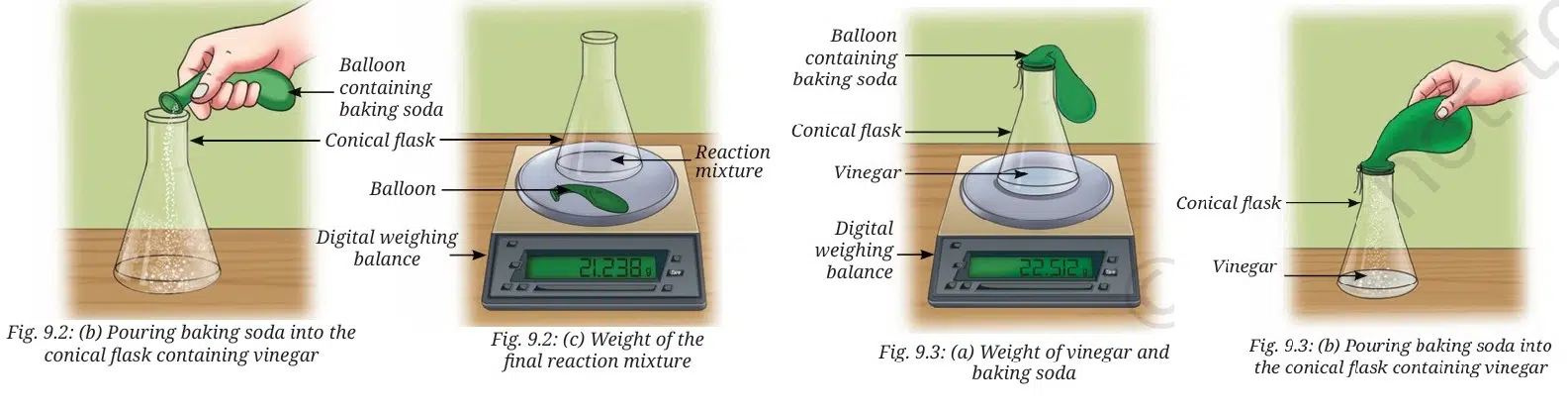
Q20. In the vinegar + baking soda experiment, the mass appears to decrease in setup 1 because:
(a) Vinegar evaporates.
(b) Balloon absorbs mass
(c) Carbon dioxide gas escapes
(d) Baking soda disappears.
Answer: (c) Carbon dioxide gas escapes
Q21. Sodium chloride does not conduct electricity in a solid state because:
(a) It has no ions.
(b) Ions are fixed in a lattice and cannot move.
(c) It contains only covalent bonds.
(d) It evaporates easily.
Answer: (b) Ions are fixed in a lattice and cannot move.
Q22. Sugar dissolves in water but does not conduct electricity because:
(a) It forms ions in solution.
(b) It does not form ions in solution.
(c) It evaporates quickly.
(d) It reacts with water.
Answer: (b) It does not form ions in solution.
Q23. The formula of hydrogen sulfide is written as:
(a) HS
(b) H₂S
(c) HS₂
(d) H₂SO₄
Answer: (b) H₂S
Q24. Aluminum has valency 3 and oxygen has valency 2. The correct formula of aluminum oxide is:
(a) AlO
(b) Al₂O₃
(c) Al₃O₂
(d) Al₂O₂
Answer: (b) Al₂O₃
Q25. Magnesium hydroxide is formed by Mg²⁺ and OH⁻ ions. Its correct formula is ________.
(a) MgOH
(b) Mg(OH)₂
(c) Mg₂OH
(d) Mg₂(OH)₂
Answer: (b) Mg(OH)₂
Q26. A magnesium atom loses two electrons to form Mg²⁺. Chlorine atom gains one electron to form Cl⁻. How many chloride ions are needed to balance one magnesium ion in MgCl₂?
(a) 1
(b) 2
(c) 3
(d) 4
Answer: (b) 2
Q27. Sodium sulfide (Na₂S) is formed when:
(a) One sodium atom gives one electron to sulfur.
(b) Two sodium atoms give one electron each to sulfur.
(c) The sulfur atom loses two electrons to sodium.
(d) Sodium atoms share electrons with sulfur.
Answer: (b) Two sodium atoms give one electron each to sulfur.
Q28. When magnesium burns in air to form magnesium oxide, Dalton’s theory explains that ________.
(a) Magnesium atoms are destroyed.
(b) Oxygen atoms are destroyed.
(c) Magnesium and oxygen atoms rearrange to form a new compound.
(d) Atoms change into new particles.
Answer: (c) Magnesium and oxygen atoms rearrange to form a new compound.
Q29. In water formation, hydrogen and oxygen atoms combine but are not destroyed. This supports Dalton’s postulate that ________.
(a) Atoms are indivisible and cannot be created or destroyed.
(b) Atoms can be created during reactions.
(c) Atoms lose their identity in compounds.
(d) Atoms are destroyed in chemical changes.
Answer: (a) Atoms are indivisible and cannot be created or destroyed.
Q30. Sodium chloride contains sodium and chlorine in the mass ratio 23:35.5. If 46 g of sodium reacts completely, how much chlorine is needed?
(a) 23 g
(b) 35.5 g
(c) 71 g
(d) 92 g
Answer: (c) 71 g
Q31. A compound consists of 40% sulfur and 60% oxygen by mass. In a sample containing 20 g of sulfur, what mass of oxygen must be present?
(a) 20 g
(b) 30 g
(c) 40 g
(d) 60 g
Answer: (c) 30 g
Q32. When 20 g of hydrogen reacts completely with 160 g of oxygen, how much water is formed?
(a) 160 g
(b) 180 g
(c) 200 g
(d) 20 g
Answer: (b) 180 g
Q33. In Example 9.2, 12 g of carbon reacts with 32 g of oxygen to form 44 g of carbon dioxide. If 2.4 g of carbon reacts completely, how much carbon dioxide will be produced?
(a) 4.4 g
(b) 8.8 g
(c) 12 g
(d) 2.4 g
Answer: (b) 8.8 g
Q34. In a hydrogen molecule (H₂), each hydrogen atom shares:
(a) Two electrons
(b) One electron
(c) Three electrons
(d) No electrons
Answer: (b) One electron
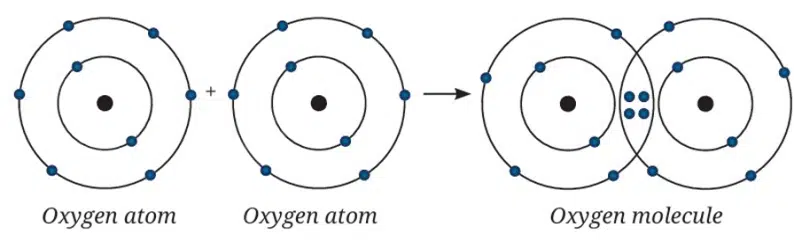
Q35. An oxygen atom has 6 valence electrons. To complete its octet, two oxygen atoms share two pairs of electrons, forming ________.
(a) Single bond
(b) Double bond
(c) Triple bond
(d) Ionic bond
Answer: (b) Double bond
Q36. In a water molecule (H₂O), oxygen shares electrons with:
(a) One hydrogen atom
(b) Two hydrogen atoms
(c) Three hydrogen atoms
(d) Four hydrogen atoms
Answer: (b) Two hydrogen atoms
Assertion–Reason MCQs
Q37. Assertion (A): In physical changes, mass remains unchanged.
Reason (R): No new substance is formed, only form changes.
(a) Both A and R are true, and R is the correct explanation.
(b) Both A and R are true; R is not an explanation.
(c) A true, R false
(d) A is false, R is true.
Answer: (a) Both A and R are true, and R is the correct explanation.
Q38. Assertion (A): In chemical reactions, mass is conserved.
Reason (R): The total mass of reactants equals the total mass of products.
(a) Both A and R are true, and R is the correct explanation.
(b) Both A and R are true; R is not an explanation.
(c) A true, R false
(d) A is false, R is true.
Answer: (a) Both A and R are true, and R is the correct explanation.
Q39. Assertion (A): In every chemical reaction, the total mass of reactants equals the total mass of products.
Reason (R): Matter can neither be created nor destroyed.
(a) Both A and R are true, and R is the correct explanation.
(b) Both A and R are true; R is not an explanation.
(c) A true, R false
(d) A is false, R is true.
Answer: (a) Both A and R are true, and R is the correct explanation.
Q41. Assertion (A): The Law of Constant Proportions holds true for compounds.
Reason (R): Elements in a compound always combine in fixed ratios by mass.
(a) Both A and R are true, and R is the correct explanation.
(b) Both A and R are true; R is not an explanation.
(c) A true, R false
(d) A is false, R is true.
Answer: (a) Both A and R are true, and R is the correct explanation.
Q42. Assertion (A): The Law of Constant Proportions does not hold true for mixtures.
Reason (R): Mixtures can have variable composition.
(a) Both A and R are true, and R is the correct explanation.
(b) Both A and R are true; R is not an explanation.
(c) A true, R false
(d) A is false, R is true.
Answer: (a) Both A and R are true, and R is the correct explanation.
Q43. Assertion (A): Chlorine molecule (Cl₂) is formed by sharing one electron pair.
Reason (R): Each chlorine atom has 7 valence electrons and needs 1 more to complete the octet.
(a) Both A and R are true, and R is the correct explanation.
(b) Both A and R are true; R is not an explanation.
(c) A true, R false
(d) A is false, R is true.
Answer: (a) Both A and R are true, and R is the correct explanation.
Q44. Assertion (A): Neon does not form covalent bonds.
Reason (R): Neon has a complete octet in its valence shell.
(a) Both A and R are true, and R is the correct explanation.
(b) Both A and R are true; R is not an explanation.
(c) A true, R false
(d) A is false, R is true.
Answer: (a) Both A and R are true, and R is the correct explanation.
Q45. Assertion (A): Chlorine atom becomes Cl⁻ after gaining one electron.
Reason (R): Chlorine has 7 valence electrons and needs 1 more to complete its octet.
(a) Both A and R are true, and R is the correct explanation.
(b) Both A and R are true; R is not an explanation.
(c) A true, R false
(d) A is false, R is true.
Answer: (a) Both A and R are true, and R is the correct explanation.
Q46. Assertion (A): Ionic compounds form 3-D crystal lattices.
Reason (R): Oppositely charged ions arrange in a repeating pattern.
(a) Both A and R are true, and R is the correct explanation.
(b) Both A and R are true; R is not an explanation.
(c) A true, R false
(d) A is false, R is true.
Answer: (a) Both A and R are true, and R is the correct explanation.
Q47. Assertion (A): Brackets are used in formulae when more than one polyatomic ion is present.
Reason (R): Brackets help indicate the number of polyatomic ions clearly.
(a) Both A and R are true, and R is the correct explanation.
(b) Both A and R are true; R is not an explanation.
(c) A true, R false
(d) A is false, R is true.
Answer: (a) Both A and R are true, and R is the correct explanation.
Q48. Assertion (A): The formula of MgO is written instead of Mg₂O₂.
Reason (R): The subscripts are divided by a common factor to give the simplest ratio.
(a) Both A and R are true, and R is the correct explanation.
(b) Both A and R are true; R is not an explanation.
(c) A true, R false
(d) A is false, R is true.
Answer: (a) Both A and R are true, and R is the correct explanation.
Q49. Assertion (A): Ionic compounds conduct electricity in aqueous solution.
Reason (R): Ions are free to move in solution.
(a) Both A and R are true, and R is the correct explanation.
(b) Both A and R are true; R is not an explanation.
(c) A true, R false
(d) A is false, R is true.
Answer: (a) Both A and R are true, and R is the correct explanation.
Q50. Assertion (A): Covalent compounds generally have low melting and boiling points.
Reason (R): They have weak intermolecular forces.
(a) Both A and R are true, and R is the correct explanation.
(b) Both A and R are true; R is not an explanation.
(c) A true, R false
(d) A is false, R is true.
Answer: (a) Both A and R are true, and R is the correct explanation.
Q51. Assertion (A): 2 g of hydrogen combines with 16 g of oxygen to form 18 g of water.
Reason (R): According to Dalton’s atomic theory, atoms combine in simple whole number ratios by mass.
(a) Both A and R are true, and R is the correct explanation.
(b) Both A and R are true; R is not an explanation.
(c) A true, R false
(d) A is false, R is true.
Answer: (a) Both A and R are true, and R is the correct explanation.
Q52. Assertion (A): Atoms of different elements have different masses and chemical properties.
Reason (R): Dalton’s atomic theory states that atoms of the same element are identical.
(a) Both A and R are true, and R is the correct explanation.
(b) Both A and R are true; R is not an explanation.
(c) A true, R false
(d) A is false, R is true.
Answer: (a) Both A and R are true, and R is the correct explanation.
Case-Based MCQ
Q53. A student performs the vinegar + baking soda experiment. In setup 1, the mass decreases after reaction. In setup 2, the mass remains constant. What conclusion can be drawn?
(a) Mass is not conserved in chemical reactions.
(b) Mass is conserved only if gas is collected.
(c) Mass changes randomly
(d) Mass depends on the type of flask used.
Answer: (b) Mass is conserved only if gas is collected.
Q54. Students placed 4.0 g of calcium carbonate with 2.92 g of hydrochloric acid in a closed container. After reaction, they measured 1.76 g of carbon dioxide, 0.72 g of water, and 4.44 g of calcium chloride. What conclusion can be drawn?
(a) Mass is not conserved.
(b) Mass of reactants = Mass of products; the law is obeyed.
(c) Mass decreases after the reaction.
(d) Mass increases after reaction
Answer: (b) Mass of reactants = Mass of products; the law is obeyed.
Q55. Students X and Y prepared copper oxide by combining copper and oxygen in ratios 4:1 and 8:2, respectively. Do their results justify the Law of Constant Proportions?
(a) No, because ratios are different.
(b) Yes, because both ratios simplify to 4:1.
(c) No, because copper oxide composition changes.
(d) Yes, because mixtures always follow fixed ratios.
Answer: (b) Yes, because both ratios simplify to 4:1.
Q56. A student combines hydrogen and oxygen to form water. The mass of hydrogen used is 2 g, and oxygen is 16 g. The water formed is 18 g. Which law and theory does this verify?
(a) Law of Multiple Proportions and Bohr’s Theory
(b) Law of Conservation of Mass and Dalton’s Atomic Theory
(c) Law of Constant Proportions and Thomson’s Model
(d) Law of Isotopes and Rutherford’s Model
Answer: (b) Law of Conservation of Mass and Dalton’s Atomic Theory
Q57. A student studies the formation of hydrogen chloride (HCl). Hydrogen needs 1 electron to complete a duplet; chlorine needs 1 electron to complete an octet. They share one electron each. What type of bond is formed?
(a) Ionic bond
(b) Single covalent bond
(c) Double covalent bond
(d) Metallic bond
Answer: (b) Single covalent bond
Q58. A student studies NaCl crystal. Each Na⁺ ion is surrounded by six Cl⁻ ions, and each Cl⁻ ion is surrounded by six Na⁺ ions. What does this arrangement represent?
(a) Single molecule of NaCl
(b) Crystal lattice structure
(c) Covalent bonding
(d) Random packing of ions
Answer: (b) Crystal lattice structure
Q59. A student combines Fe³⁺ and OH⁻ ions. After criss-crossing, the formula obtained is Fe(OH)₃. What does this represent?
(a) Ferrous hydroxide
(b) Ferric hydroxide
(c) Iron oxide
(d) Iron carbonate
Answer: (b) Ferric hydroxide
Q60. In Activity 9.4, sodium chloride solution made the bulb glow, but solid sodium chloride did not. What does this show?
(a) Ionic compounds conduct electricity only in the solid state.
(b) Ionic compounds conduct electricity only when ions are free in solution.
(c) Covalent compounds conduct electricity in the solid state.
(d) Covalent compounds conduct electricity in solution.
Answer: (b) Ionic compounds conduct electricity only when ions are free in solution.
Diagram-Based MCQ
Q61. In Fig. 9.2 and Fig. 9.3, the balloon inflates during the reaction because __________.
(a) Vinegar evaporates.
(b) Baking soda melts
(c) Carbon dioxide gas is produced.
(d) Balloon absorbs liquid
Answer: (c) Carbon dioxide gas is produced.
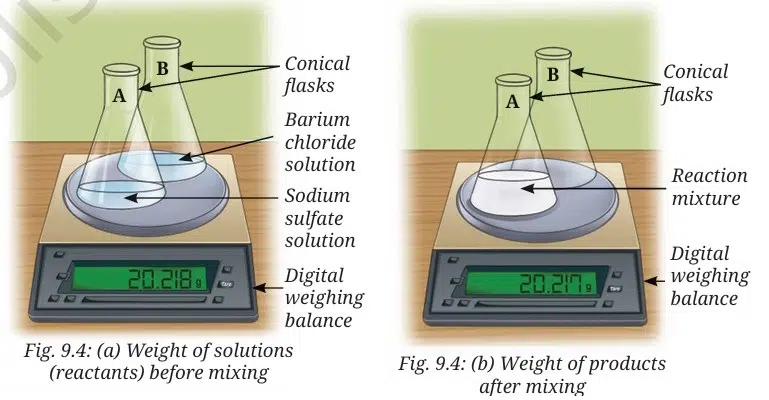
Q62. In Figure, when sodium sulfate solution is mixed with barium chloride solution, the balance reading remains unchanged because __________.
(a) Mass is lost during mixing.
(b) Mass is gained during mixing.
(c) Mass is conserved during chemical reactions.
(d) Mass depends on the type of flask used.
Answer: (c) Mass is conserved during chemical reactions.
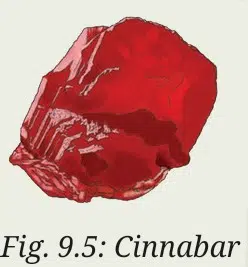
Q63. In Figure, cinnabar (hingula) always contains mercury and sulfur in fixed mass percentages of ________.
(a) 50% mercury, 50% sulfur
(b) 86.22% mercury, 13.78% sulfur
(c) 90% mercury, 10% sulfur
(d) 75% mercury, 25% sulfur
Answer: (b) 86.22% mercury, 13.78% sulfur
Q64. In Dalton’s model, atoms are represented as __________.
(a) Tiny solid indivisible spheres
(b) Hollow shells with electrons
(c) Nucleus with orbiting electrons
(d) Clouds of charges
Answer: (a) Tiny solid indivisible spheres
Q65. In Figure, the oxygen molecule is shown with two lines (O=O). This represents:
(a) Single bond
(b) Double bond
(c) Triple bond
(d) Ionic bond
Answer: (b) Double bond
Q66. In Fig. 9.11 and Fig. 9.12, sodium loses one electron and chlorine gains one electron. The resulting ions are held together by:
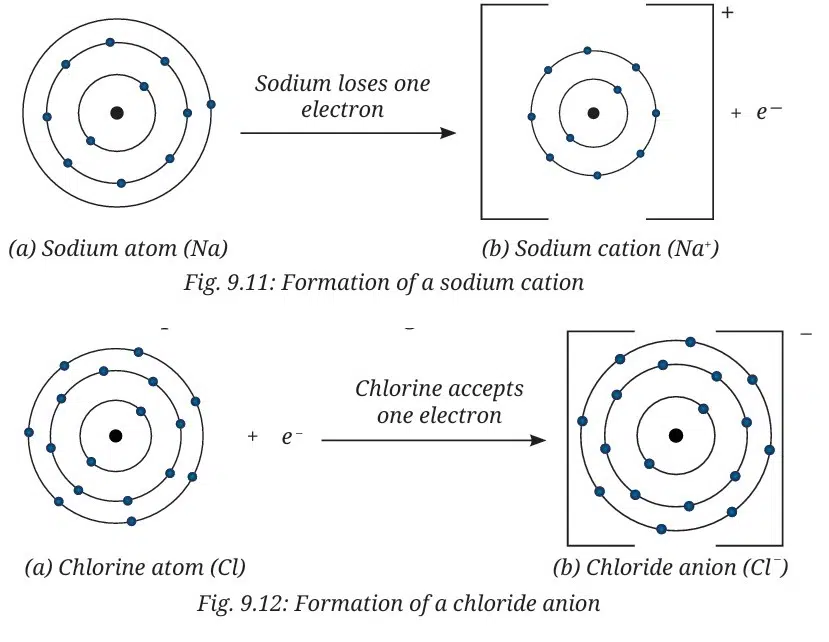
(a) Sharing of electrons
(b) Electrostatic attraction
(c) Metallic bonding
(d) Van der Waals forces
Answer: (b) Electrostatic attraction
Q67. The sodium loses one electron and chlorine gains one electron. The formula of the compound formed is:
(a) NaCl
(b) Na₂Cl
(c) NaCl₂
(d) Na₂Cl₂
Answer: (a) NaCl
Q68. In Figure, the bulb glows when ionic compounds are dissolved in water because _________.
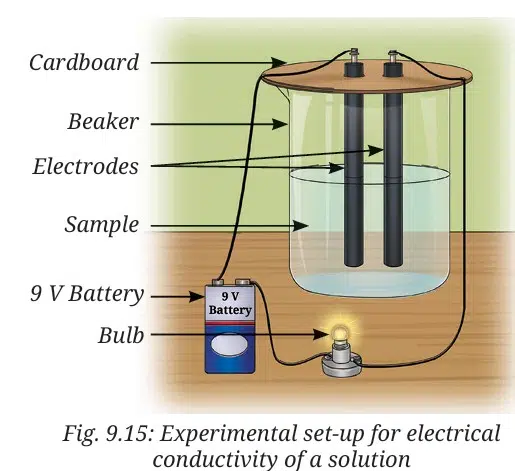
(a) Water molecules conduct electricity.
(b) Free ions in solution carry current.
(c) Electrodes absorb ions.
(d) A battery supplies direct current only.
Answer: (b) Free ions in solution carry current.
Naming Covalent Compounds MCQs
Q69. The compound CO₂ is named as:
(a) Carbon monoxide
(b) Carbon dioxide
(c) Carbon trioxide
(d) Carbon tetraoxide
Answer: (b) Carbon dioxide
Q70. The compound CS₂ is named as:
(a) Carbon monosulfide
(b) Carbon disulfide
(c) Carbon trisulfide
(d) Carbon sulfide
Answer: (b) Carbon disulfide
Q71. The compound SF₆ is named as:
(a) Sulfur hexafluoride
(b) Sulfur monofluoride
(c) Sulfur pentafluoride
(d) Sulfur tetrafluoride
Answer: (a) Sulfur hexafluoride
Q72. The correct name of Na₂S is:
(a) Sodium sulfide
(b) Sodium sulfate
(c) Sodium disulfide
(d) Sodium sulfur
Answer: (a) Sodium sulfide
Q73. The correct name of CaO is:
(a) Calcium oxide
(b) Calcium hydroxide
(c) Calcium carbonate
(d) Calcium dioxide
Answer: (a) Calcium oxide
Q74. The correct name of NH₄NO₃ is:
(a) Ammonium nitrate
(b) Ammonium nitride
(c) Ammonium hydroxide
(d) Ammonium oxide
Answer: (a) Ammonium nitrate
Q75. CO₂ is named as:
(a) Carbon monoxide
(b) Carbon dioxide
(c) Carbon trioxide
(d) Carbon tetraoxide
Answer: (b) Carbon dioxide
Q76. SF₆ is named as:
(a) Sulfur hexafluoride
(b) Sulfur pentafluoride
(c) Sulfur tetrafluoride
(d) Sulfur monofluoride
Answer: (a) Sulfur hexafluoride
Q77. The correct formula of ferric chloride is:
(a) FeCl₂
(b) FeCl₃
(c) Fe₂Cl₃
(d) Fe₃Cl₂
Answer: (b) FeCl₃
Q77. The correct formula of cuprous oxide is:
(a) CuO
(b) Cu₂O
(c) Cu₂O₂
(d) CuO₂
Answer: (b) Cu₂O
Q78. The molecular mass of water (H₂O) is:
(a) 16 u
(b) 17 u
(c) 18 u
(d) 20 u
Answer: (c) 18 u
Q79. The molecular mass of carbon dioxide (CO₂) is:
(a) 28 u
(b) 32 u
(c) 44 u
(d) 46 u
Answer: (c) 44 u
Q80. The formula unit mass of sodium oxide (Na₂O) is:
(a) 39 u
(b) 62 u
(c) 74 u
(d) 80 u
Answer: (b) 62 u
Q81. The formula unit mass of calcium nitrate, Ca(NO₃)₂, is:
(a) 120 u
(b) 140 u
(c) 164 u
(d) 180 u
Answer: (c) 164 u
Disclaimer: The content that is present on our website is based on the NCERT Class 9 Science textbook and is provided for educational purposes only. All the content and images have been taken from Science Class 9 NCERT Textbook and CBSE Support material. Images and content shown above are the property of individual organizations and are used here for reference purposes only. To make it easy to understand, some of the content and images are generated by AI and cross-checked by the teachers.