
I’m Up and Down and Round and Round Class 9 Notes provide simple and easy-to-understand explanations of the concepts related to circles and their properties. These notes are based on the NCERT Class 9 Mathematics curriculum and cover important definitions, concepts, examples, and key points in a student-friendly manner. They are useful for quick revision, understanding the chapter, and preparing for exams.
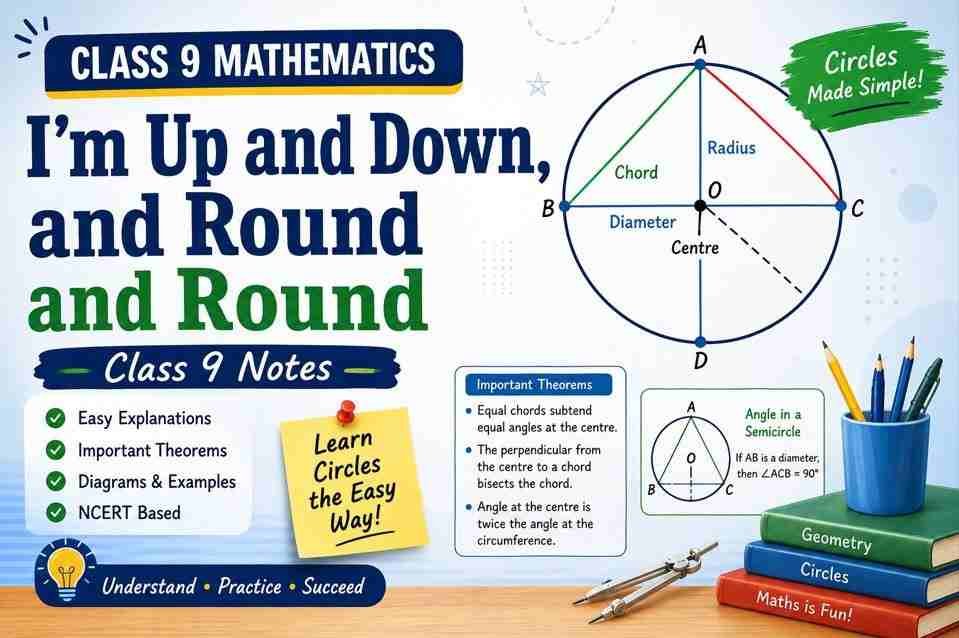
I’m Up and Down and Round and Round Class 9 Notes
You can find circles everywhere in nature, like raindrops on water, plant stems, sunflower heads, full moons, suns, etc.
A circle is a round shape. It has a centre, and all the points on the circle are at the same distance from the centre. This distance is called the radius. Circles are perfectly round, and they have the same shape everywhere, big or small. A circle is the first shape humans noticed in nature.
Definitions
A circle is the set of all points on a plane that are equidistant from a fixed point. The fixed point is called the centre, and the common distance is called the radius.
Important Terms
- Centre: The middle point of the circle.
- Radius: Distance from centre to any point on the circle.
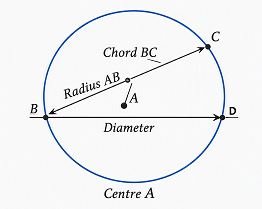
- Chord: A line segment joining two points on a circle.
- Diameter: A chord that passes through the centre. It is the longest chord.
Example with Figure
- Imagine a circle with centre A.
- Point B is on the circle. Distance AB = radius.
- Points B and C are on the circle. Line segment BC is a chord.
- If a chord passes through A, it becomes a diameter BD.
Symmetries of a Circle
What is symmetry?
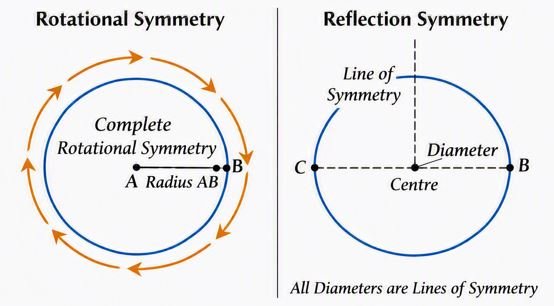
Symmetry means when one part of a shape or object is an exact reflection of another part. A circle is the most symmetrical shape in geometry.
- Rotational Symmetry: Imagine a wheel; when it turns, it always looks the same. A circle has rotational symmetry for every angle of rotation about its centre.
- Reflection symmetry: Take a paper circle and fold it so the edges match perfectly. Open it and you will see a crease. This crease is a line of symmetry. Every diameter of a circle is a line of symmetry. Therefore, a circle has infinitely many lines of symmetry.
How Many Circles?
Circles through Two Points (A and B)
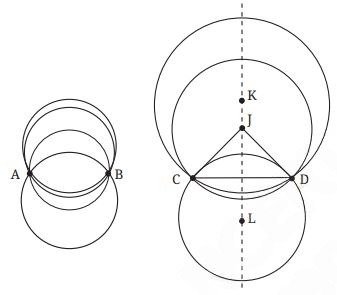
Suppose there are two points, A and B, on paper.
A circle can pass through both points. The centre of such a circle must be equidistant from A and B. All such centres lie on the perpendicular bisector of AB. That means there are infinite circles through two points. Example: If the centre is the midpoint of AB, then AB becomes the diameter of the circle.
Circles through Three Points (A, B, C)
Now take three points, A, B, and C.
- If they lie on a straight line (are collinear), no circle can pass through all three.
- If they are not collinear, there is exactly one circle that passes through them.
This is called Theorem 1: There is a unique circle passing through three non‑collinear points.
Why only one?
- The centre must be equidistant from A, B, and C.
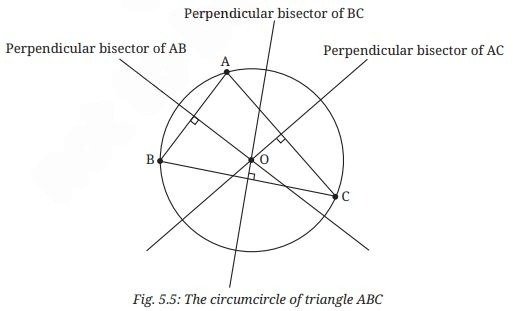
- So, it lies on the perpendicular bisector of AB and also on the perpendicular bisector of AC.
- These two bisectors meet at one unique point, O.
- That point O is the circumcentre, and the circle is the circumcircle.
- These two perpendicular bisectors meet at one unique point, O. That point O is the circumcentre, and the circle with centre O passing through A, B and C is the circumcircle.
Circumcircle and Circumcentre
When the circle passes through the three vertices (A, B, C) of a triangle:
- The circle is called the circumcircle.
- The centre O is called the circumcentre.
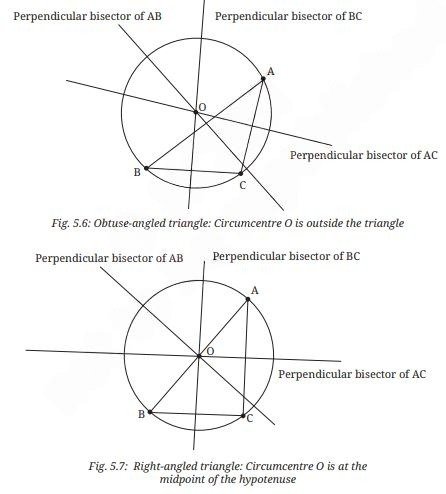
Depending on the type of triangle:
| Triangle Type | Position of Circumcentre |
|---|---|
| Acute‑angled | Inside the triangle |
| Right‑angled | At midpoint of hypotenuse |
| Obtuse‑angled | Outside the triangle |
Chords and the Angles They Subtend
What is a chord?
A chord joins two points on a circle. When the endpoints of the chord are joined to the centre, the chord subtends an angle at the centre. For chords of the same circle, a longer chord subtends a larger angle at the centre.
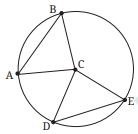
Theorem 2: Equal chords make equal angles at the centre. Suppose chord AB and chord DE are equal in length. Then the angles they make at the centre are also equal. You can see that the triangles formed are congruent, meaning the same size and shape.
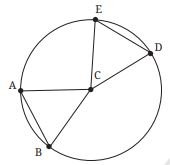
Theorem 3: Chords that make equal angles at the centre are equal. Suppose chord AB and chord DE make the same angle at the centre; then their lengths must be equal. You can see the triangles formed are congruent, so the chords are equal.
Midpoints and Perpendicular Bisectors of Chords
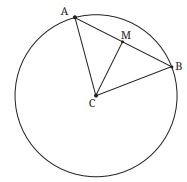
Theorem 4: Draw a circle with centre C. Draw a chord AB and mark M as the midpoint of AB. The line CM (centre to midpoint) is always perpendicular to AB.
Why?
- Triangle CAB is isosceles (CA = CB).
- Midpoint M makes AM = MB.
- By congruence, ∆CMA ≅ ∆CMB.
- So, ∠CMA = ∠CMB = 90°.
- Hence, CM ⟂ AB.
Theorem 5: The perpendicular from the centre of a circle to a chord bisects the chord. If a perpendicular is drawn from the centre of a circle to a chord, it divides the chord into two equal parts.
For example, if CM ⊥ AB, then:
AM = MB
Therefore, M is the midpoint of chord AB.
Distance of Chords from the Centre
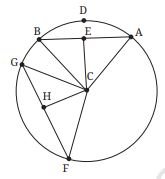
Theorem 6: Suppose two chords AB and FG are equal in length. Draw perpendiculars from centre C to both chords (CE and CH). Then CE = CH.
Why?
- Equal chords form congruent triangles with the centre.
- So, the perpendicular distances from the centre to each chord are equal.
- Equal chords are always at the same distance from the centre.
Theorem 7: Chords of a circle that are equidistant from the centre have equal length.
Which of the two unequal chords is further from the centre?
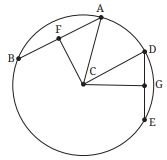
Theorem 8: If chord AB is longer than chord DE, then the distance from the centre to AB (CF) is less than the distance from the centre to DE (CG).
Why?
- Longer chord → midpoint closer to centre.
- Shorter chord → midpoint further from centre.
- Using the Pythagoras theorem, we prove CF < CG.
Angles Subtended by an Arc
What is an Arc?
An arc is just a curved part of the circle between two points. Example: If you mark points A and B on a circle, the curved path from A to B is an arc.
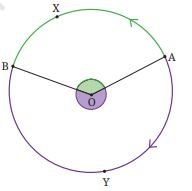
There are two arcs between A and B:
- The smaller one → called the minor arc.
- The bigger one → called the major arc.
- For the minor arc AB, the angle at the centre is less than 180°.
- For the major arc AB, the angle at the centre is greater than 180°.
Angle Subtended by an Arc
When you join the ends of the arc (A and B) to the centre O, the arc makes an angle at the centre.
- For the minor arc AB, the angle at the centre is less than 180°.
- For the major arc AB, the angle at the centre is greater than 180°.
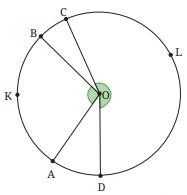
Angle subtended by an arc at a point on the circle outside the arc
Arc and Angles
- An arc is a curved part of the circle between two points (say A and B).
- The minor arc subtends a smaller angle at the centre (less than 180°).
- The major arc subtends a larger angle at the centre (more than 180°).
Angle at a Point on Circle
Suppose arc AFB is given.
- At the centre O, the arc subtends angle ∠AOB.
- At a point D on the circle (outside the arc), the arc subtends angle ∠ADB.
Theorem 9 says:
Angle at centre = 2 × Angle at circle
So, ∠AOB = 2 ∠ADB.
If you take arc AB and choose any point D, E, F outside the arc, The angle subtended (∠ADB, ∠AEB, ∠AFB) is always the same. This is a special property of circles — angles in the same arc are equal.
Corollary
If AB is a diameter, then the angle subtended at any point on the circle is 90°. That’s why a semicircle always makes a right angle at the boundary.
Angles inside the circle (like ∠AIB, ∠ACB, ∠AHB) are different. But angles subtended by the same arc on the circle boundary (like ∠ADB and ∠AEB) are equal.
Concyclicity of Points
What does “Concyclic” mean?
Points are called concyclic if they all lie on the same circle. Example: If A, B, C, D are on one circle, they are concyclic.
Theorem 10: If a line segment AB makes equal angles at two points C and D lying on the same side of AB, then A, B, C, and D lie on the same circle. Therefore, D must lie on the circle passing through A, B, and C. Hence, A,B,C,D are concyclic.
Theorem 11: The sum of two opposite angles of a cyclic quadrilateral is 180°. If four points A, B, C, D lie on a circle, the quadrilateral formed is called a cyclic quadrilateral.
Property: The sum of opposite angles is 180°.
∠𝐵𝐴𝐷 + ∠𝐵𝐶𝐷 = 180∘
Converse (Theorem 12)
If in any quadrilateral, opposite angles add up to 180°, then its vertices lie on a circle. That means the quadrilateral is cyclic.
Disclaimer: The content that is present on our website is based on the NCERT Class 9 Mathematics textbook and is provided for educational purposes only. All the content and images have been taken from Mathematics Class 9 NCERT Textbook and CBSE Support material. Images and content shown above are the property of individual organizations and are used here for reference purposes only. To make it easy to understand, some of the content and images are generated by AI and cross-checked by the teachers.