
Practice Cultural Currents 13th to 17th Centuries Class 8 MCQs with answers to revise important concepts from the chapter. These multiple-choice questions cover key cultural developments, traditions, literature, art, architecture, and social changes during the period. They are useful for Class 8 exams, revision, and quick preparation.
Cultural Currents 13th to 17th Centuries Class 8 MCQs
Conceptual Recall
Q. Which of the following is NOT a feature of Indian culture that made it resilient?
a) Deep roots and timeless values
b) Scientific temper and philosophy
c) Dependence only on foreign influences
d) Rich artistic traditions
Answer: c) Dependence only on foreign influences
Q. Which text formalised Indian traditions of dance, drama, and music in an interdisciplinary way?
a) Ain‑i‑Akbari
b) Natyashastra
c) Razmnama
d) Divya Prabandham
Answer: b) Natyashastra
Q. Which of the following was a key feature of the Bhakti tradition?
a) Dependence on priests and rituals
b) Path of devotion open to all
c) Strict caste‑based worship
d) Exclusive use of Sanskrit only
Answer: b) Path of devotion open to all
Q. A student compares Kabir’s doha about wheat flour with social life. What lesson should he derive?
a) Differences between religions must always remain
b) Unity of all people when divine truth is realised
c) Rituals are necessary for equality
d) Only Hindu names of God are valid
Answer: b) Unity of all people when divine truth is realised
Q. Which design did the Mughals borrow from Persia for their gardens?
a) Charbagh (four‑part garden)
b) Gothic arches
c) Roman courtyards
d) Greek amphitheatres
Answer: a) Charbagh (four‑part garden)
Q. Which centre of learning is known for laying the seeds of infinite series and calculus?
a) Nalanda University
b) Kerala School of Mathematics
c) Vikramashila University
d) Sringeri Matha
Answer: b) Kerala School of Mathematics
Q. Who translated the Mahabharata into Bengali in the early 16th century?
a) Amir Khusrau
b) Kavindra Paramesvara
c) Dara Shikoh
d) Faizi
Answer: b) Kavindra Paramesvara
Q. Who authored Gaṇitakaumudī, a massive treatise on mathematics in the 14th century?
a) Madhava
b) Narayana Pandita
c) Nilakantha Somayaji
d) Bhaskara II
Answer: b) Narayana Pandita
Q. Which of the following dishes was introduced into India through Persian influence?
a) Khichri
b) Naan
c) Dosa
d) Idli
Answer: b) Naan
Application-Based
Q. A trader from Persia visits India in the 14th century. Which cultural impact is MOST likely to be seen?
a) Introduction of Greek temples
b) Spread of Persian language and art forms
c) Decline of Indian food habits
d) Replacement of Indian literature with Roman texts
Answer: b) Spread of Persian language and art forms
Q. A travelling bard in Odisha uses pattachitra to narrate stories. Which themes would MOST likely be depicted?
a) Greek myths
b) Ramayana and Mahabharata scenes
c) Mughal court hunting scenes
d) Roman legends
Answer: b) Ramayana and Mahabharata scenes
Q. A historian studies Amer Fort gardens of the 17th century. Which feature would BEST reflect Mughal influence?
a) Use of marble statues only
b) Geometrical patterns with water channels
c) Absence of irrigation systems
d) Exclusive use of Persian plants
Answer: b) Geometrical patterns with water channels
Q. A ruler in Vijayanagara follows pūrvamaryade. What impact would this MOST likely have on education?
a) Decline of temple schools
b) Continuation of dharma‑based institutions like mathas and temples
c) Replacement of Sanskrit with Persian only
d) End of apprenticeship systems
Answer: b) Continuation of dharma‑based institutions like mathas and temples
Q. A student compares Chaitanya Mahaprabhu’s Dhamali songs with Kathak performances. What conclusion can he draw?
a) Bhakti literature influenced performing arts
b) Persian poetry replaced Indian dance forms
c) Kathak was limited to Mughal courts only
d) Bhakti songs were confined to temples
Answer: a) Bhakti literature influenced performing arts
Q. A modern scientist studies Madhava’s series expansion for trigonometric functions. Which conclusion can he draw?
a) India pioneered early ideas of calculus
b) Calculus was first introduced only by Copernicus
c) Infinite series were unknown in India
d) Mathematics was limited to temple rituals
Answer: a) India pioneered early ideas of calculus
Q. Akbar reduced meat consumption in his court. Which cultural influence MOST likely guided this decision?
a) Roman traditions
b) Jain and Hindu traditions
c) Persian court practices
d) Greek dietary habits
Answer: b) Jain and Hindu traditions
Assertion–Reason
Q. Assertion (A): Indian culture survived invasions and political instability.
Reason (R): It continuously absorbed external influences while keeping its core traditions alive.
a) Both A and R are true, and R is the correct explanation of A
b) Both A and R are true, but R is not the correct explanation of A
c) A is true, but R is false
d) A is false, but R is true
Answer: a) Both A and R are true, and R is the correct explanation of A
Q. Assertion (A): Guru Nanak’s teachings promoted equality of all people.
Reason (R): His hymns, along with those of Hindu saints, were preserved in the Guru Granth Sahib.
a) Both A and R are true, and R is the correct explanation of A
b) Both A and R are true, but R is not the correct explanation of A
c) A is true, but R is false
d) A is false, but R is true
Answer: a) Both A and R are true, and R is the correct explanation of A
Q. Assertion (A): Tansen became one of the nine gems in Akbar’s court.
Reason (R): He was influenced only by Persian music and rejected Indian traditions.
a) Both A and R are true, and R is the correct explanation of A
b) Both A and R are true, but R is not the correct explanation of A
c) A is true, but R is false
d) A is false, but R is true
Answer: c) A is true, but R is false
Q. Assertion (A): Razia Sultan broke tradition by appearing unveiled at court.
Reason (R): She wanted to establish a merit‑based administration and directly address the public.
a) Both A and R are true, and R is the correct explanation of A
b) Both A and R are true, but R is not the correct explanation of A
c) A is true, but R is false
d) A is false, but R is true
Answer: a) Both A and R are true, and R is the correct explanation of A
Q. Assertion (A): The destruction of Nalanda and Vikramashila was a huge cultural loss.
Reason (R): It led to dispersal of scholars and collapse of an entire ecosystem of learning.
a) Both A and R are true, and R is the correct explanation of A
b) Both A and R are true, but R is not the correct explanation of A
c) A is true, but R is false
d) A is false, but R is true
Answer: a) Both A and R are true, and R is the correct explanation of A
Q. Assertion (A): Persian became the language of Mughal administration and courtly culture.
Reason (R): It helped preserve Indian knowledge through translations of Sanskrit texts.
a) Both A and R are true, and R is the correct explanation of A
b) Both A and R are true, but R is not the correct explanation of A
c) A is true, but R is false
d) A is false, but R is true
Answer: a) Both A and R are true, and R is the correct explanation of A
Q. Assertion (A): Nilakantha Somayaji’s planetary model placed Mercury and Venus orbiting the Sun.
Reason (R): His model was formulated decades before Copernicus’ heliocentric theory.
a) Both A and R are true, and R is the correct explanation of A
b) Both A and R are true, but R is not the correct explanation of A
c) A is true, but R is false
d) A is false, but R is true
Answer: a) Both A and R are true, and R is the correct explanation of A
Q. Assertion (A): Samosas and jalebis are popular Indian snacks today.
Reason (R): They have been part of Indian cuisine for over 1500 years.
a) Both A and R are true, and R is the correct explanation of A
b) Both A and R are true, but R is not the correct explanation of A
c) A is true, but R is false
d) A is false, but R is true
Answer: c) A is true, but R is false
Case Study
Q. During the 13th–17th centuries, rulers of different backgrounds supported arts and literature. At the same time, Persian and Arabic influences blended with Indian traditions, creating new art forms. Despite invasions, people across communities actively participated in cultural life.
Which conclusion can be drawn from the passage?
a) Indian culture declined due to foreign invasions
b) Patronage of rulers and people’s participation enriched Indian culture
c) Persian and Arabic influences replaced Indian traditions completely
d) Indian culture remained isolated from external influences
Answer: b) Patronage of rulers and people’s participation enriched Indian culture
Q. Purandaradasa, known as the father of Carnatic music, gave up his diamond business and composed thousands of devotional songs. His fame spread across the Vijayanagara empire and he was invited to Krishnadevaraya’s court.
Which of the following conclusions is MOST appropriate?
a) Bhakti saints influenced only local villages
b) Bhakti saints connected devotion with music and reached royal courts
c) Bhakti saints avoided rulers and courts completely
d) Bhakti saints were limited to northern India only
Answer: b) Bhakti saints connected devotion with music and reached royal courts
Q. Amir Khusro, an Indo‑Persian poet and singer, fused Indian, Persian, and Arabic styles to develop qawwali. His compositions enriched Indian music with themes of devotion and unity.
Which conclusion is MOST appropriate?
a) Indian music remained unaffected by foreign influences
b) Fusion of styles created new musical forms like qawwali
c) Amir Khusro rejected devotional themes in his songs
d) Indian music declined during the 13th century
Answer: b) Fusion of styles created new musical forms like qawwali
Q. Nur Jahan, wife of Jahangir, issued royal orders, attended court meetings, and even had coins minted in her name. She supported art, architecture, and trade.
Which conclusion is MOST appropriate?
a) Women in Mughal courts had no political role
b) Nur Jahan played an active role in governance and culture
c) Coins were never minted in the name of women
d) Mughal queens were confined only to household duties
Answer: b) Nur Jahan played an active role in governance and culture
Q. Weavers from Gujarat moved to Banaras with Akbar’s encouragement. They introduced zari and brocades, which became part of the Banaras silk sari tradition, featuring designs inspired by nature and geometry.
Which conclusion is MOST appropriate?
a) Mughal patronage enriched local textile traditions
b) Weaving declined under Mughal rule
c) Banaras silk lost its uniqueness
d) Apprenticeship systems ended in weaving
Answer: a) Mughal patronage enriched local textile traditions
Q. Dara Shikoh translated 52 Upanishads into Persian with the help of scholars in Varanasi. These translations later reached Europe and influenced philosophers in the 19th century.
Which conclusion is MOST appropriate?
a) Translations helped spread Indian philosophy globally
b) Persian translations destroyed Indian texts
c) Dara Shikoh rejected Hindu traditions completely
d) Upanishads were confined only to Sanskrit readers
Answer: a) Translations helped spread Indian philosophy globally
Q. During Akbar’s time, Indian saltpetre was used to make gunpowder and also to cool water and beverages. Perfumes like Itr Jahangir were developed using applied chemistry.
Which conclusion is MOST appropriate?
a) Chemistry was applied in both warfare and daily life
b) Saltpetre was used only for agriculture
c) Perfume making declined during Mughal rule
d) Chemistry was limited to temple rituals
Answer: a) Chemistry was applied in both warfare and daily life
Q. Cotton, muslin, and silk production increased during the 13th–17th centuries. New dresses like the jama and pyjama were adopted in courts, while the sari continued with regional variations.
Which conclusion is MOST appropriate?
a) Indian clothing blended new influences with traditional styles
b) The sari disappeared completely from Indian fashion
c) Only Persian styles dominated Indian clothing
d) Cotton production declined during this period
Answer: a) Indian clothing blended new influences with traditional styles
Diagram/Visual-Based
Q. Look at the figure of Arab merchants visiting India to buy spices. What does this image BEST represent?
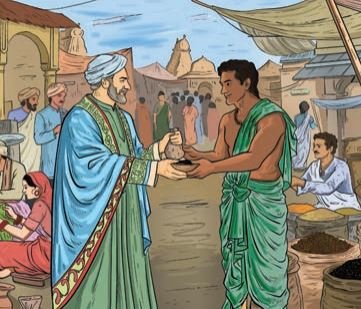
a) India’s isolation from the world
b) India’s role as a global trade hub
c) Decline of Indian agriculture
d) End of cultural exchanges with other regions
Answer: b) India’s role as a global trade hub
Q. Look at the image of whirling dervishes of Sufism. What does this practice BEST represent?

a) A form of military training
b) Meditation and remembrance of God
c) Celebration of harvest festivals
d) A dance competition among Sufi saints
Answer: b) Meditation and remembrance of God
Q. Look at the miniature painting of Krishna defeating Trinavarta. What does this painting BEST represent?
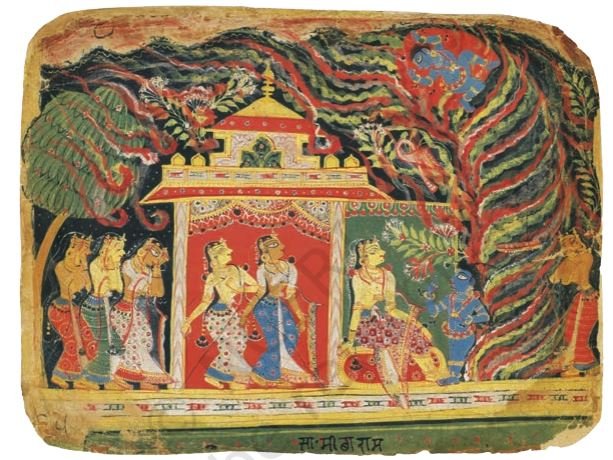
a) Mughal court scenes
b) Rajput tradition depicting Hindu epics
c) Persian landscapes
d) Roman mythology
Answer: b) Rajput tradition depicting Hindu epics
Q. Look at the image of Mughal garden at Nishat Bagh, Srinagar. What does the design with terraces, waterfalls, and canals BEST symbolise?
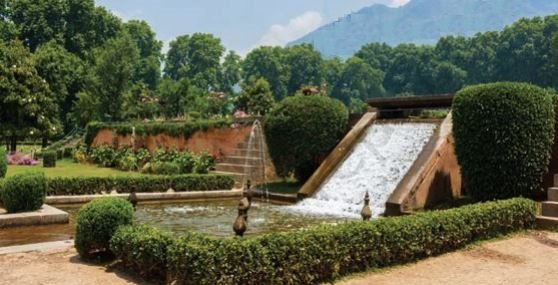
a) Representation of rivers of Paradise in Islamic tradition
b) A purely decorative style without meaning
c) Influence of Greek mythology
d) Decline of Indian gardening traditions
Answer: a) Representation of rivers of Paradise in Islamic tradition
Q. Look at the image of ruins of Vikramashila University. What does the meditation area with seats BEST symbolise?
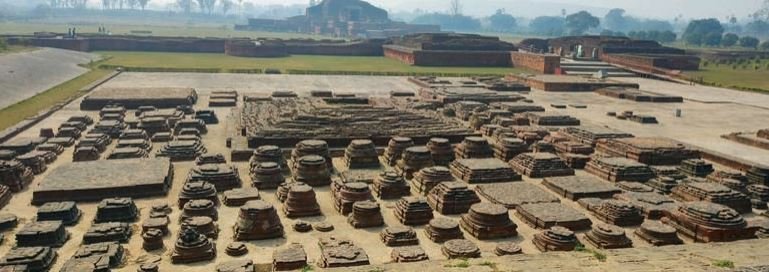
a) Decline of mathematics in India
b) Importance of spiritual and intellectual training in ancient universities
c) Exclusive focus on warfare training
d) Replacement of Indian education with European systems
Answer: b) Importance of spiritual and intellectual training in ancient universities
Q. Look at the miniature of Dara Shikoh as a royal ascetic. What does this image BEST symbolise?
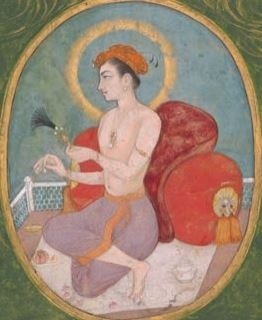
a) His rejection of scholarship
b) His role in promoting Hindu‑Muslim harmony
c) His opposition to translations
d) His focus only on military campaigns
Answer: b) His role in promoting Hindu‑Muslim harmony
Q. Look at the image of Konark Sun Temple’s stone wheels. What do these wheels BEST symbolise?
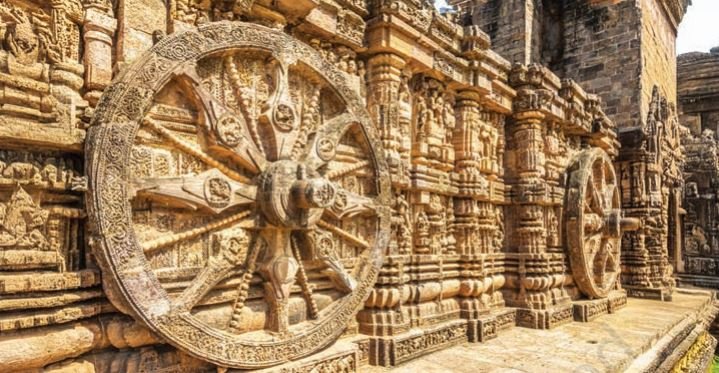
a) Decorative art only
b) Advanced engineering and astronomical knowledge
c) Decline of temple architecture
d) Influence of Roman design
Answer: b) Advanced engineering and astronomical knowledge
Q. Look at the Mughal painting of nobles in Shah Jahan’s court. What does the clothing style BEST represent?
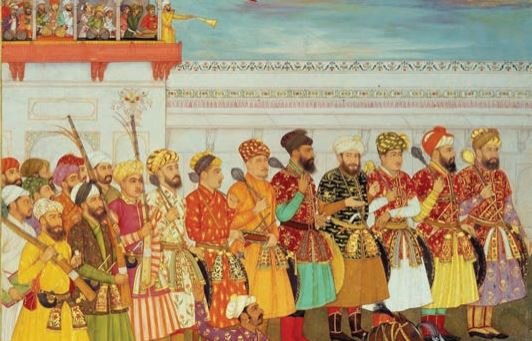
a) Decline of textile production
b) Fusion of vibrant colours, turbans, and Persian‑influenced garments
c) Exclusive use of Greek attire
d) End of regional clothing traditions
Answer: b) Fusion of vibrant colours, turbans, and Persian‑influenced garments
Disclaimer: The content that is present on our website is based on the NCERT Class 8 Social Science textbook and is provided for educational purposes only. All the content and images have been taken from Socail Science Class 8 NCERT Textbook. Images and content shown above are the property of individual organizations and are used here for reference purposes only. To make it easy to understand, some of the content and images are generated by AI and cross-checked by the teachers.