
← Back to English Class 9 Kaveri
The Pot Maker is an engaging chapter in the Class 9 NCERT English syllabus that highlights the dignity of labour, traditional craftsmanship, and the importance of preserving cultural heritage. The story introduces readers to the life and skills of a potter, showcasing the dedication, creativity, and hard work involved in transforming clay into beautiful and useful pottery.
The Pot Maker Class 9 NCERT Solutions
Reflect and Respond
I. Look at the pictures given below and identify the vocations. Now, list at least five more vocations.
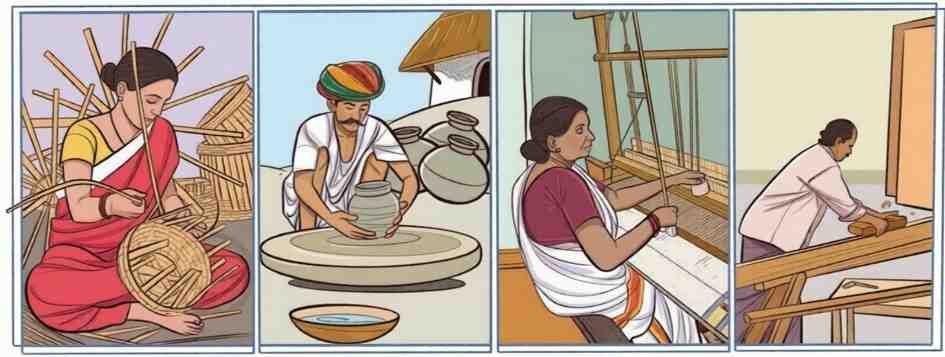
Answer: The pictures show the following vocations:
- Basket Weaver (making baskets from bamboo/cane)
- Potter (making clay pots)
- Weaver (weaving cloth on a loom)
- Carpenter (working with wood)
Five more vocations:
- Farmer
- Mason
- Blacksmith
- Tailor
- Shoemaker
II. Work in pairs. Discuss the following questions and share your answers with your classmates and teacher.
1. What is common among these pictures?
Answer: All the pictures show people engaged in skill-based occupations or traditional crafts.
2. We refer to such skill-based work as v__ _ a _ _ o _ s.
Answer: Vocations
3. Mention a few differences between handmade and machine-made products.
Answer:
| Handmade Products | Machine-made Products |
|---|---|
| Made by hand using skills and craftsmanship | Made by machines in factories |
| Unique and artistic | Uniform and identical |
| Take more time to produce | Produced quickly in large quantities |
Check Your Understanding
I. Do you think Onula’s support helped Sentila? If yes, why? If no, why not?
Answer: Yes, Onula supported Sentila; Onula encouraged Sentila when she was frustrated, and Onula taught her the correct way to make a pot. Onula also gave her confidence and advised her to observe her mother’s techniques. Because of Onula’s guidance, Sentila finally learned the art of pot making.
II. Sentila observes her mother making pots. What does this tell us about her?
Answer: This tells us that Sentila was very eager to learn pot-making. She was hardworking, patient, and determined. She carefully watched every step and learned by observing her mother’s skills.
III. Arrange the following events of the story in the correct sequence. Share your answer with your classmates and teacher.
| 1. The village council called Mesoba to know about Arenla’s unwillingness to teach pottery to Sentila. | ………………… |
| 2. Arenla made a new batch of pots and asked Sentila to continue the work as she was unwell. | ………………… |
| 3. Sentila observed how other expert potters crafted beautiful pots. | ………………… |
| 4. Sentila was passionate about pottery but did not share it with her mother. | ………………… |
| 5. Onula guided Sentila in the art of pot making. | ………………… |
| 6. Sentila overheard her mother saying that pot making was a tiring job and that she earned very little from it. | ………………… |
| 7. Onula observed two rows of pots inside the work shed, which she felt was the work of two people. | ………………… |
| 8. Sentila learnt the art of pot making for a year from her mother but was unsuccessful. | ………………… |
| 9. Sentila was able to make pots quickly and skilfully, just one less than her mother’s. | ………………… |
Answer:
| 1 | Sentila was passionate about pottery but did not share it with her mother. |
| 2 | Sentila overheard her mother saying that pot making was a tiring job and that she earned very little from it. |
| 3 | Sentila observed how other expert potters crafted beautiful pots. |
| 4 | The village council called Mesoba to know about Arenla’s unwillingness to teach pottery to Sentila. |
| 5 | Sentila learnt the art of pot making for a year from her mother but was unsuccessful. |
| 6 | Onula guided Sentila in the art of pot making. |
| 7 | Arenla made a new batch of pots and asked Sentila to continue the work as she was unwell. |
| 8 | Sentila was able to make pots quickly and skilfully, just one less than her mother’s. |
| 9 | Onula observed two rows of pots inside the work shed, which she felt was the work of two people. |
Critical Reflection
I. Read the extracts given below and answer the questions that follow.
1. Pounding the stubborn clay inside bamboo cylinders to soften it, is also tedious. So many times I’ve dropped the mould out of sheer exhaustion and have had to start all over again. It takes months to bring out a batch of pots after so much labour. And the reward?
A few rupees. But if Sentila learns weaving, she can make much more money besides providing enough cloth for the family. Weaving is not messy like pot making and can be done indoors in all seasons. Also, the time spent on weaving one shawl is much less and the return is handsome.
(i) Choose the correct reason for the given assertion.
(A): The effort in making pots is far greater than the returns.
A. The process of pot making is quite tiresome and long, and one hardly earns much.
B. The process of pot making is exhausting, takes a long time, yet gives a sense of satisfaction.
Answer: A. The process of pot making is quite tiresome and long, and one hardly earns much.
(ii) Why does Arenla want Sentila to learn weaving?
Answer: Arenla wants Sentila to learn weaving instead of pot making because weaving earns more money, can be done indoors in all seasons, and takes less time.
(iii) State one advantage that weaving has over pot making, as per the extract.
Answer: Weaving takes less time and gives better income than pot making.
(iv) Choose the sentence that uses the word ‘handsome’ in the same way as in the extract.
A. My father is a handsome man.
B. They will make a handsome profit selling this property.
Answer: B. They will make a handsome profit selling this property.
(v) ‘And the reward?’ What is the author’s purpose of using a question mark here?
Answer: The question mark shows Arenla’s disappointment and frustration because she gets very little money after so much hard work.
2. Onula saw her taking out some clay and the implements from her basket quietly. She watched Sentila’s clumsy efforts to make a pot and noticed that Sentila was too tense. As a result, the clay seemed unable or unwilling to yield the right shape. When Sentila wearily let the misshapen lump fall flat on the ground, Onula went to her and said, “Don’t worry, little one, I shall teach you how to make a perfect pot.” Sentila watched in amazement as Onula fashioned a beautiful pot and asked her to try again.
(i) Complete the sentence with an appropriate reason.
Onula feels Sentila’s effort at making a pot is clumsy because __.
Answer: she was too tense and lacked confidence.
(ii) Choose the correct option to complete the following sentence.
‘Don’t worry, little one, I shall teach you how to make a perfect pot.’ This shows that Onula was _.
A. sincere and generous
B. forgiving and thoughtful
C. thoughtful and generous
D. forgiving and sincere
Answer: C. thoughtful and generous
(iii) Which among the following is the effect of a cause?
A. As a result, the clay seemed unable or unwilling to yield the right shape.
B. Onula saw her taking out some clay and the implements from her basket quietly.
Answer: A. As a result, the clay seemed unable or unwilling to yield the right shape.
(iv) ‘Onula fashioned a beautiful pot.’ Here, the word ‘fashioned’ means __. (created/styled)
Answer: created
(v) How might Sentila have felt when she saw ‘the misshapen lump fall flat on the ground’?
Answer: Setila felt frustrated, disappointed, and discouraged because her attempt to make a pot had failed.
II. Answer the following questions.
1. Describe the process of pot making followed by expert pot makers, as observed by Sentila.
Answer: Sentila observed that the clay was first mixed with water and pounded properly until it became soft. The potters then shape the clay with their hands and a spatula while rotating it. After some days the pots were given a final touch, dried in the sun, and then baked carefully in a kiln. The fire inside the kiln is controlled properly to avoid damaging the pots.
2. What warning was given to Mesoba by the village council?
Answer: The village council told Mesoba that Arenla should teach Sentila the art of pot-making. They said that traditional skills should be passed to the next generation and should not be kept by one person.
3. How did Sentila feel when she failed at pot making even after a year of training with her mother?
Answer: Sentila felt disappointed and frustrated because after a year of practice, she was unable to make pots properly.
4. ‘Onula stood there for a long time as if trying to absorb a new phenomenon.’ Explain.
Answer: Onula saw two rows of pots that looked equally beautiful and skilfully made. She realised that Sentila had finally mastered the art of pot-making. She was surprised and amazed by what she saw.
5. ‘The tradition and history of the people did not belong to any individual.’ What does this symbolise?
Answer: The tradition and culture belong to the whole community. They should be preserved and passed on to future generations rather than being kept by one person.
6. What is the significance of the concluding line of the story, ‘A new pot maker was born’?
Answer: The line means that the Sentila had finally become a skilled pot maker. Her dream had come true, and the tradition of pot making would continue.
7. What is the role of perseverance in pursuing one’s dreams? Elaborate with reference to Sentila.
Answer: Perseverance means not giving up. Sentila kept trying to learn pot making even when she failed many times. She worked hard and stayed determined. In the end, she achieved her dream. Her story teaches us that hard work and patience help us succeed.
Vocabulary and Structures in Context
I. Read the highlighted words in the following sentences from the text.
1. She taught Sentila how to dig the clay with dao, load it on to her carrying basket…
2. Sentila was a quick learner and turned the clay into malleable dough. Pounding the stubborn clay inside bamboo cylinders to soften it …
The highlighted words describe the tools and materials required in the process of pot making.
Now, classify the words/phrases given in the box as shown in the table below. One example for each category has been done for you.
| dao | dough | pounding | bamboo |
| clay | kiln | spatula | basket |
| cylinders | rotating | bed of hay | shaping |
| Tools/Implements | Raw Materials | Process |
|---|---|---|
| dao | dough | pounding |
Answer:
| Tools/Implements | Raw Materials | Process |
|---|---|---|
| dao | dough | pounding |
| spatula | clay | shaping |
| basket | bamboo | rotating |
| cylinders | bed of hay | kiln |
II. Notice the use of the following words in the text.
| pittance | rupees | reward | return |
These words relate to livelihood and economic aspects that are crucial for any enterprise/business/vocation. Work in pairs and find the meanings of the following words related to economy. You may refer to a dictionary.
| bankrupt | credit | currency | debt |
| fiscal | inflation | investment | interest |
Now, frame sentences using each word. interest
Answer:
| Word | Meaning | Sentence |
|---|---|---|
| bankrupt | having no money left to pay debts | The company became bankrupt after heavy losses. |
| credit | money borrowed or trust given | He bought a bicycle on credit. |
| currency | money used in a country | The Indian currency is the rupee. |
| debt | money that is owed | He worked hard to repay his debt. |
| fiscal | related to government money and taxes | The government announced a new fiscal policy. |
| inflation | rise in prices of goods and services | Inflation has made daily items expensive. |
| investment | money put into something to earn profit | She made an investment in a small business. |
| interest | extra money paid on borrowed money | The bank charges interest on loans. |
III. Read the following sentences from the text. The main clause has been underlined and the subordinate clause has been circled.
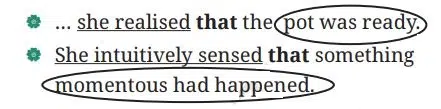
| Subordinate clauses that act like nouns and perform the same functions as subject or object are called noun clauses. |
1. Complete the following sentences with suitable noun clauses.
(i) The elders emphasised that _______________.
Answer: traditional skills should be passed on to the next generation.
(ii) Mesoba explained why _______________.
Answer: Arenla had not yet taught Sentila pot making.
(iii) Onula’s promise was that _______________.
Answer: she would teach Sentila how to make a perfect pot.
(iv) Sentila observed her mother carefully when she was shaping the mouth of the pot, which _______________.
Answer: helped her learn the correct technique.
(v) The kiln, where _______________, required careful attention to prevent over-or-under firing.
Answer: the pots were baked
2. Read the following sentences from the text.
Underline the main clause and circle the subordinate clause.
(i) Arenla took Sentila to the riverbank where the grey and red clay was found.
Answer:
- Main Clause: Arenla took Sentila to the riverbank
- Subordinate Clause: (where the grey and red clay was found)
(ii) She started on the next one, and like a sprinter who had suddenly found momentum…
Answer:
- Main Clause: She started on the next one
- Subordinate Clause: (who had suddenly found momentum)
(iii) … skills such as pot making, which not only catered to the needs of the people…
Answer:
- Main Clause: Skills such as pot-making
- Subordinate Clause: (which not only catered to the needs of the people)
| Subordinate clauses that act like adjectives and give further description of the noun in the main clause are called adjectival or relative clauses. |
3. Complete the following sentences with suitable relative clauses.
(i) Sentila, whose __, practised the craft diligently.
Answer: dream was to become a pot maker
(ii) The village council, where _, sought an explanation for Arenla’s reluctance.
Answer: the elders gathered
(iii) The potter’s hands, which __, shaped the clay into beautiful creations.
Answer: moved skillfully and carefully
(iv) Arenla, her mother, wanted her to learn weaving, which __________.
Answer: could earn more money and be done indoors.
(v) Mesoba went home and discussed the matter with Arenla, who _.
Answer: later agreed to teach Sentila.
Read the highlighted words in the following lines from the text.
- Onula saw her taking out some clay…
- … make as many pots as they could.
- … did not belong to any individual.
- Slowly she walked away from this place of wonder.
- … they would not have enough days of sunshine …
| The highlighted words are determiners. Determiners are words that come before nouns and specify something about their quantity, definiteness, or ownership. |
(i) Find out some more determiners from the text.
Answer: the, a, an, this, that, many, few, another, all, every, her, their, one, and two.
(ii) Fill in the banks with suitable determiners.
The first two blanks have been done for you.
A. The florist arranged five bouquets for her clients, that were displayed in _ elegant floral shop.
Answer: an
B. The carpenter crafted _ unique tables, and _________ became the centrepiece in ________ furniture collection.
Answer: two, they, his
C. _ of _ apprentices in _ culinary class demonstrated _ knife skills during the intense cooking session.
Answer: All, the, the, their
D. _ of _ sculptures were displayed at ___ art exhibition, showcasing _ diverse artistic skills.
Answer: Some, the, the, their
Listen and Respond
I. You will listen to a man speak about stone statues.
As you listen, complete the given paragraph by filling in the blanks with the exact words you listen to. (Transcript for teacher on page 261)
A statue is carved to create a shape that is 1. _______. Among the many things stone is used for making stone 2. ____ is one of them. India has some of the most 3. _________ stone sculptures, as is obvious from its many stone monuments across the country.
Answer: A statue is carved to create a shape that is 1. visually interesting. Among the many things stone is used for making stone 2. sculptures is one of them. India has some of the most 3. fascinating and mesmerising stone sculptures, as is obvious from its many stone monuments across the country.
II. You will now listen to the man speaking about some steps involved in making stone statues. As you listen, select the six correct steps out of the nine given. (Transcript for teacher on page 261)
- carve to remove large unwanted portions of the stone
- set up the different tools
- measure the weight and dimensions of the statue
- leave the statue in water to firm up overnight
- refine the creation within the stone
- choose the stone
- begin carving from the centre
- detach the creation from the stone as the final statue
- work to bring out the imagined shape
Answer: The six correct steps out of the nine given below –
- choose the stone
- measure the weight and dimensions of the statue
- carve to remove large unwanted portions of the stone
- work to bring out the imagined shape
- refine the creation within the stone
- detach the creation from the stone as the final statue
Speaking Activity
- Work in pairs and choose two characters from the story—Sentila and one other character [Arenla, Mesoba, Onula, or a village elder].
- Prepare to speak from the chosen character’s perspective based on information from the story and the understanding of the intentions of the characters.
- Prepare a role-play between Sentila and the chosen character. The conversation between the characters should cover the following points.
- Sentila’s desire to learn pot making
- the challenges she faces
- the advice or perspective the other character offers
- Students can use direct quotes from the story and creatively expand on the characters’ thoughts and feelings.
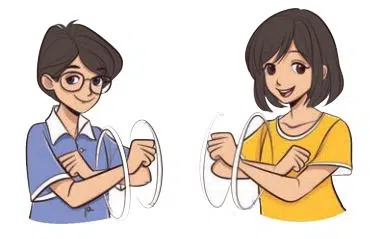
You may use the following sentence prompts.
- I feel/felt __ because…
- I wish/wished __ because…
- When you said/did _, it made me feel/think because…
Answer:
Role Play: Sentila and Onula
Sentila: Onula, I really want to become a pot maker like my mother and grandmother. I love watching the potters at work.
Onula: I know, Sentila. I have seen your interest and dedication. You work very hard to learn this skill.
Sentila: I feel sad because I have tried for a long time, but I still cannot make a good pot.
Onula: Don’t lose hope. Learning a skill takes time and practice.
Sentila: When my mother shapes a beautiful pot so easily, it makes me think that I may never learn it.
Onula: That is not true. I have watched you carefully. You are a quick learner, but you are too tense when you work.
Sentila: I wish I could make pots as skillfully as my mother because pot making is my dream.
Onula: You can achieve your dream. Watch your mother carefully and learn from every step she follows.
Sentila: When you said, “Don’t worry, little one, I shall teach you how to make a perfect pot,” it made me feel confident.
Onula: I am happy to hear that. Confidence is as important as skill.
Sentila: Thank you for helping me. I will keep trying and never give up.
Onula: That is the right attitude. With patience, hard work, and determination, you will become a skilled pot maker one day.
Writing Task
Reflective Writing – Identifying Skills and Passion
Reflective writing encourages introspection and thoughtful
exploration of personal experiences, skills, and aspirations.
It helps individuals gain deeper insights into themselves and
their goals through structured reflection.
I Follow the steps given below to create a write-up about your skills and passions.
- Step 1: Introduction
Reflect on your passions and the skills you currently possess or are developing. Consider why these activities or interests are meaningful and enjoyable to you. - Step 2: Describing skills
Describe specific activities or practices you engage in to nurture your skills. This could include hobbies, classes (art, music, coding, etc.), workshops, or personal projects. - Step 3: Passion into profession
Identify which of these skills you believe have the potential to turn your passion into a profession. Explain why you think these skills are crucial or advantageous in your chosen field. - Step 4: Examples and reflection
Provide examples or anecdotes that illustrate how your skills and passions complement each other. Reflect on how these experiences have shaped your career aspirations and personal growth. - Step 5: Conclusion
Summarise your reflections. Discuss any insights gained about yourself, your skills, and your career ambitions through this exercise.
Disclaimer: The content that is present on our website is based on the NCERT Class 9 English textbook and is provided for educational purposes only. All the content and images have been taken from English Class 9 NCERT Textbook and CBSE Support material. Images and content shown above are the property of individual organizations and are used here for reference purposes only. To make it easy to understand, some of the content and images are generated by AI and cross-checked by the teachers.