
← Back to Class 9 Science NCERT Solutions
Master Describing Motion Around Us Class 9 NCERT Solutions with clear and step-by-step answers based on the latest CBSE syllabus. This chapter introduces important concepts such as motion, distance, displacement, speed, velocity, acceleration, and graphical representation of motion. These NCERT solutions are designed to help students understand the concepts easily, improve problem-solving skills, and prepare effectively for school exams and competitive assessments.
Describing Motion Around Us Class 9 NCERT Solutions
1. How much distance should we maintain from the truck ahead to avoid a collision if it suddenly applies the brakes?
Answer: Trucks are big and heavy. They need more time to stop, so, to be safe, you must keep a big gap behind them. As per the road safety guidelines, in normal conditions, a 3 to 4 second gap or more is safe for trucks. In rain, fog, or hilly roads, increase to 6 to 8 seconds.
2. Does this distance depend upon the speed with which we are moving?
Answer: Yes, the distance depends on speed. In normal conditions, you can keep the distance between 3 to 4 seconds for trucks, but when the truck speed increases, then more distance should be followed.
Speed 3‑second gap (cars) 4‑second gap (trucks)
| Speed | 3‑second gap (cars) | 4‑second gap (trucks) |
|---|---|---|
| 40 km/h | 33 m | 44 m |
| 60 km/h | 50 m | 66 m |
| 100 km/h | 83 m | 112 m |
3. As shown in Fig. 4.5, a ball is thrown vertically upwards from O. It moves up straight till B and then falls back to O. Can this be considered a motion in a straight line?
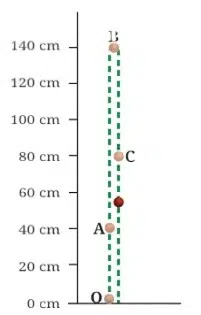
Answer: Yes, it is motion in a straight line.
Explanation:
The ball goes upwards from O to point B. Then it comes downward back to point O. Because the ball moves only in a vertical line, meaning upwards and downwards, the motion is linear, meaning straight-line motion, not curved.
4. For this motion, fill up the values in Table 4.1.
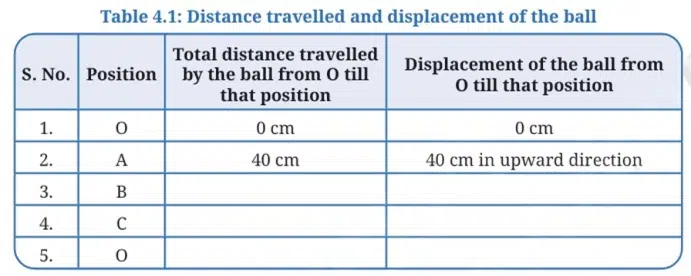
Answer:
| Position | Total distance travelled by the ball from 0 till that position | Displacement of the ball from 0 till that position |
|---|---|---|
| O | 0 cm | 0 cm |
| A | 40 cm | 40 cm in upward direction |
| B | 140 cm (40 cm up to A + 100 cm from A to B) | 140 cm upward |
| C | 180 cm (up to B = 140 cm + 40 cm down to C) | 100 cm upward |
| D | 280 cm (up to B = 140 cm + down to O = 140 cm) | 0 cm |
5. Analyse the data filled in Table 4.1 and choose which of the following is true for displacement:
- (i) It is never zero.
- (ii) Its magnitude can be greater than the total distance travelled.
- (iii) Its magnitude is less than or equal to the total distance travelled.
- (iv) Its magnitude is less than the total distance travelled in all cases.
Answer: (iii) Its magnitude is less than or equal to the total distance travelled.
Explanation:
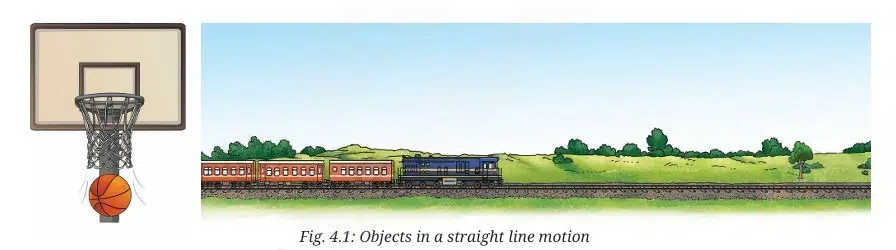
When the object moves in only one direction, either up-down or left-right, it is known as straight-line motion. In the fig., the basketball moves straight up and down through the hoop, which is a vertical straight line. The train moves forward on the track; it is a horizontal straight line.
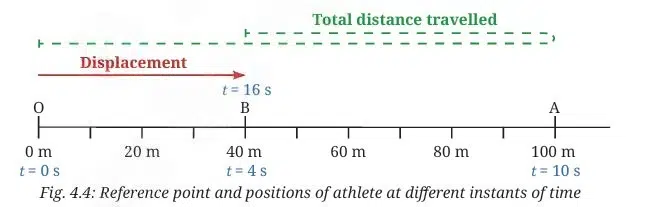
6. In the example of an athlete running back and forth on a straight track (Fig. 4.4), when will the displacement of the athlete be zero? What will be the total distance travelled in that case?
Answer:
- The athlete starts at O (0 m).
- Runs forward to A (100 m).
- Then back to B (40 m).
- Finally returns to O (0 m).
Distance Travelled
Distance = total path covered (adds up every step).
- O to A = 100 m
- A to B = 60 m
- B to O = 40 m
Total distance = 100 + 60 + 40 = 160 m
- The displacement of the athlete will be zero when she returns to the starting point O.
- The total distance travelled was 160 m.
7. Fuel used up in a vehicle depends on which of the following? Justify your answer.
(i) Total distance travelled
(ii) Displacement
Answer: Fuel used up in a vehicle depends on (i) Total distance travelled, not displacement.
Explanation:
The fuel consumption depends on how much the engine runs and how far the vehicle actually moves along the road. It means it depends on the total distance travelled.
8. A ball rolls down an inclined track as shown in Fig. 4.6. Is its motion, a straight line motion? Assuming the starting point of the ball (O) to be the origin, can its motion from O to D be depicted using a horizontal line as shown in Fig. 4.3? Are the values of total distance travelled and magnitude of displacement from O equal or different at positions A, B, C and D?
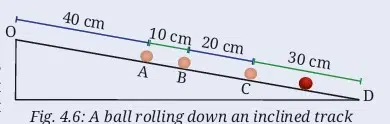

Answer: The ball’s motion is straight‑line motion along the slope. It cannot be shown as a horizontal line. At points A, B, C, and D, the total distance travelled and displacement are equal.
Explanation:
It is straight-line motion. Yes, the ball moves only on one slope line (O → A → B → C → D). Even if the slope is tilted, it is still a straight path.
Can we show it as a horizontal line? No, the athlete ran on a flat track, so we used a horizontal line. Here, the ball moves down a slanted track, so we must draw it as a slanted line, not flat.
Distance vs. Displacement
Distance is how much path the ball covers, and displacement is how far the ball is from the start point O. On this slope, the ball’s path and its straight line are the same. So, at A, B, C, and D, the distance traveled and displacement are equal.
9. During a family road trip, you drive 200 km north in three hours. Afterwards, you drive 200 km south in two hours. Find the average speed and average velocity for your entire trip.
Answer:
Given
- First part: 200 km north in 3 hours
- Second part: 200 km south in 2 hours
- Total time = 3 + 2 = 5 hours
Average Speed
Formula
\[ \text{Average Speed} = \frac{\text{Total Distance Travelled}}{\text{Total Time}} \]- Total distance = 200 + 200 = 400 km
- Total time = 5 hours
Average Velocity
Formula:
\[ \text{Average Velocity} = \frac{\text{Displacement}}{\text{Total Time}} \]- Displacement = final position – initial position
- You go 200 km north, then 200 km south → back to starting point
- So displacement = 0 km
- Average speed = 80 km/h
- Average velocity = 0 km/h
10. Under what condition(s) is the
(i) magnitude of average velocity of an object equal to its average speed?
(ii) magnitude of average velocity of an object zero while its average speed is not zero?
Answer:
- (i) Equal when motion is in one straight line, no change in direction.
- (ii) Velocity = 0, Speed ≠ 0 when the object comes back to the starting point.
11. My father went to a shop from home which is located at a distance of 250 m on a straight road. On reaching there, he discovered that he forgot to carry a cloth bag. He came home to take it, went to the shop again, bought provisions and came back home. How much was the total distance travelled by him? What was his displacement from home?
Answer:
The shop distance from home is 250m.

The father’s journey –
- Home to Shop = 250 m
- Shop to Home = 250 m
- Home to Shop = 250 m
- Shop to Home = 250 m
Total distance travelled
= 250 + 250 + 250 + 250
= 1000 m
Displacement
The displacement is the shortest distance from the starting point to the final position.
He started from home and finally return to the home on a straight road.
So, displacement = 0 m
Final Answer:
- Total distance travelled = 1000 m
- Displacement = 0 m
12. A student runs from the ground floor to the fourth floor of a school building to collect a book and then comes down to their classroom on the second floor. If the height of each floor is 3 m, find:
(i) the total vertical distance travelled, and
(ii) their displacement from the starting point.
Answer:
The height of each floor is 3 m
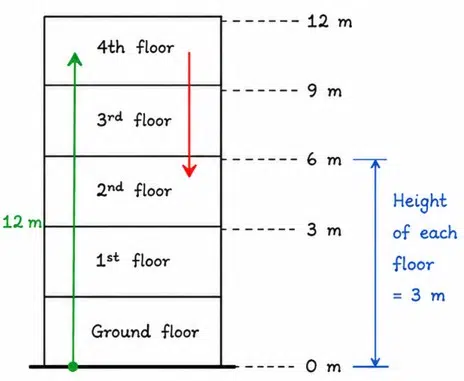
(i) Total vertical distance travelled
- Ground floor to 4th floor = 4 floors = 4 x 3 = 12 m
- 4th floor to 2nd floor = 2 floors = 2 x 3 = 6 m
Total distance = 12 + 6 = 18m
(ii) Displacement
- The formula is, displacement = final position – initial position
- Initial position (Ground floor) = 0 m
- Final position (2nd floor) = 2 x 3 = 6 m
So, displacement = 6 – 0 = 6 m
Final Answer:
- (i) Total vertical distance travelled = 18 m
- (ii) Displacement = 6 m upward
13. A girl is riding her scooter and finds that its speedometer reading is constant. Is it possible for her scooter to be accelerating and if so, how?
Answer: Yes, the scooter can be accelerating if the speedometer reading is constant. The speed meter shows only speed; it does not show the direction. Acceleration means the change in velocity (velocity = speed + direction). If the speed is constant but the direction changes, then the velocity will also change. This is acceleration. For example, if the girl rides her scooter around the circular track at a constant speed, then the speedometer shows the same reading, but the scooter is still accelerating because its direction is changing continuously. This acceleration is called centripetal acceleration.
- Constant speed + straight road = No acceleration
- Constant speed + turning road = Acceleration
14. A car starts from rest and its velocity reaches 24 m s–1 in 6 s. Find the average acceleration and the distance travelled in these 6 s.
Answer:
Given:
- Initial velocity, 𝑢 = 0 m/s (car starts from rest)
- Final velocity, 𝑣 = 24 m/s
- Time, 𝑡 = 6 s
Average Acceleration
Formula:
\[ a = \frac{v – u}{t} \]\[ a = \frac{24 – 0}{6} = \frac{24}{6} = 4 \, \text{m/s}^2 \]Average acceleration = 4 m/s²
Distance Travelled
Formula (using equation of motion):
\[ s = ut + \tfrac{1}{2}at^2 \]Here, 𝑢 = 0. So:
\[ s = 0 \cdot 6 + \tfrac{1}{2} \cdot 4 \cdot (6^2) \]\[ s = 2 \cdot 36 = 72 \, \text{m} \]Distance travelled in 6 s = 72 m
- The Average acceleration = 4 m/s²
- Distance travelled = 72m
15. A motorbike moving with initial velocity 28 m s–1 and constant acceleration stops after travelling 98 m. Find the acceleration of the motorbike and the time taken to come to a stop.
Answer:
Given:
- Initial velocity, u=28 m s−1
- Final velocity, v=0 m s−1 (motorbike stops)
- Distance travelled, s = 98 m
Step 1: Find the acceleration
Using the equation:
- v2 = u2 + 2as
Substituting the values:
- 02 = 282 + 2 × a × 98
- 0= 784 + 196a
- 196a = −784
- a = −4 m s−2
Acceleration = −4 m s−2
The negative sign indicates deceleration.
Step 2: Find the time taken to stop
Using the equation:
- v = u + at
Substituting the values:
- 0 = 28 + (−4)t
- 4t = 28
- t = 7 s
- Acceleration of the motorbike = −4 m s−2
- Time taken to come to a stop = 7 s
15. Fig. 4.27 shows a position-time graph of two objects A and B that are moving along the parallel tracks in the same direction. Do objects A and B ever have equal velocity? Justify your answer.
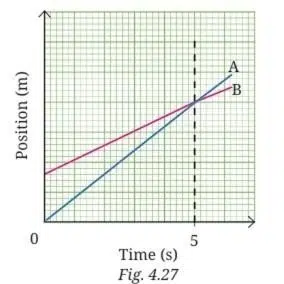
Answer: No, object A and B do not have equal velocity at any instant.
Justification:
In a position-time graph, the slope of the graph represents velocity.
\[ \text{Velocity} = \frac{\text{Change in Position}}{\text{Change in Time}} \]In figure,
- Object A is represented in the blue line.
- Object B is represented in a pink line.
- Both of the graphs have straight lines; it means that both objects move with constant velocity.
The slopes of the two lines are different and remain constant throughout the motion; their velocities are different at all times.
16. A graph in Fig. 4.28 shows the change in position with time for two objects A and B moving in a straight line from 0 to 10 seconds. Choose the correct option(s).
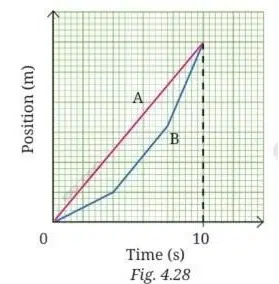
(i) The average velocity of both over the 10 s time interval is equal since they have the same initial and final positions.
(ii) The average speeds of both over the 10 s time interval are equal since both cover equal distance in equal time.
(iii) The average speed of A over the 10 s time interval is lower than that of B since it covers a shorter distance than B in 10 seconds.
(iv) The average speed of A over the 10 s time interval is greater than that of B since B’s speed is lower than A’s in some segments.
Answer: The correct options are (i) and (ii).
Explanation:
From Fig. 4.28
- Both of the object start from the same position at t = 0 s.
- Both of the object reach the same final position at t = 10 s.
(i) The average velocity of both over the 10 s time interval is equal since they have the same initial and final positions.
\[ \text{Average Velocity} = \frac{\text{Displacement}}{\text{Time}} \](ii) The average speeds of both over the 10 s time interval are equal since both cover equal distance in equal time.
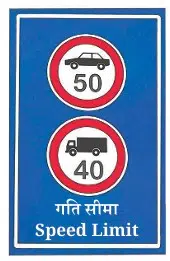
\[ \text{Average Speed} = \frac{\text{Distance}}{\text{Time}} \]17. A truck driver driving at the speed of 54 km h–1 notices a road sign with a speed limit of 40 km h–1 (Fig. 4.29) for trucks. He slows down to 36 km h–1 in 36 s. What was the distance travelled by him during this time? Assume the acceleration to be constant while slowing down.
Answer:
Given:
- Initial velocity, 𝑢 = 54 km/h = 15 m/s
- Final velocity, 𝑣 = 36 km/h = 10 m/s
- Time, 𝑡 = 36 s
Acceleration
Formula:
\[ a = \frac{v – u}{t} \]\[ a = \frac{10 – 15}{36} = \frac{-5}{36} \approx -0.14 \, \text{m/s}^2 \]Negative sign shows deceleration.
Distance Travelled
Equation:
\[ s = ut + \tfrac{1}{2}at^2 \]\[ s = 15 \cdot 36 + \tfrac{1}{2} \cdot (-0.14) \cdot (36^2) \]𝑠 = 540 − 91.5 = 448.5 m
- Acceleration = –0.14 m/s²
- Distance travelled = ≈ 449 m
18. A car starts from rest and accelerates uniformly to 20 m s–1 in 5 seconds. It then travels at 20 m s–1 for 10 seconds and finally applies the brake (with uniform acceleration) to stop in 6 seconds. Find the total distance travelled.
Answer:
Given:
- Initial velocity, 𝑢 = 0 m/s
- Final velocity after acceleration, 𝑣 = 20 m/s
- Time for acceleration, 𝑡1 = 5 s
- Constant velocity time, 𝑡2 = 10 s
- Time for braking, 𝑡3 = 6 s
Distance during acceleration
Equation:
\[ s_1 = ut + \tfrac{1}{2}at^2 \]First, find acceleration:
\[ a = \frac{v – u}{t} = \frac{20 – 0}{5} = 4 \, \text{m/s}^2 \]Now,
\[ s_1 = 0 \cdot 5 + \tfrac{1}{2} \cdot 4 \cdot (5^2) \]\[ s_1 = 2 \cdot 25 = 50 \, \text{m} \]Distance during constant velocity
Equation:
- s2 = v . t
- s2 = 20 . 10 = 200 m
Distance during braking
Equation:
\[ s_3 = \tfrac{1}{2}(u+v)t \]\[ \text{Here, } u = 20 \, \text{m/s}, \; v = 0 \, \text{m/s}, \; t = 6 \, \text{s} \]\[ s_3 = \tfrac{1}{2}(20+0) \cdot 6 \]\[ s_3 = 10 \cdot 6 = 60 \, \text{m} \]Total Distance
- 𝑠 = 𝑠1 + 𝑠2 + 𝑠3
- 𝑠 = 50 + 200 + 60 = 310 m
Total distance traveled = 310 m
19. A bus is travelling at 36 km h–1 when the driver sees an obstacle 30 m ahead. The driver takes 0.5 seconds to react before pressing the brake. Once the brake is applied, the velocity of the bus reduces with constant acceleration of 2.5 m s–2. Will the bus be able to stop before reaching the obstacle?
Answer:
Given data
- Initial velocity: 𝑢 = 36 km/h = 10 m/s
- Distance to obstacle: 30 m
- Reaction time: 𝑡𝑟 = 0.5 s
- Deceleration: 𝑎 = − 2.5 m/s2
Step 1: Distance covered during reaction time
𝑠𝑟 = 𝑢 ⋅ 𝑡𝑟 = 10 ⋅ 0.5 = 5 m
Step 2: Braking distance
Formula:
\[ s_b = \frac{u^2}{2|a|} \]\[ s_b = \frac{10^2}{2 \cdot 2.5} = \frac{100}{5} = 20 \, \text{m} \]Step 3: Total stopping distance
s = s𝑟 + sb = 5 + 20 = 25 m
- Total stopping distance = 25 m
- Obstacle distance = 30 m
- Since 25 < 30, the bus will stop safely before hitting the obstacle.
20. A student said, “The Earth moves around the Sun”. In this context, discuss whether an object kept on the Earth can be considered to be at rest.
Answer: Rest and motion are both relative terms. The earth moves around the sun, but everything on earth, like trees, houses, and people, also moves with the earth. If we take the earth as the reference frame, then an object kept on Earth does not change its position with respect to Earth. So it is considered rest. If we take the reference of the sun, then the same object is moving because it is carried along with earth in its orbit.
Explanation:
Suppose you are sitting in the bus; you are at rest compared to the bus seat, but you are moving compared to the roadside. In the same way, a book on Earth is at rest compared to Earth, but moving compared to the sun.
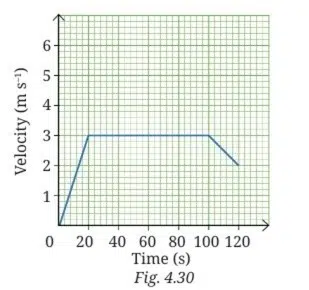
21. The velocity-time graph from 0 s to 120 s for a cyclist is shown in Fig. 4.30. Shade the areas (in different colours) representing the displacement of the cyclist
(i) while cyclist is moving with constant velocity.
(ii) when the velocity of cyclist is decreasing.
Also, calculate the displacement and average acceleration in the 120 s time interval.
Answer:
Constant velocity (20–80 s):
- Velocity = 3 m/s
- Time = 60 s
- Displacement = 3 × 60 = 180 m
Decreasing velocity (80–120 s):
- Velocity falls from 3 m/s to 2 m/s
- Shape = trapezium
Increasing velocity (0–20 s):
- Shape = triangle
Total Displacement
𝑠 = 30 + 180 + 100 = 310 m
Average Acceleration
\[ a_{\text{avg}} = \frac{v_{\text{final}} – v_{\text{initial}}}{t} = \frac{2 – 0}{120} = 0.0167 \,\text{m/s}^2 \]- Displacement of cyclist = 310 m
- Average acceleration = 0.0167 m/s²
- Shaded areas:
- Rectangle (constant velocity, 20–80 s)
- Trapezium (decreasing velocity, 80–120 s)
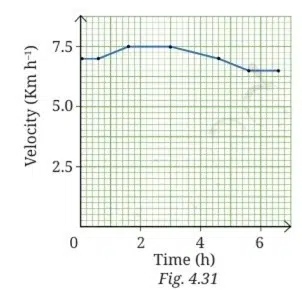
23. A girl is preparing for her first marathon by running on a straight road. She uses a smartwatch to calculate her running speed at different intervals. The graph (Fig. 4.31) depicts her velocity versus time. Estimate the distance she ran based on the graph.
Answer:
The distance travelled by the girl is equal to the area under the velocity–time graph. We divide the graph into simple parts and calculate the area of each part.
From 0 h to 1 h
Speed = 7 km/h
Distance = 7 × 1 = 7 km
From 1 h to 2 h
Speed = 7.5 km/h.
Average speed
\[ =\frac{7+7.5}{2}=7.25 \text{ km/h} \]Distance
\[ =7.25 \times 1 = 7.25 \text{ km} \]From 6 h to 7 h
Speed = 6.5 km/h
\[ \text{Distance} = 7.5 \times 2 = 15 \text{ km} \]Total Distance
7 + 7.25 + 15 + 7.25 + 6.75 + 6.5 = 49.75 km
The girl ran approximately 50 km.
24. On entering a state highway, a car continues to move with a constant velocity of 6 m s–1 for 2 minutes and then accelerates with a constant acceleration 1 m s–2 for 6 seconds. Find the displacement of the car on the state highway in the 2 min 6 s time interval by drawing a velocity-time graph for its motion.
Answer:
Given:
- Initial velocity, u = 6 ms−1−2
- Time of acceleration = 6 s
First, find the final velocity after acceleration:
- v= u + at
- v= 6 + ( 1 × 6 )
- v = 12 ms−1
The velocity-time graph consists of:
- A rectangle from 0 to 120 s with height 6 ms−1
- A trapezium from 120 s to 126 s with parallel sides 6 and 12 ms−1
Distance during first 120 s
Area of rectangle = 120 × 6
= 720 m
Distance during next 6 s
\[ \text{Area of trapezium} = \frac{1}{2}(6+12)\times 6 \]\[ = \frac{1}{2}\times 18 \times 6 \]\[ = 54\ \text{m} \]Total Displacement
Displacement = 720 + 54
= 774 m
The displacement of the car in 2 min 6 s is 774 m.
25. Two cars A and B start moving with a constant acceleration from rest, in a straight line. Car A attains a velocity of 5 m s–1 in 5 s. Car B attains a velocity of 3 m s–1 in 10 s. Plot the velocity-time graphs for both the cars in the same graph. Using the graph, calculate the displacement in the two time intervals mentioned (Hint: Calculate the acceleration in both cases. Then calculate their velocities at five instants of time to plot the graph).
Answer:
For Car A:
u = 0, v = 5 ms−1, t = 5 s
\[ a_A=\frac{v-u}{t} =\frac{5-0}{5} =1\ \text{m s}^{-2} \]For Car B:
u = 0, v = 3 ms−1, t = 10 s
\[ a_B=\frac{v-u}{t} =\frac{3-0}{10} =0.3\ \text{m s}^{-2} \]Plot the following points on the same velocity-time graph:
| Time (s) | Velocity of A (m/s) | Velocity of B (m/s) |
|---|---|---|
| 0 | 0 | 0 |
| 1 | 1 | 0.3 |
| 2 | 2 | 0.6 |
| 3 | 3 | 0.9 |
| 4 | 4 | 1.2 |
| 5 | 5 | 1.5 |
| 10 | 10 | 9 |
Velocity-Time Graph of Cars A and B
Both cars start from rest with constant acceleration.
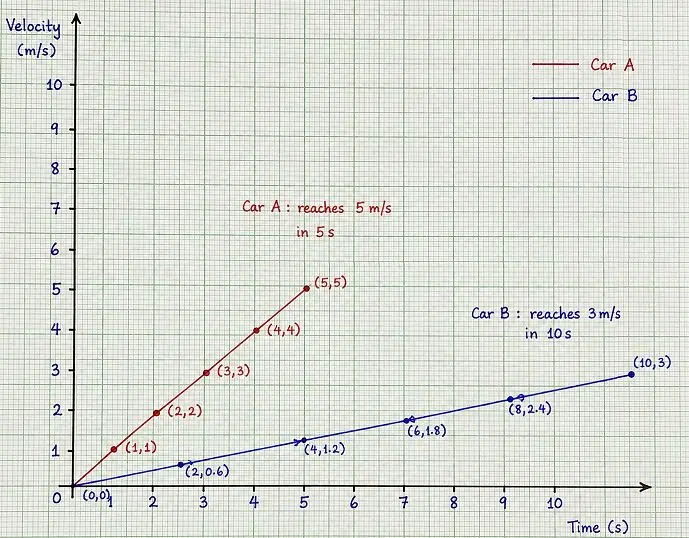
The displacement is equal to the area under the velocity-time graph.
Car A (0 to 5 s)
\[ \text{Area of triangle} = \frac{1}{2}\times 5 \times 5 \]\[ = 12.5\ \text{m} \]Car B (0 to 10 s)
\[ \text{Area of triangle} = \frac{1}{2}\times 10 \times 3 \]\[ = 15\ \text{m} \]- Displacement of Car A = 12.5 m
- Displacement of Car B = 15 m
Car B travels a greater displacement than Car A during the given time intervals.
26. Rohan studies science from 6 PM to 7:30 PM at home. Consider the tip of the minute’s hand of the wall clock. During the given time interval, what is its:
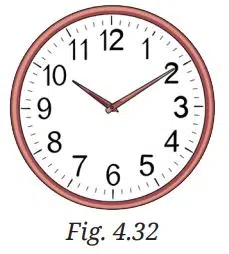
(i) distance travelled,
(ii) displacement,
(iii) speed, and
(iv) velocity.
The length of the minute’s hand is 7 cm (Fig. 4.32).
Answer:
- Time interval = 6:00 PM to 7:30 PM = 90 minutes
- Length of minute hand, r=7 cm
The minute hand completes:
\[ \frac{90}{60} = 1.5 \]revolutions in 90 minutes.
(i) Distance travelled
In one revolution, the tip of the minute hand travels a distance equal to the circumference of the circle.
Circumference = 2πr
\[ = 2\times\frac{22}{7}\times 7 \]\[ = 44\ \text{cm} \]Distance travelled in 1.5 revolutions:
Distance = 1.5 × 44
= 66 cm
Distance travelled = 66 cm
(ii) Displacement
From 6:00 PM to 7:30 PM, the minute hand moves through 1.5 revolutions and reaches the position diametrically opposite to its starting point.
Therefore, displacement is equal to the diameter of the circle.
Displacement = 2r
= 2 × 7
= 14 cm
Displacement = 14 cm
(iii) Speed
\[ speed = \frac{distance travelled}{time taken} \]\[ \frac{66}{90} = 1.5 \]= 0.733 cm min−1
Speed = 0.733 cm min-1
(iv) Velocity
\[ Velocity = \frac{displacement}{time taken} \]\[ \frac{14}{90} \]= 0.156 cm min−1
Disclaimer: The content that is present on our website is based on the NCERT Class 9 Science textbook and is provided for educational purposes only. All the content and images have been taken from Science Class 9 NCERT Textbook and CBSE Support material. Images and content shown above are the property of individual organizations and are used here for reference purposes only. To make it easy to understand, some of the content and images are generated by AI and cross-checked by the teachers.