
These Coordinate Geometry Class 9 Notes cover The Use of Coordinates, also known as Maths Class 9 Chapter 1 in the latest NCERT syllabus. These notes explain the Cartesian plane, coordinates, quadrants, distance between two points, solved examples, and important questions for quick revision.
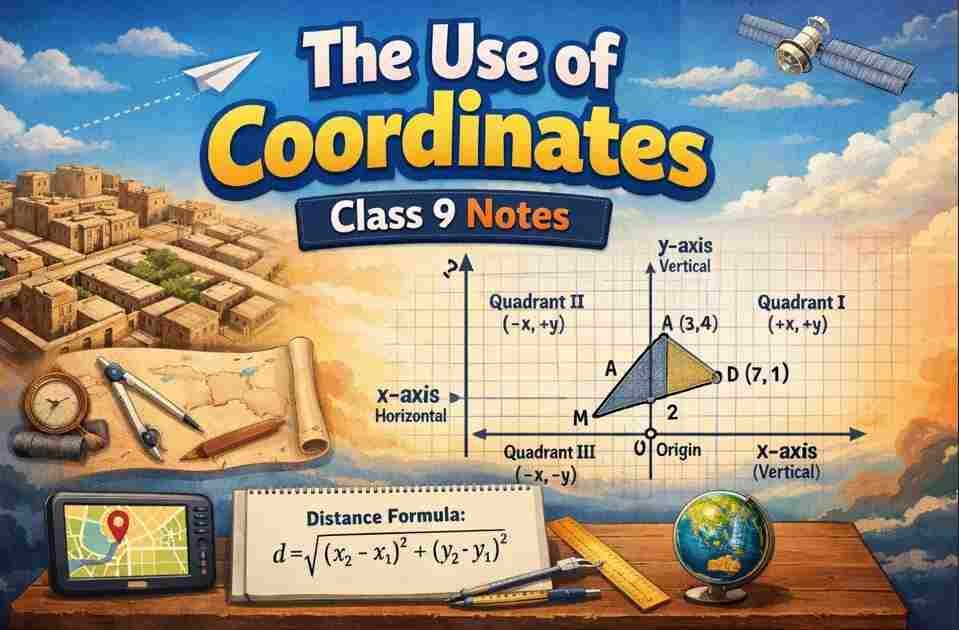
The Use of Coordinates Class 9 Notes | Coordinate Geometry Chapter 1
What is a coordinate system?
A coordinate system is a method to find the exact position of the point using numbers; it is just like a map or graph paper with lines and grids. For example, if you want to find a seat in a classroom, then coordinates help to locate points.
History of Coordinate Geometry
1. Ancient India and Grids: In ancient India, the Sindhu-Saraswati civilisation used the grid method to plan the city. The roads were built from north to south and east to west directions. At that time, people located places by using counting distances.
2. Baudhāyana’s Contribution: In many places in India you will find Boudh construction. At that time Baudhāyana used geometric lines for mathematical constructions. They developed the Baudhāyana–Pythagoras theorem, and it is known as the base of coordinate geometry.
3. Ujjayinī and Navigation: Today, many maps use Greenwich (England) as the “zero longitude” point. In a similar manner, in India, Ujjayinī was treated like a starting reference point. In ancient times, people wanted to find the location, and then they measured its distance and direction from Ujjayinī.
4. Aryabhata’s Work: Aryabhata used sines and celestial coordinates, which helped to calculate positions of stars and cities.
5. Brahmagupta’s Contribution: Brahmagupta introduced zero and negative numbers. These methods are very important in modern coordinate systems.
6. Arab and European Contributions: The Indian mathematical ideas spread to Arab scholars, and Al-Bīrūnī used Indian methods for mapping cities. René Descartes later developed the Cartesian coordinate system.
7. Cartesian Coordinate System: In the Cartesian Coordinate System, a point in a plane is represented using two numbers. These numbers show the distance from:
- Horizontal axis (x-axis)
- Vertical axis (y-axis)
Setting In
Reiaan and his sister Shalini went to a new city and joined a new school, but Reiaan cannot see, so Shalini used coordinate geometry to help him to understand the layout of this new room. Shalini made a rectangular grid using pins and threads. The grid represented the floor map of the room. Shalini uses a scale to make geometry coordination where 1 cm = 1 foot. Now, the Reiaan could feel the arrangement of the room using his fingers.
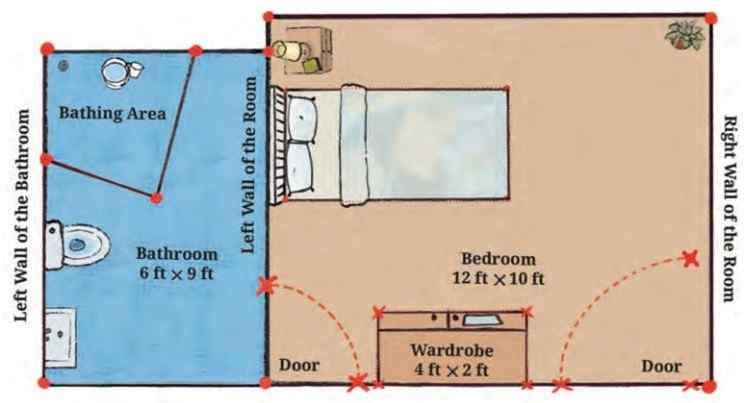
Why are windows not shown?
The map can only represent the floor of the room. Windows are placed on the wall above the floor, so it is not possible to show the windows.
The 2-d Cartesian Coordinate System
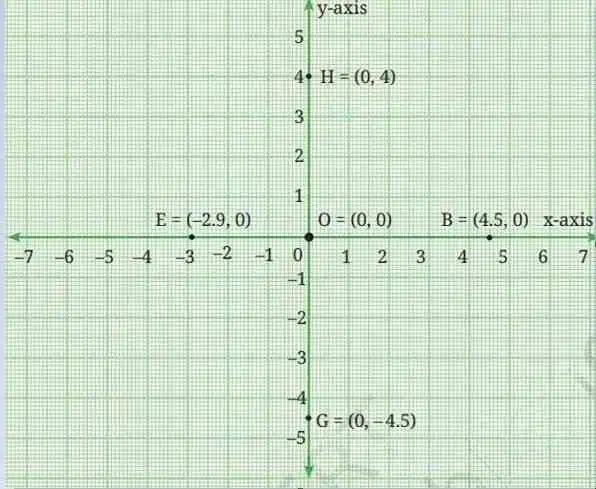
In coordinate geometry, we use two lines to locate points in a plane. There are two perpendicular lines:
- x-axis: Horizontal line
- y-axis: Vertical line
When the two axes meet at a point called the origin, or you can say that the point where both axes intersect is called the origin. The coordinates of the origin will be (0,0).
Positive and Negative Directions
On the x-axis
- Right side of origin: Positive numbers
- Left side of origin: Negative numbers
On the y-axis
- Above origin: positive numbers
- Below is the origin: Negative numbers
Coordinates of points are written as (x, y), where the first number is the position on the x-axis and the second number is the position on the y-axis.
Cartesian Plane and Quadrants
The plane in which the axes are situated is called the Cartesian plane, the coordinate plane or the xy-plane. The axes
divide the plane into four parts, called quadrants.
- Quadrant I: (+x, +y)
- Both x and y are positive.
- Quadrant II: (−x, +y)
- x is negative, y is positive.
- Quadrant III: (−x,−y)
- Both x and y are negative.
- Quadrant IV: (+x,−y)
- x is positive; y is negative.
Distance Between Two Points in the 2-D Plane
We already understand how to find the distance between two points when they lie on the same axis or when the line joining them in parallel to the x-axis or y-axis. But when the points are not aligned horizontally or vertically, we use the special method Baudhāyana–Pythagoras Theorem (Pythagoras Theorem).
How it works
- If two points form a slanted line in the xy-plane, we can:
- Form a right-angled triangle using horizontal and vertical lines.
- Treat the horizontal and vertical distances as the two sides of a right triangle.
- Then apply the Pythagorean theorem to find the actual distance (hypotenuse).
Look at triangle ADM in Fig.
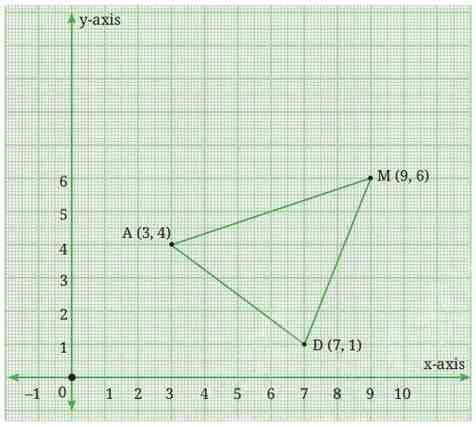
Triangle ADM is an acute angled triangle in the first quadrant. How do we find the lengths of its sides AD, DM and MA?
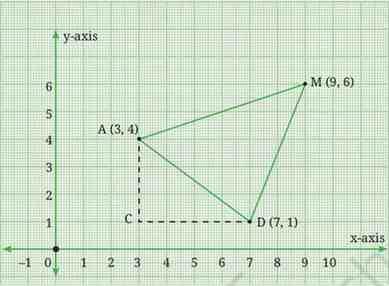
Fig. gives us a clue. The distance moved along the x-axis is given by CD.
CD = x-coordinate of D – x-coordinate of A = 7 – 3 = 4.
The distance moved along the y-axis is given by AC.
AC = y-coordinate of A – y-coordinate of D = 4 – 1 = 3.
Using the Baudhāyana–Pythagoras Theorem, we get the distance
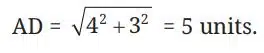
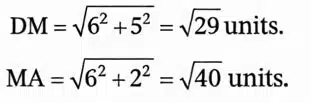
We similarly find the distances DM and MA:
In general, the distance between the points (x1, y1) and (x2, y2) is given by
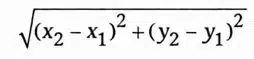
and is calculated as shown in Fig.
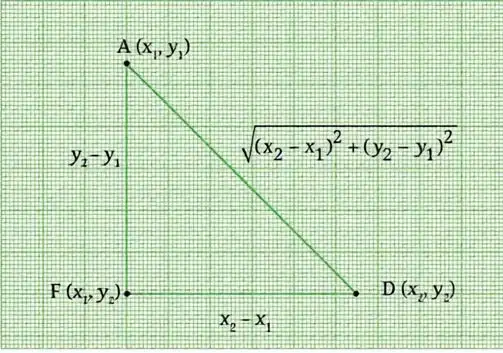
It makes no difference whether (x2 – x1) and (y2 – y1) are positive or negative, as we are simply measuring the shifts along the two axes.
What if, x1, x2, y1, y2 take negative values? In Fig, triangle AMD is reflected in the y-axis. What are the coordinates of the images of points A, M, and D?
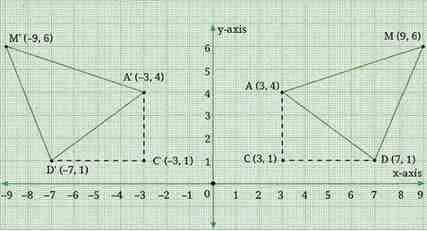
C’D’ = x-coordinate of A’ – x-coordinate of D’ = –3 – (–7) = 4.
A’C’ = y-coordinate of A’ – y-coordinate of D’ = 4 – 1 = 3.
Using the Baudhāyana–Pythagoras Theorem, we get
You can similarly calculate both D’M’ and M’A’:
We see that reflection has preserved the lengths of the sides of the triangles.
Disclaimer: The content that is present on our website is based on the NCERT Class 9 Science textbook and is provided for educational purposes only. All the content and images have been taken from Science Class 9 NCERT Textbook and CBSE Support material. Images and content shown above are the property of individual organizations and are used here for reference purposes only. To make it easy to understand, some of the content and images are generated by AI and cross-checked by the teachers.