
← Back to Class 9 Science Notes
The chapter “Describing Motion Around Us” helps students understand different types of motion and the methods used to describe them. It also explains important concepts like distance, displacement, speed, velocity, and acceleration with examples from everyday life. This chapter builds the foundation for understanding advanced topics in physics and motion.
Describing Motion Around Us Class 9 Notes
What are motions?
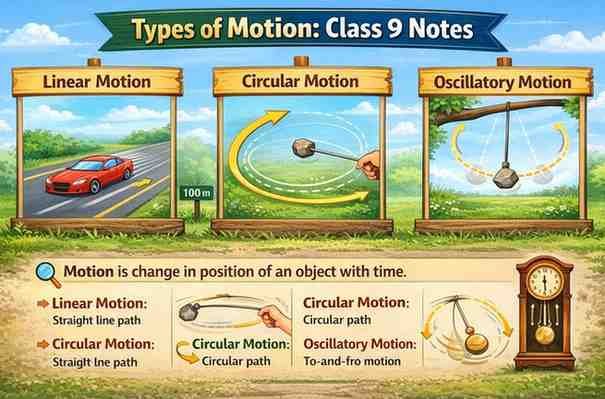
Motion means a change in the position of an object with time. Everything in nature is in motion, like butterflies flying, snakes slithering, ocean tides, etc. Motion in nature is complex and varied. Scientists simplify it to understand better. They study motion in simple form first.
There are three types of motion.
- Linear Motion: It is a motion in a straight line, e.g., a car moving on a straight road.
- Circular motion, in this motion the motion in a circular path example, a stone tied to a string and rotated
- Oscillatory motion: It is to-and-fro motion about a mean position, for example, the pendulum of a clock.
Motion in a Straight Line
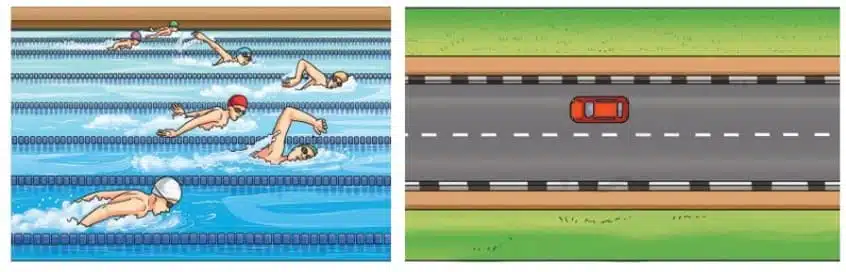
When an object moves in a straight line, its motion is called ‘linear motion’ or ‘motion in a straight line’. It is the simplest kind of motion. For example, children in a swimming race or car moving on the highway. To discuss the motion of an object, first we need to describe its position at various instants of time.
Describing position
The position of an object tells us where the object is located at a particular time. To describe the position, we need the following:
- A reference point
- Distance from that point
- Direction
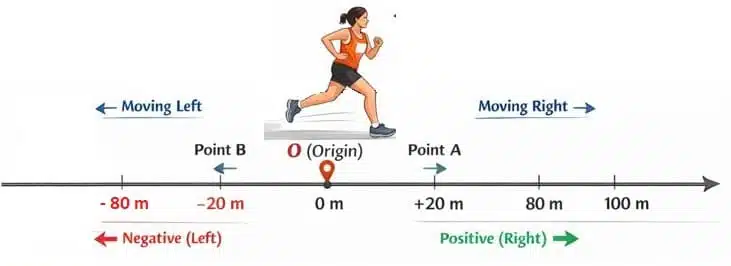
Let us take the example of an athlete running on a straight track.
To describe the position of the athlete, her starting point is taken as a reference point, which is marked as the origin (O). The athlete starts running from O, and her positions at different instants of time are marked by points B and A.
To describe the position of an object, we also need to specify its direction. If the object is moving in a straight line, it can move in only two directions — forward and backward.
- The forward direction is represented by a plus (+) sign.
- The backward direction is represented by a minus (–) sign.
The positions to the right of the reference point (O) are generally taken as positive (+), and the positions to the left of O are taken as negative (–).
Distance travelled and displacement
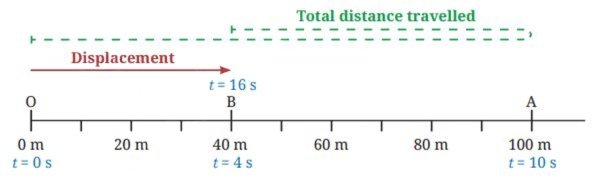
Suppose an athlete starts running from point O and reaches point A in 10 s. After that, she returns back to point B and takes 6 s. The total distance travelled is 100 m + 60 m = 160 m, and the total time taken is 16 s. The displacement is the shortest distance between the starting point and the final position, along with direction. Here, the athlete starts from O and stops at B, so the displacement is OB = 40 m in the forward (positive) direction.
Displacement is the change in position of an object. It is the shortest distance from the starting point to the final position and has a direction.
Distance tells only the total path covered and has no direction.
Example: Distance = 160 m, Displacement = 40 m (positive direction).
Average speed and average velocity
1. Average speed
The average speed of an object is the total distance travelled divided by the time interval during which this distance is covered. Thus,

The distance travelled has no direction (but only a numerical value).
Example 4.1: Consider two postman. They start walking towards each other from a distance of 210 km. One postman travels 9 km per day and the other covers 5 km per day. Can you determine in how many days they will meet each other?
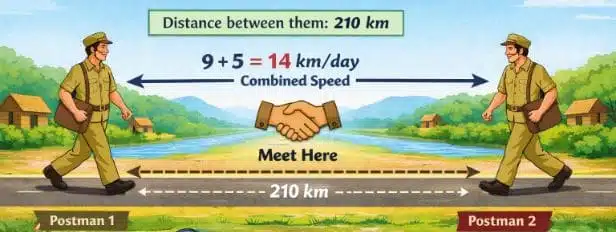
Total of distance covered by each postman in one day = 9 km + 5 km = 14 km.
To meet with each other, the postmen need to cover 210 km together.
Time taken by them to cover 210 km together
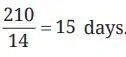
So, both postmen will meet each other after 15 days.
2. Average velocity
Average velocity tells how fast and in which direction position changes. It is calculated as,

If we represent average velocity by vav , displacement by s and time interval by t, then can be written as
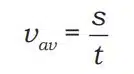
- To express the average velocity, you need to specify its magnitude as well as the direction.
- The direction of the velocity is the same as the direction of displacement and is indicated by a ʻ ʼ or ʻ–ʼ sign.
- The SI unit of average speed and average velocity are the same.
- It is metre per second which is represented by m s–1 or m/s.
- It is also commonly measured in kilometre per hour (km h–1).
Example: Sarang takes 50 seconds to swim from one end to the other end and back in the swimming pool. Find his average speed and average velocity within the time interval of 50s.
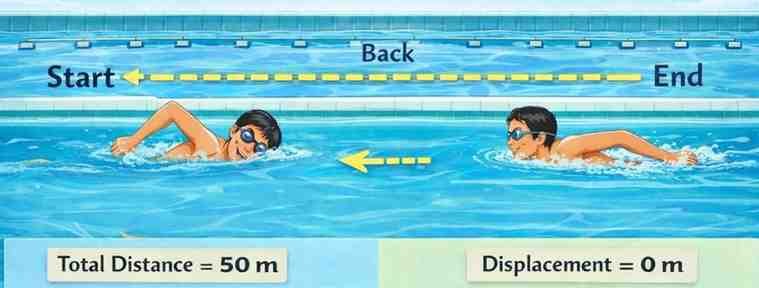
Total distance travelled by Sarang in 50 s = 50 m, displacement of Sarang in 50 s = 0 m
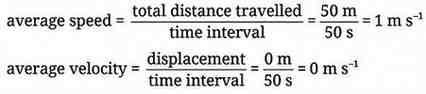
During the 50 s time interval, the average speed of Sarang is approximately 1 m s –1 while his average velocity is 0 m s –1.
Average acceleration
when the vehicle is in motion and suddenly stops, you experience a jolt. These occurrences capture the feeling of the change in velocity. You can find the change in velocity if you know the velocity at two different instants of time.
The average acceleration of an object over a time interval is the change in its velocity divided by the time interval. That is,
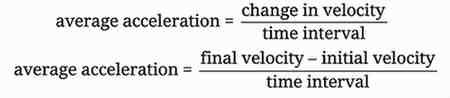
If the velocity of an object changes from an initial value u at time t1 to the final value v at time t2, the average acceleration a is,
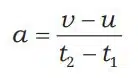
- The SI unit of average acceleration is m s –2 or m/s2.
- Like displacement and velocity, we need to specify the magnitude as well as the direction of acceleration.
- For motion in a straight line, if the magnitude of velocity is increasing in a given time interval, the average acceleration is in the direction of velocity.
- Whereas, the average acceleration is opposite to the direction of velocity if the magnitude of velocity is decreasing.
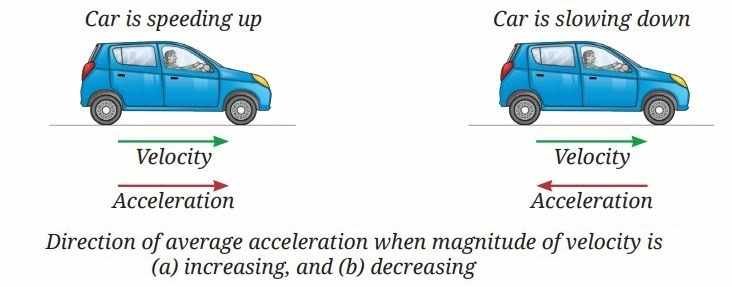
The average acceleration can result from change in the magnitude of velocity or change in its direction, or both.
Example:
- A Car on the Road
- A car is moving with an initial velocity of 20 m/s.
- After 5 seconds, its velocity increases to 30 m/s.
Step 1: Formula for Average Acceleration
𝑎 = (𝑣 − 𝑢) / 𝑡
where:
- 𝑣 = final velocity
- 𝑢 = initial velocity
- 𝑡 = time taken
Step 2: Substitute values
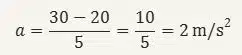
The average acceleration of the car is 2 m/s².
Graphical Representation of Motion
Graphical presentation is a useful method for representing motion. It provides a visual representation of how position, velocity and acceleration change with time. Such graphs help in:
- Comparing the motion of two objects
- Calculating physical quantities
- Identifying whether the motion is uniform or non-uniform.
Plotting a graph
To plot a graph, let us use the data given for a vehicle moving on a straight road.

- Draw X-axis (time) and Y-axis (position) with origin O.
- Choose a suitable scale for both axes.
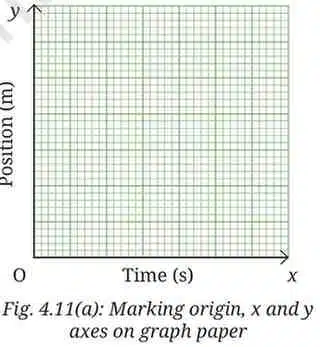
- Mark time values on the X-axis.
- Mark position values on the Y-axis.
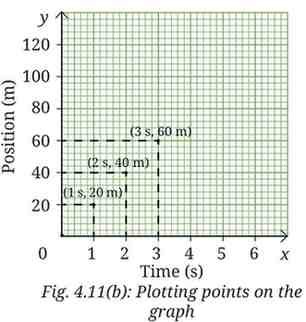
- Plot each point on the graph.
- Join all points smoothly and make a straight line or curve.
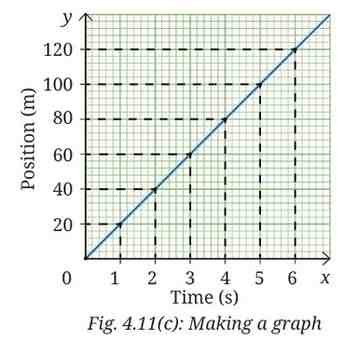
Note: A graph shows the route and how the position of the object changes with time with respect to the origin.
Position-time graphs
The position-time graph represents the motion of an object and shows how the position of an object changes with time.
What does the shape of the position-time graph indicate about the nature of motion?
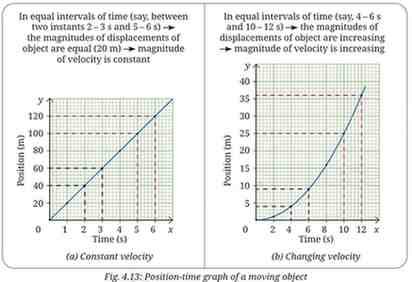
As we can see, a straight-line position-time graph indicates that the object is moving with a constant velocity. On the other hand, a curved position-time graph indicates that the velocity is not constant, and thus, the object is in accelerated motion.
Which physical quantities can be obtained from a position-time graph?
From a position-time graph, we can obtain the following:
- Position of the object
- Velocity of the object (by calculating the slope of the graph)
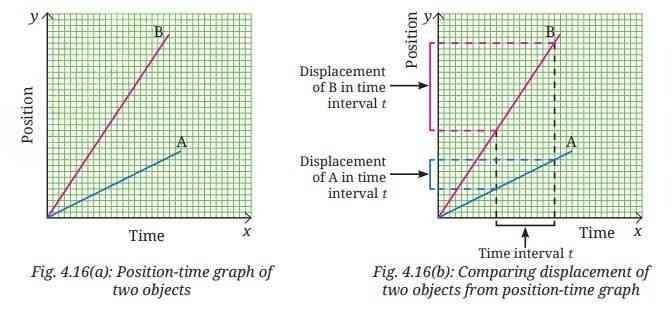
Example: The position-time graphs of two objects, A and B, are given. In which object is the magnitude of average velocity higher?
By making lines parallel to axes as shown, it is found that the displacement of object B is greater than object A for the same time interval. That is, the slope of the line for B is steeper than the slope for line A. Thus, the velocity of B is higher than that of A.
Velocity-time graphs
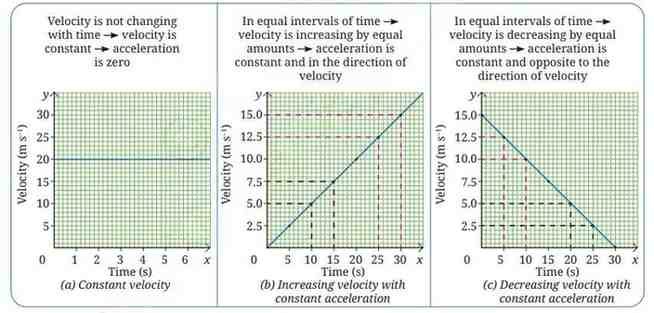
A velocity–time graph shows how the velocity of an object changes with time. It helps us understand the nature of motion and acceleration of the object.
Case 1: Constant Velocity
If a car moves at a constant speed of 72 km/h (20 m/s), the velocity–time graph is a straight line parallel to the time axis (x-axis).
This means:
- Velocity does not change with time
- Acceleration is zero
This represents uniform motion
Case 2: Increasing Velocity
If a car starts from rest and its velocity increases uniformly, the velocity–time graph is a straight line sloping upward.
This means:
- Velocity increases uniformly with time
- Acceleration is constant and positive
This represents uniform acceleration
Case 3: Decreasing Velocity
If a car slows down from 15 m/s, the velocity–time graph is a straight line sloping downward.
This means:
- Velocity decreases uniformly with time
- Acceleration is constant and negative (retardation)
This represents uniform deceleration
Which physical quantities can be obtained from a velocity-time graph?
Apart from finding the velocity at each instant, a velocity–time graph helps us calculate other important physical quantities:
1. Acceleration (from slope of graph)
The slope of a velocity–time graph gives the rate of change of velocity with time. This is called acceleration
Formula:
a = (u – u) / (t2 – t2)
Meaning:
- If slope = 0 → velocity is constant → acceleration = 0
- If slope is positive → uniform acceleration
- If slope is negative → uniform deceleration (retardation)
2. Displacement (from area under graph)
The area between the velocity–time graph and the time axis gives displacement. This works for both constant and uniformly changing motion.
1. Case A: Constant velocity
Displacement = velocity x time
2. Case B: Uniform acceleration
For a straight-line graph (trapezium/triangle + rectangle):
Displacement=ut + (1/2)at2
Kinematic Equations for Motion in a Straight Line with Constant Acceleration
When an object moves in a straight line with constant acceleration, we use some simple formulas called kinematic equations. These help us calculate velocity, displacement, and time.
1. First Equation of Motion
- Formula: v = u + at
- Meaning: Final velocity = Initial velocity + (Acceleration × Time)
- Use: To find final speed when time is given.
2. Second Equation of Motion
- Formula: s = ut + ½ at²
- Meaning: Displacement = (Initial velocity × time) + (½ × acceleration × time²)
- Use: To find distance (displacement) when time is known.
3. Third Equation of Motion
- Formula: v² = u² + 2as
- Meaning: Final velocity² = Initial velocity² + (2 × acceleration × displacement)
- Use: To find velocity or distance when time is NOT given.
Circular motion
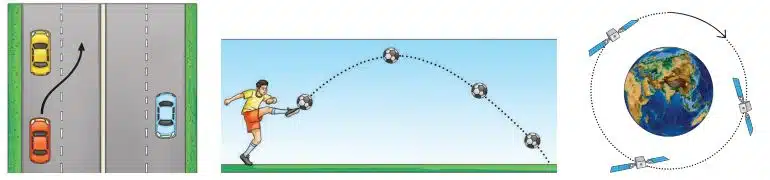
When an object moves along a circular path, its motion is called circular motion. Examples include a merry-go-round, wheels, and a rotating fan. For example, A child sitting on a merry-go-round moves along a circular path (A → B → C).
- Distance travelled = curved path (ABC)
- Displacement = straight line (AC)
Distance and displacement are not equal.
When the child completes one full round:
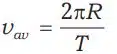
Distance = circumference of circle =
2πR
Displacement = 0 (returns to starting point)
If time for one revolution is T, then:
Uniform Circular Motion
When an object moves in a circular path with constant speed, it is called uniform circular motion. Even if speed is constant, the direction of velocity changes continuously.
Example (Athlete on Track)
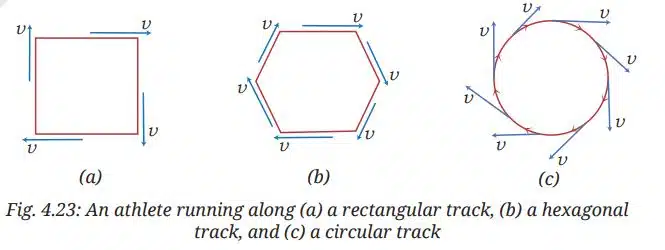
- Rectangular track → direction changes 4 times
- Hexagonal track → direction changes 6 times
- As sides increase → becomes circular path
- In circle → direction changes continuously
Disclaimer: The content that is present on our website is based on the NCERT Class 9 Science textbook and is provided for educational purposes only. All the content and images have been taken from Science Class 9 NCERT Textbook and CBSE Support material. Images and content shown above are the property of individual organizations and are used here for reference purposes only. To make it easy to understand, some of the content and images are generated by AI and cross-checked by the teachers.
थैंक्यू