
← Back to Class 9 Science Notes
Science is not about memorising facts; it is about understanding how these facts come to our knowledge. In this stage we learn to observe carefully, measure accurately, use symbols and equations and test our ideas. The scene uses models to simplify the things.
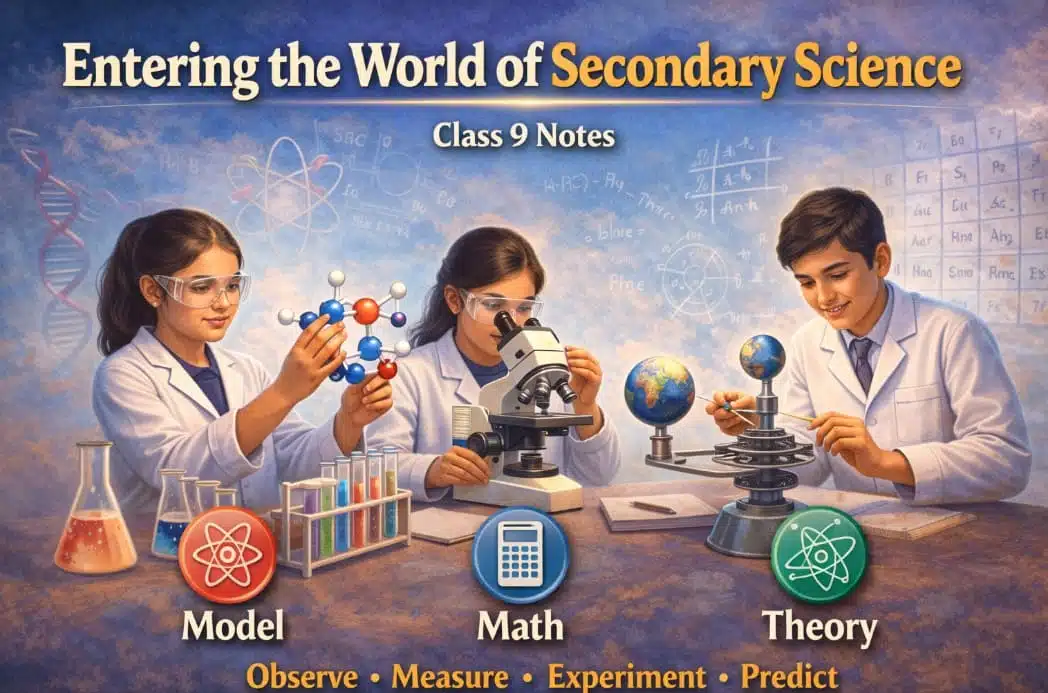
Entering the World of Secondary Science Class 9 Notes
Example 1.1: A cricket shot. Think of a cricket ball being hit for a six. You want to make a simple model. What details would you include? What would you ignore?
Science makes simple models to focus on important details. To know if the cricket ball will cross the boundary, we need the ball’s mass, speed and direction. Things like the bat brand, the ball colour or grass on the field do not matter.
Activity 1.1: Let us model
Science makes models to keep only important details and the rest of the things ignored. For example, if the speed and distance of the bicycle we want to know then we have to understand force (f) and mass (m), we do not check the bicycle colour.
Science also uses laws, theories and principles:
- Laws describe patterns (Newton’s laws of motion).
- Theories explain why patterns occur (atomic theory).
- Principles guide understanding (conservation of energy).
Science simplifies with models, explains with math, builds on laws and theories, and makes reliable predictions.
Example 1.2: How do we check predictions? Varsha told her friend Meghna, “It will rain this afternoon because the clouds look dark.” Think of some questions Meghna could ask Varsha to make this prediction scientifically testable.
To make a prediction scientific, we must ask for measurable evidence like humidity, wind speed, or past patterns, not just “dark clouds”. Science is strong because it accepts corrections when predictions fail.
In secondary science, we learn to:
- Understand the situation
- Identify important quantities.
- Make rough estimates to check if answers make sense.
Science uses laws (patterns), theories (explanations), and principles (broad ideas). Predictions in science are based on evidence and reasoning, not guesses. If predictions match observations, confidence grows; if not, scientists improve their models.
Example 1.3: Estimate how many litres of air you breathe in one day. Start by estimating how many breaths you take per minute and the volume of one breath. Your aim is not to find an exact answer but a reasonable estimate.
We can estimate things in science, like how much air we breathe in a day. Exact answers are not always needed—sometimes a rough estimate is enough to check if an idea makes sense.
Science is divided into subjects like physics, chemistry, biology, and earth science, but real-world problems often need ideas from many fields together, like climate change or medicine. Science also connects with maths, technology, arts, and social studies.
Finally, science is not just facts or equations—it is a human activity shaped by curiosity, creativity, teamwork, and questioning. It grows when people ask questions, test ideas, share results, and learn from mistakes. Over time, many individuals across cultures and generations have built science together.
Even if you don’t study science, scientific thinking is useful everywhere. It helps you understand technology, judge information carefully, and make sense of the world. Science invites you not only to learn about nature but also to learn how we try to understand it.
Disclaimer: The content that is present on our website is based on the NCERT Class 9 Science textbook and is provided for educational purposes only. All the content and images have been taken from Science Class 9 NCERT Textbook and CBSE Support material. Images and content shown above are the property of individual organizations and are used here for reference purposes only. To make it easy to understand, some of the content and images are generated by AI and cross-checked by the teachers.