
The AI Project Cycle is a step-by-step process used to build Artificial Intelligence projects. Class 8 students learn how AI systems are created using simple and logical steps. The cycle includes Problem Scoping, Data Acquisition, Data Exploration, Modelling, and Evaluation. This topic is part of CBSE Class 8 Artificial Intelligence Curriculum, helping learners develop critical thinking, creativity, and problem-solving skills.
AI Project Cycle Class 8 Notes
Introduction to Project and Project Cycle
What is a project?
A project is a series of tasks or a group of activities that have a specific goal to be completed under a given time frame with limited resources.
What is a project cycle?
A project cycle is the sequence of phases through which a project progresses from beginning to end. For example, suppose coffee production is a perfect example of a project cycle because it follows defined stages like:
- Stage 1 (Seeding): Foundation stage, coffee seedlings are nurtured in fields for several years until the first harvest.
- Stage 2 (Harvesting): Ripe coffee cherries are carefully picked by hand or machine.
- Stage 3 (Processing): Different methods remove the fruit surrounding the coffee bean, impacting flavour.
- Stage 4 (Roasting): Beans are roasted to develop flavour and aroma before packaging for sale.
- Stage 5 (Packaging): Roasted coffee is then packaged in the form of coffee products.
What is an AI project cycle?
The AI Project Cycle is a step-by-step process that a company must follow in order to solve the problem. The AI Project Cycle offers us a suitable framework that can guide us in the right direction to achieve our goal.
AI project cycle helps us:
- to create better AI projects easily
- to create AI projects faster
- to understand the process
The AI project cycle consists of five main stages –
- Problem Scoping
- Data Acquisition
- Data Exploration
- Modelling
- Evaluation
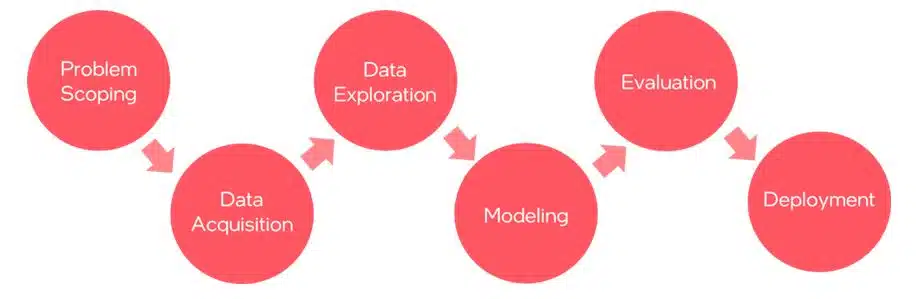
- Stage 1, In the Problem Scoping stage we define a goal for this project.
- In Stage 2, we have Data Acquisition in which you collect the data you think youwill need to train your model.
- In Stage 3, we have Data Exploration, the main objective of this stage is to visualizedatain a form that is human readable/ human friendly (usually through Graphs/Plots)
- InStage4, wehave Modeling,the main objective of modelingis to implement algorithmsand fine-tune the model which gives you the best results.
- In Stage 5, we have Evaluation, the main objective of this stage is to test and evaluatethe different models and choose the best model.
- In Stage 6, we have Deployment, the main objective of this stage is to deploy your solution based on the model you’ve selected.
a. Problem Scoping?
It is a fact that we are surrounded by problems. They could be small or big, sometimes ignored or sometimes even critical. Many times, we become so used to a problem that it becomes a part of our life. Identifying such a problem and having a vision to solve it, is what Problem Scoping is about.
It includes:
- To figure outthe problem that needs to be solved
- Tounderstand the various aspects ofthe problem
- To develop a vision to solve a problem
What is 4Ws Problem Canvas?
The 4Ws problem canvas is a framework which helps to solve the problem using four key questions and understand the problem in a better way. The 4Ws Problem Canvas are –

WHO
Who is having the problem?
- Who are the stakeholders?
- Space Organizations
- Human Race
- What do you know about them?
- Various space organizations have set up telescopes on land and in space to collect data
WHAT
What is the nature of the problem?
- What is the problem?
- Identifying an Earth like exoplanet with our existing resources
- Space travel has its limitations
- How do you know it is a problem?
- Research journals, documentaries, and news articles
WHERE
Where does the problem arise?
- What is the context/ situation in which the stake holders experience the problem?
- Rise in sea levels, melting of polarice caps and pollution of air, soil, and water.
WHY
Why do you believe it is a problem worth solving?
- What would be of key-value to the stakeholders?
- Find anEarth-like exoplanet as close to the solar systemas possible
- How would it improve their situation?
- Finding an exoplanet will help in analyzing astronomical data, predictingplanetary conditions,or even simulatinglife-supportingecosystems ondistant worlds
Problem Statement Template
A problem statement template is a tool which helps to identify the problem. It gives a clear idea of the problem, and it helps the organization, how to solve the problem or achieve the Goal. Example of problem statement template –
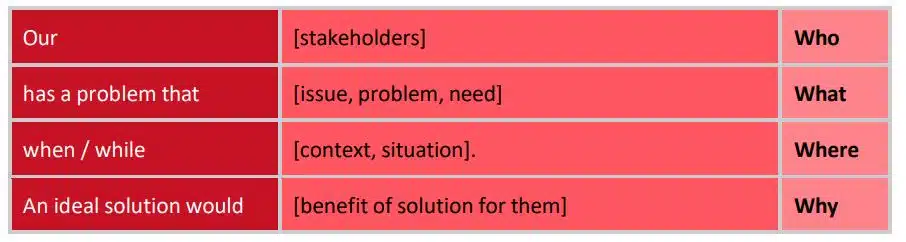
It is used to frame the 4Ws into a paragraph to describe your problem, the stakeholders involved and how solving the problem would benefit them. Example: Problem: Finding an exoplanet

b. Data Acquisition
The method of collecting accurate and trustworthy data to work is known as data acquisition. Data can be acquired from a variety of sources, including websites, journals, newspapers, and other media, such as text, video, photographs, and audio.
One of the most trustworthy sources for data acquisition are open-source website hosted by the government.
Various types of data
The data that we collect in the data acquisition stage can be of different types: Textual data, Numeric data and Visual data (images and videos).

Primary Sources: Fresh, original data collected specifically for your AI project.
Examples:
- Conducting surveys or questionnaires
- Running experiments and collecting sensor data
- Manually collecting and labeling data (e.g., image annotation)
- Using APIs to access data from internet- connected devices
Secondary Sources: Pre-existing data collected by other organizations or individuals. It’s readily available and often free or low-cost.
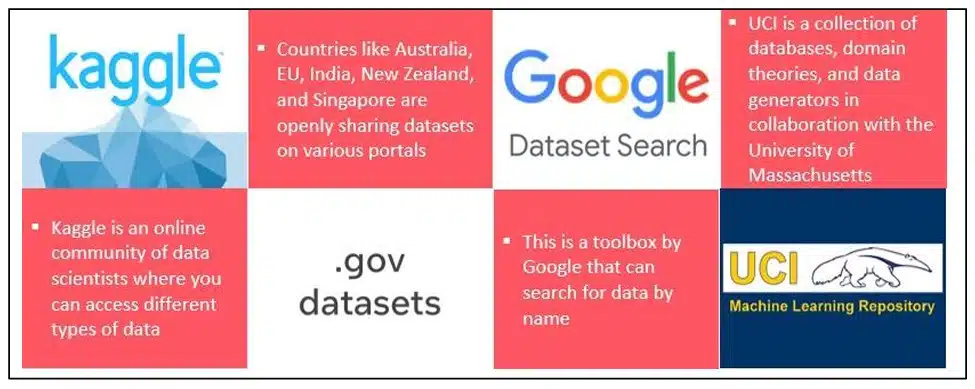
Al list of government websites:
- Indian Government Dataset
- Australian Government Dataset
- EU Open Data Portal
- New Zealand’s Government Dataset
- Singapore Government Dataset
c. Data Exploration
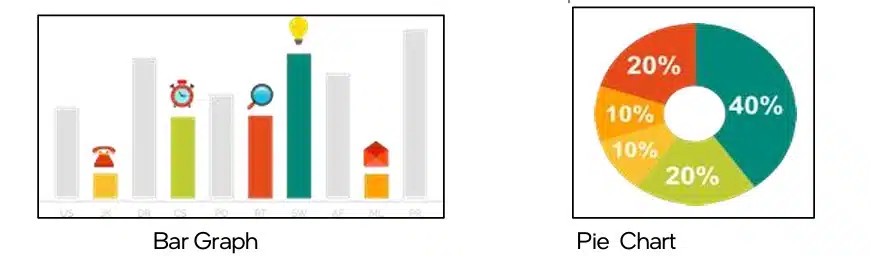
The main objective of Data Exploration is to represent data in a form that is human readable/ human friendly (usually through Graphs/ Charts)
To analyze data and present it in an easily understandable, visual form.
- It is easy to take decisions based on data that is presented in an easily understandable form.
- Data can be presented in different forms which include:
d. Data Modeling
AI modeling is the process of creating algorithms, also known as models, that may be educated to produce intelligent results. This is the process of programming code to create a machine artificially. the main objective of modeling is to create a model for AI which can help us solve the identified problem.
- AI needs a model to work.
- The model learns from collected data.
- We give input → model processes → output.
- Output depends on how well the model was trained.
- AI models turn raw input into useful insights.
Types of Models
Models help us understand and solve problems by showing how things work, like weather predictions, making decisions, or creating designs. Below are the broad classifications of models.

Rule Based Approach
AI modelling in which the developer sets the rules. The machine executes its duty in accordance with the rules or instructions specified by the developer.
Learning Based Approach
In learning-based AI, there is no need for a human being to write a set of rules or instructions for it. This type of AI learns from experience – past information or data.
e. Evaluation
The main objective of evaluation is to test different models and choose the best model.
- We test our models to check their performance and improve our models for best performance.
- The model is tested with collected data.
f. Deployment
Deployment, the main objective of this stage is to make our solution ready to be used. In this stage, we make our solution available to users who can benefit from it. AI can be used on Mobile Apps, Website Apps, etc.
Disclaimer: We have provide you with the accurate handout of “AI Project Cycle Class 8 Notes“. If you feel that there is any error or mistake, please contact me at anuraganand2017@gmail.com. The above CBSE study material present on our websites is for education purpose, not our copyrights.
All the above content and Screenshot are taken from Artificial Intelligence Code 901C Class 8 CBSE Textbook, CBSE Sample Paper, CBSE Old Sample Paper, CBSE Board Paper and CBSE Support Material which is present in CBSEACADEMIC website, NCERT website This Textbook and Support Material are legally copyright by Central Board of Secondary Education or NCERT. We are only providing a medium and helping the students to improve the performances in the examination.
Images and content shown above are the property of individual organisations and are used here for reference purposes only. To make it easy to understand, some of the content and images are generated by AI and cross-checked by the teachers. For more information, refer to the official CBSE textbooks available at cbseacademic.nic.in.
very very very exellent