
Coding is an important skill in today’s digital world. It teaches students how to think logically and solve problems by giving instructions to computers. Learning coding at an early age helps build creativity and confidence in technology.
Introduction to Coding Class 6 Notes
What is coding?
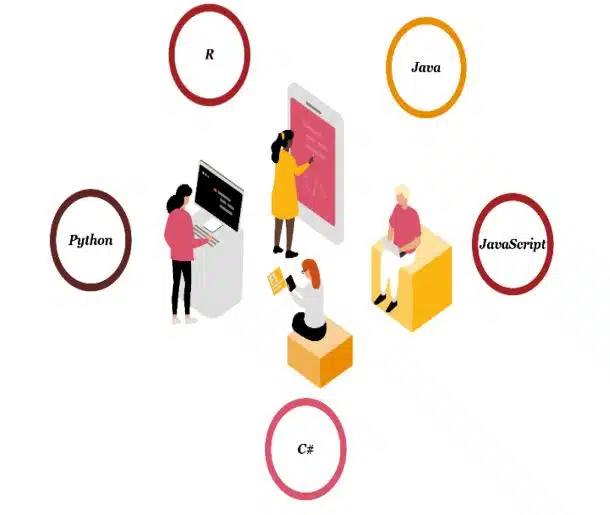
Coding, also referred to as programming, is creating instructions that can be executed on a computer to perform a specific task or achieve a particular result. For example, suppose you are playing a video game on a smartphone. Your smartphone works as a computer, and smartphones need instructions to execute the video game, like ‘turn 90° left’, ‘move forward’, etc. These instructions are written in programming languages like Python, Java or C++; each language has its own rules but serves the same purpose.
Key Aspects of Coding
Coding required logic, creativity and precision.
- Logic: Coding is built on step-by-step reasoning; they do not guess, they follow the exact instruction.
- Creativity: Coding is about designing solutions; you can build apps, games, websites or even art with code.
- Precision: Coding required accuracy, as a small error can break the program.
Why is coding important?
Coding is just like solving a math problem. There may be many ways to solve a problem. Similarly, there could be more than one way to write.
- Coding helps to make apps, websites and games; without code, your phone or computer will not work.
- Coding helps us to make tools that save time and effort.
- Many jobs today require computer software. This software is made with code.
- Coding helps to turn ideas into reality.
What is a programming language?
A programming language is a set of rules and words that humans use to give instructions to a computer. It works as a bridge between human and machine execution. A programming language is just like the English or Hindi language; only we use a programming language to talk to a computer. Computers only understand machine language (0 and 1). Programming language helps to make it easy for humans to write instructions in a readable way.
Syntax is a set of rules that we need to follow when we write a computer program. There are hundreds of programming languages used around the world. And new ones are getting developed all the time. Every programming language has its own syntax. But all programming languages have one common thing: they are eventually converted into a language that the computer will understand.
1. For a given problem, there is always only one way to write a program.
a. True
b. False
2. PIN authentication for ATM card transactions is an example of programming.
a. True
b. False
3. Code is a set of instructions that can be executed on a computer to perform a specific task.
a. True
b. False
4. Which among the below are examples of programming in real life?
a. True
b. False
5. Which among the below is not an example of a programming language?
a. True
b. False
6. How is coding being utilised in everyday life to perform complex tasks in an easy manner?
Answer: Coding helps to perform complex tasks with the help of coding, like mobile apps and online shopping websites. Coding helps doctors to keep patient records, and coding helps in GPS navigation, flight booking, and traffic signals.
7. What are the real-life applications of coding?
Answer: The real-life applications of coding are:
- Education: E-learning platforms, quizzes and interactive lessons.
- Entertainment: Games, movies and music apps.
- Business: Data analysis, automation and customer service chatbots.
- Smart device: Voice assistants like Alexa, smart TVs and IoT gadgets.
8. What is exactly meant by the term ‘coding’ in the context of computer science?
Answer: The coding is writing instructions in a programming language so a computer can understand and execute them.
9. Write the name of the most popular programming language.
Answer: The most popular programming languages are:
- Python – beginner-friendly, used in AI, data science, and web apps.
- Java – widely used for mobile apps and enterprise software.
- C++ – powerful for games and system software.
- JavaScript – makes websites interactive.
- SQL – manages databases.
Disclaimer: We have provide you with the accurate handout of “Introduction to Coding Class 6 Notes“. If you feel that there is any error or mistake, please contact me at anuraganand2017@gmail.com. The above CBSE study material present on our websites is for education purpose, not our copyrights.
All the above content and Screenshot are taken from Coding Code 910A Class 6 CBSE Textbook, CBSE Sample Paper, CBSE Old Sample Paper, CBSE Board Paper and CBSE Support Material which is present in CBSEACADEMIC website, NCERT website This Textbook and Support Material are legally copyright by Central Board of Secondary Education or NCERT. We are only providing a medium and helping the students to improve the performances in the examination.
Images and content shown above are the property of individual organisations and are used here for reference purposes only. To make it easy to understand, some of the content and images are generated by AI and cross-checked by the teachers. For more information, refer to the official CBSE textbooks available at cbseacademic.nic.in.