
These Class 12 Recent Technologies in IT Notes are prepared strictly as per the latest syllabus and exam pattern. The notes explain each concept in simple language with clear definitions, examples, and applications to help students understand and score better in board examinations. This chapter also builds awareness about emerging trends and prepares students for higher studies and future IT careers.
Recent Technologies in IT Class 12 Notes
3D Printing
The most popular form of printing is 3D printing. 3D printing is 3-dimensional printing based on the ‘stereolithography’ technique. 3D printing was invented by Charles Hull in 1984. 3D printing enables you to produce complex shapes using less material than traditional manufacturing methods.
The workings of 3D printing
In 3D printing, no special tools are required (for example, a cutting tool with certain geometry or a mould). Instead, the part is manufactured directly onto the built platform layer by layer, which leads to a unique set of benefits and limitations.
Types of 3D Printers
Desktop FDM (Fused Deposition Modelling) printers melt plastic filaments and lay them down onto the print platform through a nozzle (like a high-precision, computer-controlled glue gun).
- CAD File Development: To produce a 3D object, first you have to design the object; this you can do with Computer-Aided Design software.
- CAD File Conversions: Once the design is developed, then you have to convert it into specific formats.
- Preparing The Printer: Now that every file is converted, you have to give the print to the printer.
- The Building Up: After printing, the building process will start; it takes time based on the size of the object. It can take 4 to 18 hours to complete the 3D printing.
- Post-Processing Stuff: After completion, put on gloves to bring the object out of the printer and brush off any residual powder.
Augmented Reality (AR)
AR integrates computer-generated content into the real world in real time. AR is an interactive experience of the real world enhanced with computer-generated information like visuals, sounds (auditory), or touch feedback (haptics). The hardware components for augmented reality are a processor, display, sensors and input devices. There are two technologies used in augmented reality: diffractive waveguides and reflective waveguides.
AR-enabled eyeglasses
AR glasses are like normal eyeglasses but can show digital images or information on the lenses. AR glasses can record what you see, and AR glasses can projected or reflectproject directly on the lens.
Applications: STEM (Science, Technology, Engineering, Mathematics) education
AR has been used to complement a standard curriculum. Text, graphics, video and audio may be superimposed into a student’s real-time environment.
- Visual art: AR applied in the visual arts allows objects or places to trigger artistic multidimensional experiences and interpretations of reality.
- Video games: The gaming industry embraced AR technology.
- Industrial design: AR allows industrial designers to experience a product’s design and operation before completion.
- Tourism and sightseeing: Travelers may use AR to access real-time informational displays regarding a location, its features, and comments or content provided by previous visitors.
- Translation: Travellers AR systems such as Word Lens can interpret the foreign text on signs and menus and, in a user’s augmented view, redisplay the text in the user’s language.
Virtual reality (VR)
Virtual Reality (VR) is the use of computer technology to create a simulated environment. Modern virtual reality headset displays are based on technology developed for smartphones, including gyroscopes and motion sensors for tracking head, hand and body positions; small HD screens for stereoscopic displays; and small, lightweight and fast computer processors. Virtual reality cameras can be used to create VR photography using 360-degree panorama videos.
Applications of Virtual Reality
- Virtual reality is most commonly used in entertainment applications such as video gaming and 3D cinema.
- Digital marketing and e-commerce.
- Gaming industries.
Difference between AR and VR
| Augmented Reality (AR) | Virtual Reality (VR) |
|---|---|
| Adds digital elements to the real world | Creates a completely digital world |
| You see the real world + extra digital overlays | You are fully immersed in a virtual |
| Smartphones, tablets, AR glasses | VR headsets (Oculus Rift, HTC Vive, Google Cardboard) |
| Real-time interaction with both real and digital objects | Interaction only inside the virtual environment |
| Pokémon Go, Snapchat filters | VR games, virtual tours, exploring a penguin colony |
Fifth Generation (5G)
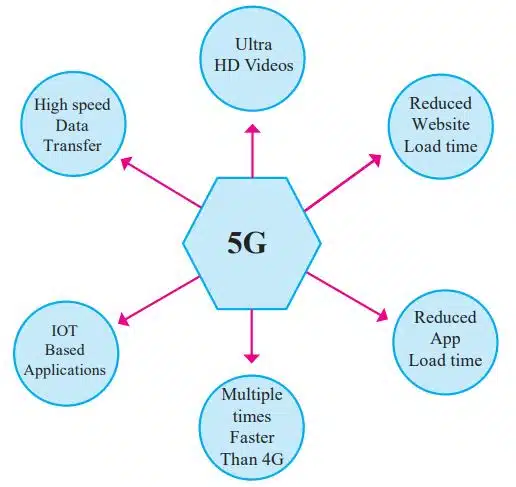
5G is the fifth generation of cellular network technology. This network provides Internet connections that are at least 40 times faster than 4G LTE. 5G technology may use a variety of spectrum bands, including millimetre wave (mmWave) radio spectrum, which can carry very large amounts of data a short distance. The drawback of the higher frequencies is that they are more easily obstructed by the walls of buildings, trees and other foliage and even inclement weather.
Millimetre wave: Millimetre waves are broadcasted at frequencies between 30 GHz and 300 GHz, compared with the bands below 6 GHz used for 4G LTE. The 5G network is divided into small geographical areas called cells.
5G can support up to a million devices per square kilometre, while 4G supports only up to 100,000 devices per square kilometre.
Applications:
- Online 5G Games.
- Automated Vehicles.
- Virtual Classrooms.
Disclaimer: We have provide you with the accurate handout of “Recent Technologies in IT Class 12 Notes“. If you feel that there is any error or mistake, please contact me at anuraganand2017@gmail.com. The above study material present on our websites is for education purpose, not our copyrights.
All the above content and Screenshot are taken from Information Technology Class 12 Textbook and MSBSHSE (HSC) Support Material which is present in MSBSHSE (HSC) website, This Textbook and Support Material are legally copyright by Maharashtra State Bureau of Textbook Production and Curriculum Research, Pune. We are only providing a medium and helping the students to improve the performances in the examination.
Images and content shown above are the property of individual organisations and are used here for reference purposes only. To make it easy to understand, some of the content and images are generated by AI and cross-checked by the teachers. For more information, refer to the official website.