
The Introduction to DBMS Class 11 Exercise Solutions are prepared to help HSC students understand textbook questions and answers in a clear and systematic way. These solutions are strictly based on the Maharashtra State Board (HSC) Information Technology syllabus and follow the latest exam pattern.
Introduction to DBMS Class 11 Exercise Solutions
Q. 1 Complete the following activity.
1. Tick whichever box is not valid.
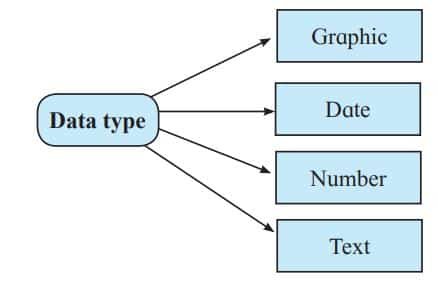
Answer: Graphic
2. Student wants to create a field pincode in a table, which data type he will choose ?
Answer: CHAR / VARCHAR
3. Tick the appropriate box.
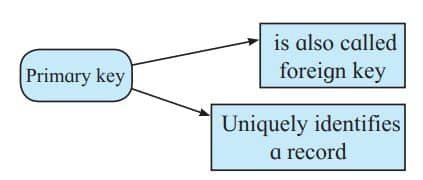
Answer: Uniquely identifies a record
4. Tick the appropriate circle.
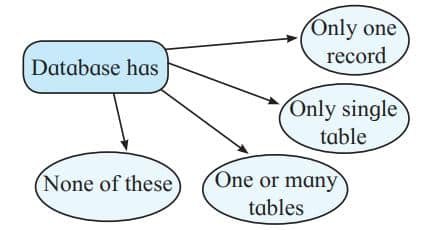
Answer: One or many tables
Q. 2 Observe the field names of a database given below in ‘Column A’ related to Bus reservation. Write suitable data types for each field in front of the respective field in ‘Column B’
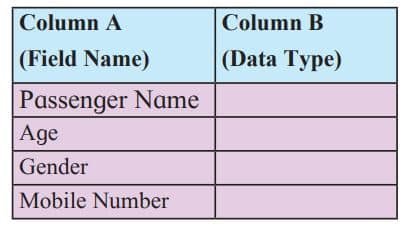
Answer:
| Field Name | Data Type |
|---|---|
| Passenger Name | VARCHAR or TEXT |
| Age | INTEGER |
| Gender | CHAR(1) or VARCHAR |
| Mobile Number | VARCHAR (to keep leading zeros) |
Q. 3 Write the use of following SQL command.
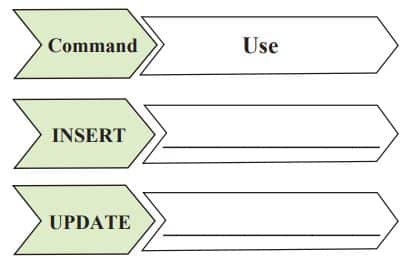
Answer:
- INSERT: To add new data into a table
- UPDATE: To modify or change existing data
Q.4 Create a table for the information given below by choosing appropriate data types. Specify proper primary key for the table 1) Movie 2) Actor
- Movie ( Registeration_no, movie_name, Realease_Date)
- Actor ( actor_id, Actor_name, birth_date )
Answer:
Movie
| Field Name | Data Type | Description |
|---|---|---|
| Registration_no | INTEGER | Unique ID for each movie (Primary Key) |
| movie_name | VARCHAR(100) | Name of the movie |
| Release_Date | DATE | Date when the movie was released |
Actors
| Field Name | Data Type | Description |
|---|---|---|
| actor_id | INTEGER | Unique ID for each movie (Primary Key) |
| Actor_name | VARCHAR(100) | Name of the movie |
| birth_date | DATE | Actor’s date of birth |
Q. 5 Consider the following table Stationary. Write SQL commands for following statements.
1) Write SQL command to create above Table
Answer:
CREATE TABLE Stationary (
item_id INT PRIMARY KEY,
item_name VARCHAR(50),
price DECIMAL(10,2),
quantity INT );
2) Write SQL command to insert above mentioned record in table
Answer:
INSERT INTO Stationary (
item_id,
item_name,
price,
quantity)
VALUES (1, 'Pen', 10.00, 100);
3) To delete above table.
Answer:
DROP TABLE Stationary;Q.6 Answer the following questions.
1) What is a database ?
Answer: A database is an organised collection of data that allows you to store, retrieve and manage the data efficiently. It is just like a centralised system where multiple users or applications can access and update data securely.
2) What are the advantages of a DBMS ?
Answer: The advantages of DBMS-
- Reducing Data Redundancy: Sometimes in a database, multiple copies of the same data can be stored; databases help to reduce the data duplication.
- Sharing of Data: The user can share the database with multiple users or applications based on the privilege given to them.
- Data Integrity: Data integrity means that the data is accurate and consistent in the database.
- Data Security: Only authorised users should be allowed to access the database, and their identity should be authenticated using a username and password.
3) What do you understand by Data Model ?
Answer: The database is designed according to certain rules. This logical structure of a database is known as a data model. Data models define how the data are connected to each other and how they are processed and stored inside the system. There are different types of data models, like the network model, the hierarchical model and the relational model.
4) What is a primary key ?
Answer: The group of one or more columns used to uniquely identify each row of a relation is called its primary key.
5) What is DDL(Data Definition language)
Answer: Data Definition Language (DDL): DDL statements or commands are used to define and modify the database structure of your tables or schema.
| COMMAND | USED FOR |
|---|---|
| CREATE DATABASE | Creates database |
| CREATE TABLE | Creates a new table |
| ALTER TABLE | Modifies a table |
| DROP TABLE DROP DATABASE | Deletes a table or Database |
Q.7 In a company the data is stored in a table under the following fields Employee number, Last name, Date of birth, Address. Which data type will you use for the above field.
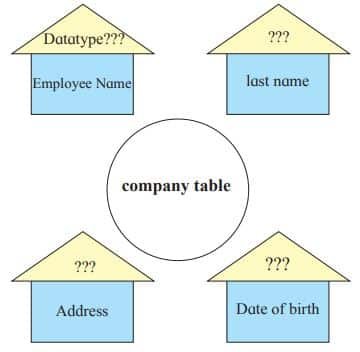
Answer:
| Field Name | Data Type | Reason |
|---|---|---|
| Employee number | INTEGER | Unique numeric ID for each employee |
| Last name | VARCHAR(50) | Text field for storing names |
| Date of birth | DATE | Stores date values in proper format |
| Address | VARCHAR(200) | Text field for storing address |
Q.8 Multiple choice select three correct answers.
Valid relationships in RDBMS are
- a) one to one
- b) one to two
- c) one to many
- d) many to two
- e) many to many
- f) one to three
Answer:
- One to One: One record in a table relates to exactly one record in another table.
- One to Many: One record in a table relates to many records in another table.
- Many to Many: Many records in one table relate to many records in another table (via a junction table).
Q.9 Complete the following.
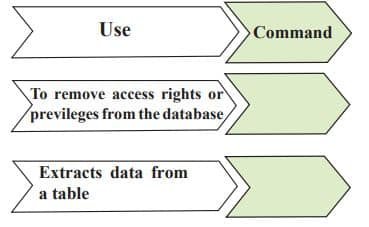
Answer:
- To remove access rights or privileges from the database: REVOKE
- Extracts data from a table: SELECT
Disclaimer: We have provide you with the accurate handout of “Introduction to DBMS Class 11 Exercise Solutions“. If you feel that there is any error or mistake, please contact me at anuraganand2017@gmail.com. The above study material present on our websites is for education purpose, not our copyrights.
All the above content and Screenshot are taken from Information Technology Class 11 Textbook and MSBSHSE (HSC) Support Material which is present in MSBSHSE (HSC) website, This Textbook and Support Material are legally copyright by Maharashtra State Bureau of Textbook Production and Curriculum Research, Pune. We are only providing a medium and helping the students to improve the performances in the examination.
Images and content shown above are the property of individual organisations and are used here for reference purposes only. To make it easy to understand, some of the content and images are generated by AI and cross-checked by the teachers. For more information, refer to the official website.