
Nationalism in India is a key chapter 2 in Class 10 History that explores the growth of the national movement against British rule. Students learn about important events such as the Non-Cooperation Movement, Civil Disobedience Movement, the role of Mahatma Gandhi, and the participation of different social groups.
Nationalism in India Class 10 MCQ
1. The First World War created a new economic situation in India because _.
a. Price goes down
b. Food price is increased.
c. Defense expenditure increased, financed by loans and taxes.
d. None of the above
2. As per the 1921 census, how many people died due to famines and the influenza epidemic?
a. 2–3 million
b. 5–6 million
c. 12–13 million
d. 20 million
3. In which year did Mahatma Gandhi return to India?
a. 1913
b. 1915
c. 1917
d. 1919
4. Mahatma Gandhi’s first satyagraha in India was organized in __.
a. Kheda (1917)
b. Champaran (1917)
c. Ahmedabad (1918)
d. Amritsar (1919)
5. Mahatma Gandhi organized a satyagraha in Ahmedabad in 1981 among __.
a. Peasants
b. Cotton mill workers
c. Plantation laborers
d. Students
6. What do you mean by the Rowlatt Act (1919)?
a. Freedom of the press
b. Detention of political prisoners without trial for 2 years
c. Abolition of taxes
d. Free trade in India
7. The Jallianwalla Bagh massacre took place on _________.
a. 6 April 1919
b. 10 April 1919
c. 13 April 1919
d. 15 August 1919
8. The Khilafat Committee was formed in Bombay in _________.
a. January 1919
b. March 1919
c. September 1920
d. December 1920
9. Which Muslim leaders worked with Gandhi on the Khilafat issue?
a. Muhammad Ali and Shaukat Ali
b. Maulana Azad and Badruddin Tyabji
c. Syed Ahmed Khan and Liaquat Ali
d. Jinnah and Aga Khan
10. At which Congress session was the Non-Cooperation program adopted?
a. Calcutta, 1920
b. Nagpur, 1920
c. Lucknow, 1916
d. Lahore, 1929
11. In his book Hind Swaraj (1909), Gandhi declared that British rule survived in India because _______.
a. Indians cooperated with it.
b. The British had superior weapons.
c. Indians lacked unity.
d. British-controlled trade routes
12. Which party in Madras did not boycott council elections?
a. Congress
b. Justice Party
c. Muslim League
d. Swaraj Party
13. Who led the farmer in Awadh against landlords and talukdars?
a. Vallabhbhai Patel
b. Baba Ramchandra
c. Jawaharlal Nehru
d. Alluri Sitaram Raju
14. What was begar?
a. Tax on land
b. Forced labor without payment
c. Rent paid in cash
d. Military recruitment
15. Which organization was set up in October 1920 in Awadh?
a. Oudh Kisan Sabha
b. Bardoli Kisan Sabha
c. Gudem Tribal Council
d. Khilafat Committee
16. Who led the Bardoli Satyagraha in 1928?
a. Jawaharlal Nehru
b. Baba Ramchandra
c. Vallabhbhai Patel
d. Mahatma Gandhi
17. What did Alluri Sitaram Raju claim?
a. He could survive bullet shots.
b. He was an incarnation of God.
c. He could heal people and predict astrology.
d. All of the above
18. What was Raju’s belief about achieving swaraj?
a. Only through non-violence
b. By use of force and guerrilla warfare
c. By petitions to the British
d. By council elections
19. Plantation workers in Assam were restricted by which law?
a. Rowlatt Act
b. Inland Emigration Act of 1859
c. Pitt’s India Act
d. Vernacular Press Act
20. Gandhi withdrew the Non-Cooperation Movement in 1922 because __________.
a. It was successful everywhere.
b. It was turning violent.
c. The British accepted all demands.
d. Congress leaders opposed it.
21. Who formed the Swaraj Party in 1923?
a. Jawaharlal Nehru and Subhas Chandra Bose
b. C.R. Das and Motilal Nehru
c. Vallabhbhai Patel and Rajendra Prasad
d. Lala Lajpat Rai and Bal Gangadhar Tilak
22. The Simon Commission (1928) was opposed because ________.
a. It had no Indian members.
b. It abolished the salt tax.
c. It supported Swaraj.
d. It reduced land revenue.
23. Independence Day was first celebrated on _______.
a. 15 August 1947
b. 26 January 1930
c. 2 October 1930
d. 13 April 1919
24. The Lahore Congress (1929) under Jawaharlal Nehru declared ________.
a. Dominion status
b. Purna Swaraj (Complete Independence)
c. Separate electorates
d. Bardoli Satyagraha
25. The Salt March began from Sabarmati Ashram to _____.
a. Bardoli
b. Champaran
c. Dandi
d. Ahmedabad
26.The Gandhi-Irwin Pact was signed in ______.
a. March 1930
b. March 1931
c. December 1931
d. September 1932
27. Which Round Table Conference did Gandhi attend?
a. First
b. Second
c. Third
d. None
28. Who led the Depressed Classes Association in 1930?
a. Vallabhbhai Patel
b. B.R. Ambedkar
c. Jawaharlal Nehru
d. Subhas Chandra Bose
29. Rich peasants (Patidars, Jats) supported civil disobedience mainly because _______.
a. They wanted temple entry.
b. They opposed high land revenue.
c. They wanted separate electorates.
d. They opposed the salt tax.
30. Who first created the image of Bharat Mata?
a. Rabindranath Tagore
b. Bankim Chandra Chattopadhyay
c. Abanindranath Tagore
d. Bal Gangadhar Tilak
31. In which novel was Vande Mataram included?
a. Gitanjali
b. Anandamath
c. Hind Swaraj
d. Discovery of India
32. Who painted the famous image of Bharat Mata in 1905?
a. Abanindranath Tagore
b. Ravi Varma
c. Rabindranath Tagore
d. Natesa Sastri
33. Who published The Folklore of Southern India?
a. Natesa Sastri
b. Bal Gangadhar Tilak
c. Subhas Chandra Bose
d. Lala Lajpat Rai
34. The tricolor flag during the Swadeshi movement had _____.
a. Spinning wheel in the center
b. Eight lotuses and a crescent moon
c. Lion and elephant symbols
d. Bharat Mata image
35. Who designed the Swaraj flag in 1921?
a. Jawaharlal Nehru
b. Mahatma Gandhi
c. Bal Gangadhar Tilak
d. Subhas Chandra Bose
36. Which one option from the following is the appropriate reason for the formation of the Swaraj party?
a. To ask for Poorna Swaraj for Indians.
b. To return to Council Politics.
c. To ask Dominion State for India.
d. To oppose Simon Commission.
37. Why did nationalists in late-nineteenth-century India focus on recording and preserving folklore?
a. To create new forms of artistic expression that reflected modern India.
b. To restore a sense of pride in traditional culture and national identity
c. To use folklore as a tool for economic development and modernization.
d. To promote a uniform culture that could be adopted across all Indian regions.
38. Arrange the following events in the correct chronological order leading up to the Civil Disobedience Movement:
- Boycott of the Simon Commission
- Poorna Swaraj resolution passed
- Letter with 11 demands sent to Viceroy Irwin
- Salt March
Options:
a. 4, 3, 2, 1
b. 2, 1, 3, 4
c. 1, 4, 3, 2
d. 1, 2, 3, 4
39. Identify and name the leader shown in the picture given below: –
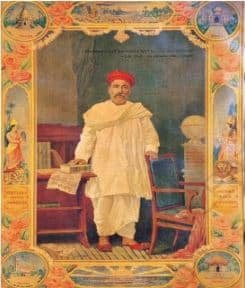
a. Lala Lajpat Rai
b. Bal Gangadhar Tilak
c. Gopal Krishan Gokhale
d. Raja Rammohan Roy
40. Which of the following newspaper was started by Bal Gangadhar Tilak?
a. Hindu
b. Kesari
c. Sudharak
d. Pratap
41. Identify the correct option that describes the act given below.
- i. The Act was passed by the Imperial Legislative Council.
- ii. It gave power to the government to repress political activities.
- iii. It empowered the government to detain political prisoners without trial.
a. Rowlatt Act
b. Vernacular Press Act
c. Government of India Act
d. Inland Emigration Act
42. Arrange the following statements in sequential order based on the events that shaped the Non-cooperation movement.
- i. General Dyer opened fire at the large crowd gathered in the enclosed ground of Jallianwala Bagh.
- ii. “Forced recruitment” carried out by the British government and the economic hardships faced by the people during the first world war.
- iii. The defeat of the Ottoman Emperor of Turkey led to the formation of the Khilafat movement.
- iv. Gandhiji launched a nationwide satyagraha against the Rowlatt act.
Options:
a. iv, iii, ii, i
b. ii, i, iv, iii
c. i, iv, iii, ii
d. i, ii, iii, iv
43. Look at the picture given below. What does the image of Bharat Mata signify?
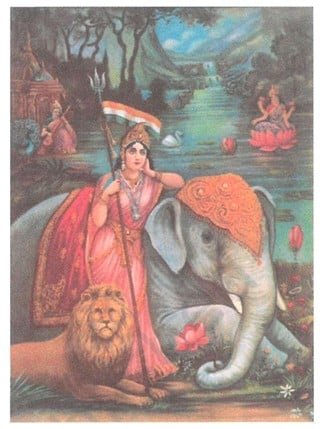
a. Diversity and heritage
b. Spiritualism and enlightenment
c. Power and authority
d. Nationalism and democracy
44. Who among the following people established the ‘Swaraj Party’?
a. Sardar Vallabhbhai Patel and Bipin Chandra Pal
b. Bal Gangadhar Tilak and Lala Lajpat Rai
c. Jawaharlal Nehru and Subhas Chandra Bose
d. C.R. Das and Motilal Nehru)
45. Which one of the following pairs regarding Indian nationalism is correctly matched?
Leaders – Contribution
a. Sardar Patel : Hindustan Socialist Republican Army
b. Bhagat Singh : Swaraj Party
c. C.R. Das : Bardoli Satyagraha
d. Jawahar Lal Nehru : Oudh Kisan Sabha
46. Arrange the following events in chronological order and choose the correct option:
I. Establishment of Depressed Classes Association
II. Gandhi-Irwin Pact
III. Formation of the Indian Chambers of Commerce and Industry (FICCI)
IV. Second Round Table Conference in London
Options:
a. I, II, III, IV
b. II, I, III, IV
c. III, I, II, IV
d. IV, I, II, III
47. Who among the following organized ‘Depressed Classes Association’ in 1930?
a. E.V. Periyar
b. Jyotiba Phule
c. B.R. Ambedkar
d. Mahatma Gandhi
48. Which one of the following aspects was common between the writings of B.R. Ambedkar and E.V. Ramaswamy Naicker?
a. Wrote on the caste system in India
b. Highlighted the experiences of women
c. Raised awareness about cultural heritage
d. Motivated Indians for their national freedom
49. Who among the following is the writer of ‘Gulamgiri’?
a. Dr. B.R. Ambedkar
b. E.V. Periyar
c. Jyotiba Phule
d. Ram Mohan Roy
Disclaimer: We have provide you with the accurate handout of “Nationalism in India Class 10 MCQ“. If you feel that there is any error or mistake, please contact me at anuraganand2017@gmail.com. The above CBSE study material present on our websites is for education purpose, not our copyrights.
All the above content and Screenshot are taken from Social Science Code 087 Class 10 NCERT Textbook, CBSE Sample Paper, CBSE Old Sample Paper, CBSE Board Paper and CBSE Support Material which is present in CBSEACADEMIC website, NCERT website This Textbook and Support Material are legally copyright by Central Board of Secondary Education or NCERT. We are only providing a medium and helping the students to improve the performances in the examination.
Images and content shown above are the property of individual organisations and are used here for reference purposes only. To make it easy to understand, some of the content and images are generated by AI and cross-checked by the teachers. For more information, refer to the official CBSE textbooks available at cbseacademic.nic.in.