
Print Culture and the Modern World Class 10 MCQ is designed to help students revise this important History chapter through objective questions. This chapter explains the development of print technology, the spread of printed books, and its impact on society, culture, and politics across the world.
Print Culture and The Modern World Class 10 MCQ
1. In which country did print technology develop?
a. Europe
b. China, Japan, and Korea
c. India
d. Egypt
2. Before AD 564, _ the book was printed in China.
a. Using movable metal type
b. By handwriting only
c. With mechanical presses
d. By rubbing paper against inked woodblocks
3. The traditional Chinese book called _.
a. Accordion book
b. Scroll
c. Codex
d. None of the above
4. What is the purpose of printing large numbers of textbooks in China?
a. For entertainment
b. For trade
c. For civil service examinations
d. For religious rituals
5. When did the western printing techniques come to China?
a. 12th century
b. Late 19th century
c. 16th century
d. Early 20th century
6. Which of the following is the oldest Japanese printed book?
a. Tripitaka Koreana
b. Diamond Sutra
c. Tao Te Ching
d. Ramayana
7. Which of the following Japanese artists was famous for ukiyo-e, the pictures of the floating world?
a. Monet
b. Van Gogh
c. Kitagawa Utamaro
d. Manet
8. Which of the following routes carried silk, spices, and later paper from China to Europe?
a Spice Route
b. Grand Trunk Road
c. Silk Route
d. Maritime Route
9. Who brought the knowledge of woodblock printing from China to Italy?
a. Kitagawa Utamaro
b. Marco Polo
c. Johann Gutenberg
d. Tsutaya Juzaburo
10. In 1430, where did Johann Gutenberg develop the first printing press?
a. Paris
b. Strasbourg, Germany
c. Rome
d. Venice
11. How many copies of the Gutenberg Bible were printed, and how many years did it take?
a. 180 copies in 3 years
b. 200 copies in 5 years
c. 80 copies in 1 year
d. 100 copies in 2 years
12. How many one-sided sheets does the Gutenberg press print within an hour?
a. 100
b. 250
c. 500
d. 50
13. What do you mean by print revolution?
a. Just a new way of writing
b. Only a religious reform
c. A change in producing books that transformed lives
d. A political movement
14. Who wrote the Ninety-Five Theses in 1517 against the Catholic Church?
a. Marco Polo
b. Johann Gutenberg
c. Martin Luther
d. Menocchio
15. Which of the following movements began due to Luther’s writings?
a. Renaissance
b. Protestant Reformation
c. Industrial Revolution
d. French Revolution
16. Who said, ‘Printing is the ultimate gift of God’? ’?
a. Gutenberg
b. Martin Luther
c. Menocchio
d. Minerva
17. Who carried small cheap books around villages in England?
a. Priests
b. Nobles
c. Chapman (pedlars)
d. Teachers
18. What do you mean by penny chapbooks?
a. Expensive novels
b. Religious manuscripts
c. Pocket-size books sold for a penny
d. Almanacks only
19. Who declared, ‘The printing press is the most powerful engine of progress’?
a. Voltaire
b. Martin Luther
c. Louise-Sebastien Mercier
d. Rousseau.
20. Which revolution is linked to the spread of print culture?
a. Industrial Revolution
b. French Revolution
c. American Revolution
d. Russian Revolution
21. When did primary education become compulsory in Europe?
a. Early 18th century
b. Late 19th century
c. Mid-20th century
d. Early 21st century
22. Which of the following countries set up the children’s press in 1857?
a. Germany
b. France
c. England
d. Italy
23. Which of the following Russian revolutionary authors wrote the book “My Childhood and My University”?
a. Maxim Gorky
b. Tolstoy
c. Chekhov
d. Lenin
24. Which of the following materials was used in India before print?
a. Bamboo sheets
b. Papyrus only
c. Palm leaves and handmade paper
d. Stone tablets
25. Why were manuscripts not widely used in everyday life?
a. They were cheap.
b. They were expensive, fragile, and hard to read.
c. They were printed in large numbers.
d. They were written in only one style.
26. Where did the printing press first arrive in India?
a. Calcutta
b. Goa
c. Bombay
d. Madras
27. Which was the first Tamil book printed in India (1579)?
a. Bhagavad Gita
b. Ramcharitmanas
c. A Catholic text at Cochin
d. Persian poetry
28. Who started the Bengal Gazette in 1780?
a. Gangadhar Bhattacharya
b. James Augustus Hickey
c. Rammohun Roy
d. Warren Hastings
29. Who published the first Indian newspaper, the Bengal Gazette?
a. Rammohun Roy
b. Gangadhar Bhattacharya
c. James Hickey
d. William Bolts
30. Which reformer published Sambad Kaumudi in 1821?
a. Gangadhar Bhattacharya
b. Rammohun Roy
c. Warren Hastings
d. Maxim Gorky
31. Which painter produced mythological prints for mass circulation?
a. Abanindranath Tagore
b. Raja Ravi Varma
c. M.F. Husain
d. Jamini Roy
32. Which Bengali woman wrote the first full-length autobiography in Bengali (1876)?
a. Kailashbashini Debi
b. Rashsundari Debi
c. Tarabai Shinde
d. Pandita Ramabai
33. In 1980, which writer has highlighted the lives of upper-caste Hindu widows?
a. Tarabai Shinde and Pandita Ramabai
b. Kailashbashini Debi and Rokeya Hossein
c. Jane Austen and the Brontë sisters
d. Raja Ravi Varma and Gokhale
34. Which Maratha reformer wrote Gulamgiri (1871)?
a. B.R. Ambedkar
b. Jyotiba Phule
c. Periyar
d. Kashibaba
35. Which Kanpur millworker wrote Chhote Aur Bade Ka Sawal (1938)?
a. Periyar
b. Kashibaba
c. Ambedkar
d. Periyar
36. Which governor-general revised press laws in 1835 to restore freedoms?
a. Warren Hastings
b. Lord Bentinck
c. Lord Curzon
d. Lord Ripon
37. Who formed the new liberal press rules in 1835?
a. Thomas Macaulay
b. James Hickey
c. Raja Ram Mohan Roy
d. Tilak
38. Which act of 1878 gives the rights to the colonial government to censor the vernacular press?
a. Indian Penal Code
b. Vernacular Press Act
c. Press Regulation Act
d. Sedition Act
39. Which nationalist leader went to jail due to writings in Kesari in 1908?
a. B.R. Ambedkar
b. Balgangadhar Tilak
c. Gandhi
d. Gokhale
40. Louise-Sebastien Mercier proclaimed “Tremble, therefore, tyrants of the world!
Tremble before the virtual writer!” Who are referred to as the tyrants in this context?
a. Educated classes who wanted to change the society
b. Absolutist institutions like monarchy and church
c. Authors of the new books
d. Printing press
41. Consider the statements given below and choose the correct answer.
Statement I. By the 1870s, caricatures and cartoons were being published in Indian journals and newspapers, commenting on social and political issues.
Statement II: Some caricatures praised the educated Indians’ fascination with Western tastes and clothes, while others were looking forward to social change.
a. Statement (I) is correct and (II) is incorrect.
b. Statement (I) is incorrect and (II) is correct.
c. Both (I) & (II) are incorrect.
d. Both (I) & (II) are correct
42. Look at the picture given below. Identify the name of the painter of this painting from the following options.
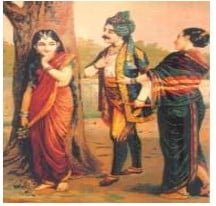
A. Abindra Nath Tagore
B. Rabindra Nath Tagore
C. Raja Ravi Verma
D. Samant Das Gupta
43. Who among the following was the author of the book ‘Gita Govind’?
A. Tulsidas
B. Surdas
C. Jayadev
D. Raidas
44. Arrange the following in chronological order:
- I. Print culture created the conditions for the French Revolution
- II. Martin Luther’s writings led to beginning of the Protestant Reformation
- III. Menocchio reinterpreted the message of the Bible
- IV. Johann Gutenberg invented Printing press
A. III, II, I & IV
B. I, II, III & IV
C. IV, III, II & I
D. IV, II, III & I
45. Consider the statements given below and choose the correct answer.
Statement I: Western printing techniques and mechanical press were imported in the late 19th Century as western powers established their outposts in China.
Statement II: Beijing became the hub of the new print culture, catering to westernstyle schools.
a. Statement (i) is correct and (ii) is incorrect.
b. Statement (i) is incorrect and (ii) is correct
c. Both (i) & (ii) are incorrect
d. Both (i) & (ii) are correct
46. Assume you are doing research on 15th century print culture. Which of the following would be the most significant advantage for your research?
(A) Easier access to rare manuscripts
(B) Reduced need for libraries
(C) Increase in the ability to copy text by hand
(D) Increased speed and accuracy of print
47. How did print culture contribute to the development of a sense of Indian nationalism? Choose the most appropriate option from the following:
(A) By providing a platform to western culture
(B) By propagating European languages
(C) By providing a platform for shared feelings of oppression
(D) By propagating the supremacy of imperialism
48. Choose the correct option to fill in the blank.
The Vernacular Press Act was passed in __ on the lines of the Irish Press Act.
(A) 1878
(B) 1968
(C) 1887
(D) 1778
49. Fill in the blank with the appropriate option.
__ began to maintain index of prohibited books in Rome during 1558.
(a) Church
(b) Aristocrats
(c) Protestants
(d) Industrialists
51. Who introduced hand-printing technology into Japan around AD 768–770?
a. Buddhist missionaries from China
b. Scholar-officials of Korea
c. Merchants of Edo
d. European traders
Around AD 768 – 770, the Buddhist monks brought the hand-printing technique from China. They used this hand printing to spread Buddhist texts.
52. On a map of East Asia, identify the country where the Tripitaka Koreana was engraved on 80,000 woodblocks.
a. Japan
b. Korea
c. China
d. India
The Tripitaka Koreana is a Buddhist scripture carved on 80,000 woodblocks. It was made in Korea, which shows the dedication to preserving religious texts.
53. “Kitagawa Utamaro was widely known for his ukiyo prints, depicting ordinary human experiences, especially urban ones. These prints influenced artists like Manet, Monet and Van Gogh.”
Q: What does this suggest about the impact of Japanese print culture?
a. It remained confined to Japan.
b. It influenced Western art and culture.
c. It was limited to Buddhist scriptures.
d. It declined after the 18th century.
His prints were inspired by famous European artists like Monet and Van Gogh, which shows Japanese art had a global impact.
54. The oldest Japanese printed book, the Diamond Sutra, was printed in AD _.
a. 768
b. 868
c. 1070
d. 1595
The Diamond Sutra is a Buddhist text and the world’s oldest printed book, made in AD 868.
55. Consider the following statements about print culture in China:
I. Books were printed by rubbing paper against inked woodblocks.
II. Reading became a leisure activity by the seventeenth century.
III. Rich women began publishing poetry and plays.
IV. Mechanical presses were introduced in the sixteenth century.
Choose the correct option:
a. I, II and III
b. II, III and IV
c. I and IV
d. I, II, III and IV
In China books were printed by rubbing paper on inked woodblocks. In this time women also started publishing poetry and plays.
56. Who developed the first-known printing press at Strasbourg in the 1430s?
a. Marco Polo
b. Johann Gutenberg
c. Kitagawa Utamaro
d. Tsutaya Juzaburo
Gutenberg developed the first printing press in Strasbourg in the 1430s. This invention changed history.
57. Identify the country where Johann Gutenberg invented the printing press.
a. Italy
b. Spain
c. France
d. Germany
Gutenberg was a German person, and he invented the press in German.
58. “By the second half of the fifteenth century, 20 million copies of printed books flooded the markets in Europe. The number went up in the sixteenth century to about 200 million copies.”
Q: What does this data suggest about the impact of the printing press?
a. Printing was confined to religious texts only.
b. Printing remained limited to monasteries.
c. Printing reduced literacy rates in Europe.
d. Printing revolutionized book production and circulation.
To spread knowledge, millions of books were printed.
59. The first book printed by Gutenberg was the _.
a. Diamond Sutra
b. Jikji
c. Bible
d. Tripitaka Koreana
Explanation: The Gutenberg Bible was the first major book printed using movable type.
60. Who called printing “the ultimate gift of God and the greatest one”?
a. Johann Gutenberg
b. Martin Luther
c. John Calvin
d. Menocchio
Explanation: Luther praised printing because it helped spread his reformist ideas quickly.
61. Which of the following was a major fear of religious authorities regarding print?
a. Spread of rebellious and irreligious thoughts
b. Decline of oral culture
c. Loss of artistic traditions
d. Increase in literacy rates
62. “Luther’s translation of the New Testament sold 5,000 copies within a few weeks and a second edition appeared within three months.”
Q: What does this reflect about the impact of print?
a. Print was confined to aristocratic circles.
b. Print reduced literacy among common people.
c. Print limited the spread of religious ideas.
d. Print accelerated the circulation of reformist ideas.
Explanation: Hist translation sold thousands of copies quickly, which shows how the print spread new ideas fast.
63. The Roman Catholic Church began maintaining the Index of Prohibited Books from the year _.
a. 1450
b. 1517
c. 1558
d. 1600
Explanation: The Catholic Church started keeping the banned books in 1558 to control ideas.
64. Before the age of print, common people lived in a world of __ culture.
a. Written
b. Mechanical
c. Visual
d. Oral
Explanation: Before printing, people believe in spoken stories and traditions.
65. Consider the following statements about the impact of print:
I. Print blurred the line between oral and reading cultures.
II. Religious authorities feared rebellious and irreligious thoughts might spread.
III. Menocchio’s reinterpretation of the Bible was welcomed by the Church.
IV. Luther’s writings led to the Protestant Reformation.
a. I, II and III
b. II, III and IV
c. I, II and IV
d. None of the above
66. By the end of the eighteenth century, literacy rates in some parts of Europe were as high as:
a. 20–30%
b. 40–50%
c. 60–80%
d. 90–100%
Explanation: By the late 18th century, literacy was very high in some parts of Europe.
67. Which low-priced small books printed in France were bound in cheap blue covers?
a. Chapbooks
b. Almanacs
c. Bibliotheque Bleue
d. Romances
Explanation: These books are low-priced and covered with a blue cover and popular among common people.
68. Who declared: “The printing press is the most powerful engine of progress and public opinion is the force that will sweep despotism away”?
a. Voltaire
b. Rousseau
c. Louise-Sebastien Mercier
d. Thomas Paine
Explanation: He believed printing and public opinion could destroy despotism.
69. “The poorer sort of farmers and even the poor country people … now shorten the winter night by hearing their sons and daughters read them tales, romances, etc.” – James Lackington, 1791.
Q: What does this reflect about the impact of print?
a. Print remained confined to elites.
b. Print created a culture of family reading among common people.
c. Print reduced literacy rates.
d. Print was limited to religious texts only.
Explanation: The poor families enjoyed listening to the stories; this shows that print reached everyone.
70. In England, petty pedlars known as __ carried penny chapbooks for sale.
a. Chapmen
b. Blue-sellers
c. Pedagogues
d. Almanac-men
Explanation: These sellers carried cheap chapbooks to villages and towns.
71. Cartoons and caricatures in France before the Revolution often mocked the __.
a. Peasants
b. Monarchy
c. Church
d. Enlightenment thinkers
72. Which press was set up in France in 1857, devoted to children’s literature?
a. Penny Press
b. Children’s Press
c. Grimm Press
d. Shilling Series
Explanation: In 1857 the press was set for printing children’s books in France.
73. Who compiled traditional folk tales gathered from peasants in Germany?
a. Jane Austen
b. The Grimm Brothers
c. George Eliot
d. Maxim Gorky
Explanation: They collected folk tales from peasants in Germany.
74. Which American innovator perfected the power-driven cylindrical press in the mid-nineteenth century?
a. Johann Gutenberg
b. Thomas Paine
c. Alfred Concanen
d. Richard M. Hoe
75. “Thomas Wood, a Yorkshire mechanic, narrated how he would rent old newspapers and read them by firelight in the evenings as he could not afford candles.”
Q: What does this reflect about nineteenth-century print culture?
a. Newspapers were free for all.
b. Print was limited to elites only.
c. Workers struggled but valued reading for self-improvement.
d. Print discouraged self-education.
Explanation: Even poor workers rented newspapers to educate themselves.
76. The Grimm Brothers’ collection of folk tales was first published in the year _.
a. 1812
b. 1832
c. 1857
d. 1920
Explanation: Their famous folk tales were first published in 1812.
77. The offset press developed in the late nineteenth century could print up to __ colours at a time.
a. Two
b. Eight
c. Six
d. Four
Explanation: The offset press could print up to four colours at once.
78. The printing press first came to India in the mid-sixteenth century with:
a. Dutch traders
b. French merchants
c. Portuguese missionaries
d. English East India Company
Explanation: In the mid-16th century they bring the press to India.
79. Who started editing the Bengal Gazette in 1780, the first English weekly in India?
a. Gangadhar Bhattacharya
b. Rammohun Roy
c. William Bolts
d. James Augustus Hickey
Explanation: He started the first English weekly in India in 1780.
80. Which was the first Tamil book printed in India in 1579?
a. Rigveda
b. Ramcharitmanas
c. A Catholic religious text at Cochin
d. Diwan of Hafiz
Explanation: The first Tamil book printed in 1579.
81. “Bolts affixed a notice in Calcutta in 1768, stating that the want of a printing press was a great disadvantage in business.”
Q: What does this reflect about the situation in India?
a. There was a demand for printing presses to aid business and communication.
b. Manuscripts were cheaper than printed books.
c. Indians opposed the introduction of print.
d. Printing was already widespread in Calcutta.
82. The first printed edition of Tulsidas’ Ramcharitmanas came out from Calcutta in the year _.
a. 1579
b. 1713
c. 1810
d. 1821
Explanation: The first printed edition of Tulsidas’ Ramcharitmanas came out in Calcutta.
83. The Naval Kishore Press at Lucknow and Shri Venkateshwar Press in Bombay published numerous __ texts in vernaculars from the 1880s.
a. Political
b. Religious
c. Scientific
d. Literary
Explanation: These presses published many religious books in local languages.
84. Assertion (A): Women became important readers and writers in the nineteenth century.
Reason (R): Novels by women like Jane Austen and the Bronte sisters defined a new type of woman with strength and determination.
a. Both A and R are true, and R is the correct explanation of A.
b. Both A and R are true, but R is not the correct explanation of A.
c. A is true but R is false.
d. A is false but R is true.
85. Assertion (A): Handwritten manuscripts could not meet the growing demand for books in Europe.
Reason (R): Copying manuscripts was expensive, fragile, and time-consuming.
a. Both A and R are true, and R is the correct explanation of A.
b. Both A and R are true, but R is not the correct explanation of A.
c. A is true but R is false.
d. A is false but R is true.
86. Assertion (A): The imperial state in China was the major producer of printed material for centuries.
Reason (R): Civil service examinations required vast numbers of textbooks to be printed.
a. Both A and R are true, and R is the correct explanation of A.
b. Both A and R are true, but R is not the correct explanation of A.
c. A is true but R is false.
d. A is false but R is true.
87. Assertion (A): The printing press created a new reading public in Europe.
Reason (R): Printing reduced the cost of books and made multiple copies easily available.
a. Both A and R are true, and R is the correct explanation of A.
b. Both A and R are true, but R is not the correct explanation of A.
c. A is true but R is false.
d. A is false but R is true.
88. Assertion (A): Print culture helped create conditions for the French Revolution.
Reason (R): Enlightenment thinkers’ writings attacked superstition, tradition, and despotism.
a. Both A and R are true, and R is the correct explanation of A.
b. Both A and R are true, but R is not the correct explanation of A.
c. A is true but R is false.
d. A is false but R is true.
89. Assertion (A): Religious reform debates in India were carried out in print.
Reason (R): Print allowed wider circulation of ideas and participation of ordinary people in public discussions.
a. Both A and R are true, and R is the correct explanation of A.
b. Both A and R are true, but R is not the correct explanation of A.
c. A is true but R is false.
d. A is false but R is true.
90. Consider the following statements about print in India:
I. Portuguese missionaries printed books in Konkani and Kanara languages by 1674.
II. James Augustus Hickey’s Bengal Gazette was independent of colonial influence.
III. Rammohun Roy’s Sambad Kaumudi supported Hindu orthodoxy.
IV. Deoband Seminary published fatwas guiding Muslim readers.
Choose the correct option:
a. I, II and IV
b. II, III and IV
c. I and III
d. I, II, III and IV
91. Match the following and choose the correct option:
| COLUMN I | COLUMN II |
|---|---|
| a. Gangadhar Bhattacharya | 1. Published Indian Bengal Gazette |
| b. Rammohun Roy | 2. Published Sambad Kaumudi (1821) |
| c. Samachar Chandrika | 3. Opposed reformist ideas in Bengal |
| d. Deoband Seminary | 4. Published fatwas in Urdu (1867) |
Options:
a. A-1, B-2, C-3, D-4
b. A-2, B-1, C-4, D-3
c. A-3, B-4, C-1, D-2
d. A-4, B-3, C-2, D-1
92. Consider the following statements about innovations in printing:
I. Richard M. Hoe’s cylindrical press could print 8,000 sheets per hour.
II. The offset press could print up to six colours at a time.
III. Electrically operated presses accelerated printing operations in the twentieth century.
IV. The Shilling Series was introduced in France in the 1930s.
Choose the correct option:
a. I and IV
b. II, III and IV
c. I, II and III
d. I, II, III and IV
93. Consider the following statements about print culture and the French Revolution:
I. Print popularised Enlightenment ideas of Voltaire and Rousseau.
II. Print created a new culture of dialogue and debate.
III. Underground literature mocked royalty and criticised their morality.
IV. Print directly shaped people’s minds without interpretation.
Choose the correct option:
a. I, II and III
b. II, III and IV
c. I and IV
d. I, II, III and IV
94. Match the following and choose the correct option:
| COLUMN I | COLUMN II |
|---|---|
| a. Penny Magazines | 1. Especially meant for women |
| b. Lending Libraries | 2. Educated workers and artisans |
| c. Maxim Gorky | 3. Wrote My Childhood and My University |
| d. Shilling Series | 4. Cheap novels sold in 1920s England |
Options:
a. A-1, B-2, C-3, D-4
b. A-2, B-1, C-3, D-4
c. A-3, B-4, C-1, D-2
d. A-4, B-3, C-2, D-1
95. Match the following and choose the correct option:
| COLUMN I | COLUMN II |
|---|---|
| a. Diamond Sutra | 1. Oldest Japanese printed book (AD 868) |
| b. Tripitaka Koreana | 2. 80,000 woodblocks of Buddhist scriptures |
| c. Kitagawa Utamaro | 3. Ukiyo prints depicting urban life |
| d. Shanghai | 4. Hub of mechanical printing in China |
Options:
a. A-1, B-2, C-3, D-4
b. A-2, B-1, C-4, D-3
c. A-3, B-4, C-1, D-2
d. A-4, B-3, C-2, D-1
96. Consider the following statements about Gutenberg’s printing press:
I. It was modeled on the olive press.
II. It used movable metal types for letters.
III. It could print 250 sheets per hour.
IV. It completely replaced handwritten manuscripts immediately.
Choose the correct option:
a. I, II and IV
b. II, III and IV
c. I, II and III
d. I, II, III and IV
97. Match the following and choose the correct option:
| COLUMN I | COLUMN II |
|---|---|
| a. Chapbooks | 1. Sold by petty pedlars in England |
| b. Bibliotheque Bleue | 2. Cheap French books with blue covers |
| c. Almanacs | 3. Annual ritual calendars with astronomical data |
| d. Periodical press | 4. Combined current affairs with entertainment |
Options:
a. A-2, B-1, C-4, D-3
b. A-3, B-4, C-1, D-2
c. A-4, B-3, C-2, D-1
d. A-1, B-2, C-3, D-4
98. Match the following and choose the correct option:
| COLUMN I | COLUMN II |
|---|---|
| a. Martin Luther | 1. Ninety-Five Theses (1517) |
| b. Menocchio | 2. Executed for heretical ideas |
| c. Index of Prohibited Books | 3. Maintained by Roman Church (1558) |
| d. Ballads and folk tales | 4. Popular printed material for common people |
Options:
a. A-1, B-2, C-3, D-4
b. A-2, B-1, C-4, D-3
c. A-3, B-4, C-1, D-2
d. A-4, B-3, C-2, D-1
99. Match the following and choose the correct option:
| COLUMN I | COLUMN II |
|---|---|
| a. Marco Polo | 1. Brought woodblock printing knowledge to Italy |
| b. Vellum | 2. Expensive parchment made from animal skin |
| c. Gutenberg Bible | 3. First major book printed (180 copies) |
| d. Strasbourg | 4. Place where printing press was invented |
Options:
a. A-1, B-2, C-3, D-4
b. A-2, B-1, C-4, D-3
c. A-3, B-4, C-1, D-2
d. A-4, B-3, C-2, D-1
Disclaimer: We have provide you with the accurate handout of “Print Culture and The Modern World Class 10 MCQ“. If you feel that there is any error or mistake, please contact me at anuraganand2017@gmail.com. The above CBSE study material present on our websites is for education purpose, not our copyrights.
All the above content and Screenshot are taken from Social Science Code 087 Class 10 NCERT Textbook, CBSE Sample Paper, CBSE Old Sample Paper, CBSE Board Paper and CBSE Support Material which is present in CBSEACADEMIC website, NCERT website This Textbook and Support Material are legally copyright by Central Board of Secondary Education or NCERT. We are only providing a medium and helping the students to improve the performances in the examination.
Images and content shown above are the property of individual organisations and are used here for reference purposes only. To make it easy to understand, some of the content and images are generated by AI and cross-checked by the teachers. For more information, refer to the official CBSE textbooks available at cbseacademic.nic.in.