
Resources and Development Class 10 MCQ helps students revise one of the most important Geography chapters through objective questions. This chapter focuses on the types of resources, their classification, sustainable development, resource planning, and land use patterns.
Resources and Development Class 10 MCQ
1. What is essential for resource development to contribute to overall development?
a. The availability of resources alone is enough.
b. The presence of foreign invaders and their governance.
c. Technological development and institutional changes.
d. Only human resources can contribute to development.
2. Identify the appropriate option to fill in the empty boxes: Alluvial?
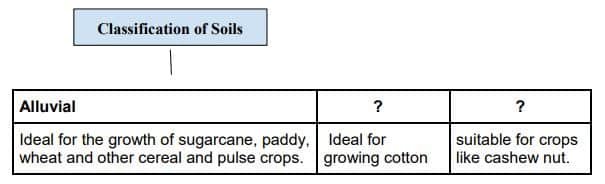
a. Black soil, Red and Yellow soils
b. Laterite soil, Black soil.
c. Red & Yellow soils & Black soil.
d. Black soil & Laterite soil.
3. Interpret the following pie diagram and choose the correct option for the following question?
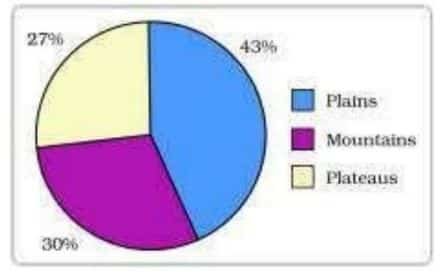
What is the significance of 43 percent land under plains?
a. It provides facilities for agriculture and industry.
b. It provides facilities for tourism.
c. It ensures perennial flow of some river.
d. It possesses rich reserves of minerals, fossil fuels and forests.
4. Transformation of things available in our environment involves an interactive relationship between ________ Choose the correct option from below.
a. Nature and technology
b. Nature, technology, and institutions
c. Nature and institutions
d. Environment and human beings
5. Read the data given below and answer the question.
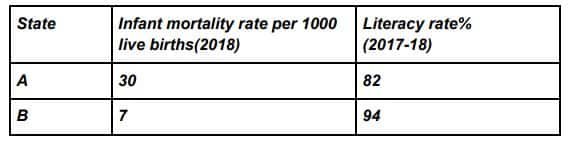
As per the data given above, why state B has a low infant mortality rate?
a. It has high per capita income.
b. It has better infrastructure than state A
c. It has good teachers and schools.
d. It has health care and education for all.
6. Match the following :
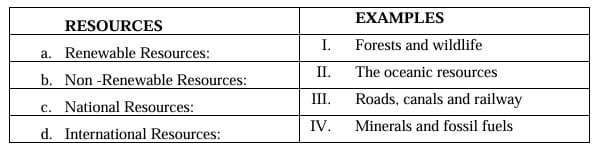
A. a-I, b-IV, c-III, d-II
B. a-II, b-I, c-IV, d-III
C. a-IV, b-I , c-IV, d-II
D. a-I, b-IV, c-II, d-III
7. The piece of land left uncultivated for the past 1 to 5 agricultural years is called _.
Choose the correct option:
A. Barren land
B. Forest land
C. Grazing land
D. Fallow land
8. Which one of the following conferences was convened to discuss environmental protection and socio-economic development at the global level in 1992?
A. Kyoto Protocol
B. Montreal Protocol
C. Rio de Janeiro Earth Summit
D. World Summit on Sustainable Development
9. India has land under a variety of relief features. Which of the following features ensure perennial flow of some rivers, provide facilities for tourism and ecological aspects?
A. Plains
B. Plateaus
C. Islands
D. Mountains
10. Which one of the following human activities has contributed significantly in land degradation?
A. Deforestation
B. Crop rotation
C. Shelter belts
D. Ploughing
11. Identify the soil with the help of clues given below –
- develops in areas with high temperature and heavy rainfall
- is low in humus content
- found in the hilly areas of Karnataka, Kerala and Tamil Nadu
A. Forest soil
B. Yellow soil
C. Black soil
D. Laterite soil
12. Identify the soil with the help of following information.
· It develops in areas with high temperature.
· It is the result of intense leaching due to heavy rain.
· Humus content is low.
Soil:
(a) Arid soil
(b) Yellow soil
(c) Laterite soil
(d) Black soil
13. Match Column 1 with Column 2 and select the correct option from the following:
| Column 1 (Soil Erosion) | Column 2 (Explanation) |
|---|---|
| A. Gully Erosion | I. Water flows as a sheet over large areas down a slope |
| B. Wind Erosion | II. Ploughing in a wrong way i.e., up and down the slope form channels for quick flow of water |
| C. Sheet Erosion | III. The running water cuts through clayey soils and makes deep channels |
| D. Defective methods of farming | IV. Wind blows loose soil off flat or sloping land |
Options:
(a) A-I, B-II, C-III, D-IV
(b) A-II, B-III, C-IV, D-I
(c) A-III, B-IV, C-I, D-II
(d) A-IV, B-I, C-II, D-III
14. Which of the following pair is correctly matched?
(A) Alluvial Soil – Gangetic Plain
(B) Black Soil – Himalayan Region
(C) Arid Soil – Western Ghats
(D) Laterite Soil – Desert Area
15. Which one of the following soils develops in an area with high temperature and heavy rainfall?
(a) Red and Yellow
(b) Black
(c) Alluvial
(d) Laterite
16. Which of the following is NOT a basis for classifying resources?
a. Origin
b. Exhaustibility
c. Ownership
d. Colour
Explanation: Resources are classified by their origin, exhaustibility and ownership.
17. Who said: “There is enough for everybody’s need and not for anybody’s greed”?
a. Jawaharlal Nehru
b. Mahatma Gandhi
c. Schumacher
d. Brundtland Commission
Explanation: Mahatma Gandhi believes in the sustainable use of resources. His quote means that nature provides enough for everyone’s needs, but greed leads to overuse and scarcity.
18. Which international conference adopted Agenda 21 for sustainable development?
a. Kyoto Protocol, 1997
b. Rio de Janeiro Earth Summit, 1992
c. Paris Climate Agreement, 2015
d. Stockholm Conference, 1972
Explanation: Agenda 21 is a global action plan of sustainable development adopted by the Rio Summit in 1992. It focused on balancing environment and development.
19. Match the following and choose the correct option:
| COLUMN I | COLUMN II |
|---|---|
| a. Jharkhand, Chhattisgarh | 1. Rich in minerals and coal |
| b. Arunachal Pradesh | 2. Abundance of water resources |
| c. Rajasthan | 3. Solar and wind energy |
| d. Ladakh | 4. Rich cultural heritage but deficient in water |
Options:
A-1, B-2, C-3, D-4
A-2, B-1, C-4, D-3
A-3, B-4, C-1, D-2
A-4, B-3, C-2, D-1
20. Assertion (A): Resource planning is essential for sustainable existence of all forms of life.
Reason (R): Indiscriminate exploitation of resources has led to ecological crises like global warming and land degradation.
a. Both A and R are true, and R is the correct explanation of a.
b. Both A and R are true, but R is not the correct explanation of a.
c. A is true but R is false.
d. A is false but R is true.
21. “The Brundtland Commission Report (1987) introduced the concept of Sustainable Development and advocated it as a means for resource conservation.”
Q: What does this reflect about global resource management?
a. It emphasised short-term economic growth.
b. It highlighted the need to balance present development with future needs.
c. It discouraged international cooperation.
d. It rejected environmental concerns.
Explanation: The report introduced sustainable development, meaning today should not harm future generations’ needs.
22. The total geographical area of India is __ million sq km.
a. 2.28
b. 3.28
c. 4.28
d. 5.28
Explanation: India’s total geographical area is 3.28 million sq km, which makes it the 7th largest country in the world.
23. The National Forest Policy (1952) recommended __% of geographical area under forest cover.
a. 25%
b. 30%
c. 33%
d. 40%
Explanation: As per the NFP policy, one-third of India’s land should be under forest cover to maintain ecological balance.
24. Consider the following statements about land degradation in India:
I. Overgrazing is a major cause in Gujarat and Rajasthan.
II. Over-irrigation has caused salinity in Punjab and Haryana.
III. Mining has led to deforestation in Jharkhand and Odisha.
IV. Industrial effluents have no impact on land.
Choose the correct option:
a. I, II and III
b. II, III and IV
c. I and IV
d. I, II, III and IV
25. Which soil type is most widely spread in India?
a. Black soil
b. Alluvial soil
c. Laterite soil
d. Red soil
Explanation: The alluvial soil is found in northern plains and covers the largest area in India and is very fertile.
26. Which soil is also known as regur and is ideal for cotton cultivation?
a. Black soil
b. Red soil
c. Laterite soil
d. Arid soil
Explanation: The black soil retains moisture and is ideal for cotton cultivation.
27. Which soil develops a reddish colour due to diffusion of iron in crystalline rocks?
a. Alluvial soil
b. Red soil
c. Laterite soil
d. Forest soil
Explanation: The red soil gets its colour from iron in crystalline rocks.
28. Match the following and choose the correct option:
| COLUMN I | COLUMN II |
|---|---|
| a. Bangar | 1. Old alluvial soil with kanker nodules |
| b. Khadar | 2. New alluvial soil, more fertile |
| c. Laterite | 3. Soil formed under tropical climate with leaching |
| d. Arid soil | 4. Sandy, saline, cultivable after irrigation |
Options:
A-1, B-2, C-3, D-4
A-2, B-1, C-4, D-3
A-3, B-4, C-1, D-2
A-4, B-3, C-2, D-1
29. Assertion (A): Black soils are well-known for their capacity to hold moisture.
Reason (R): They are made up of fine clayey material and rich in calcium carbonate, magnesium, potash and lime.
a. Both A and R are true, and R is the correct explanation of a.
b. Both A and R are true, but R is not the correct explanation of a.
c. A is true but R is false.
d. A is false but R is true.
Explantion: Black soil holds moisture because it is clayey and rich in minerals like calcium carbonate and potash.
30. “Laterite soil develops under tropical and subtropical climate with alternate wet and dry season. It is deficient in plant nutrients but useful for tea, coffee and cashew nut after conservation techniques.”
Q: What does this reflect about laterite soil?
a. It is naturally fertile without treatment.
b. It requires soil conservation measures to be productive.
c. It is confined only to northern plains.
d. It cannot support any crops.
Explanation: Laterite soil is nutrient-poor but can grow tea, coffee, and cashew after conservation techniques.
31. Alluvial soils can be classified as old alluvial () and new alluvial ().
a. Regur, Red
b. Bangar, Khadar
c. Laterite, Arid
d. Forest, Desert
32. In the Chambal basin, bad lands formed due to gully erosion are called __.
a. Ravines
b. Shelter belts
c. Strip cropping
d. Contour ploughing
Explanation: Gully erosion in the Chambal basin creates ravines, making land unfit for farming.
33. Consider the following statements about soil erosion and conservation:
I. Gully erosion makes land unfit for cultivation.
II. Sheet erosion washes away the top soil.
III. Contour ploughing slows down water flow on slopes.
IV. Shelter belts help stabilise sand dunes in western India.
Choose the correct option:
a. I, II and III
b. II, III and IV
c. I, III and IV
d. I, II, III and IV
Disclaimer: We have provide you with the accurate handout of “Resources and Development Class 10 MCQ“. If you feel that there is any error or mistake, please contact me at anuraganand2017@gmail.com. The above CBSE study material present on our websites is for education purpose, not our copyrights.
All the above content and Screenshot are taken from Social Science Code 087 Class 10 NCERT Textbook, CBSE Sample Paper, CBSE Old Sample Paper, CBSE Board Paper and CBSE Support Material which is present in CBSEACADEMIC website, NCERT website This Textbook and Support Material are legally copyright by Central Board of Secondary Education or NCERT. We are only providing a medium and helping the students to improve the performances in the examination.
Images and content shown above are the property of individual organisations and are used here for reference purposes only. To make it easy to understand, some of the content and images are generated by AI and cross-checked by the teachers. For more information, refer to the official CBSE textbooks available at cbseacademic.nic.in.